Clear Sky Science · en
Opportunity windows accelerate action and expand options for climate adaptation in Europe
Why timing matters for living with a changing climate
As Europe warms, floods, droughts and storms are becoming more frequent and damaging. Much of the discussion about how to cope focuses on growing dangers and hard limits to what we can protect. This study flips the perspective: instead of looking only at threats, it asks when conditions are especially favourable for taking smarter climate actions. By spotting and preparing for these “opportunity windows”, communities and governments can move faster, save money and keep more options open for the future.
Moments when action becomes easier
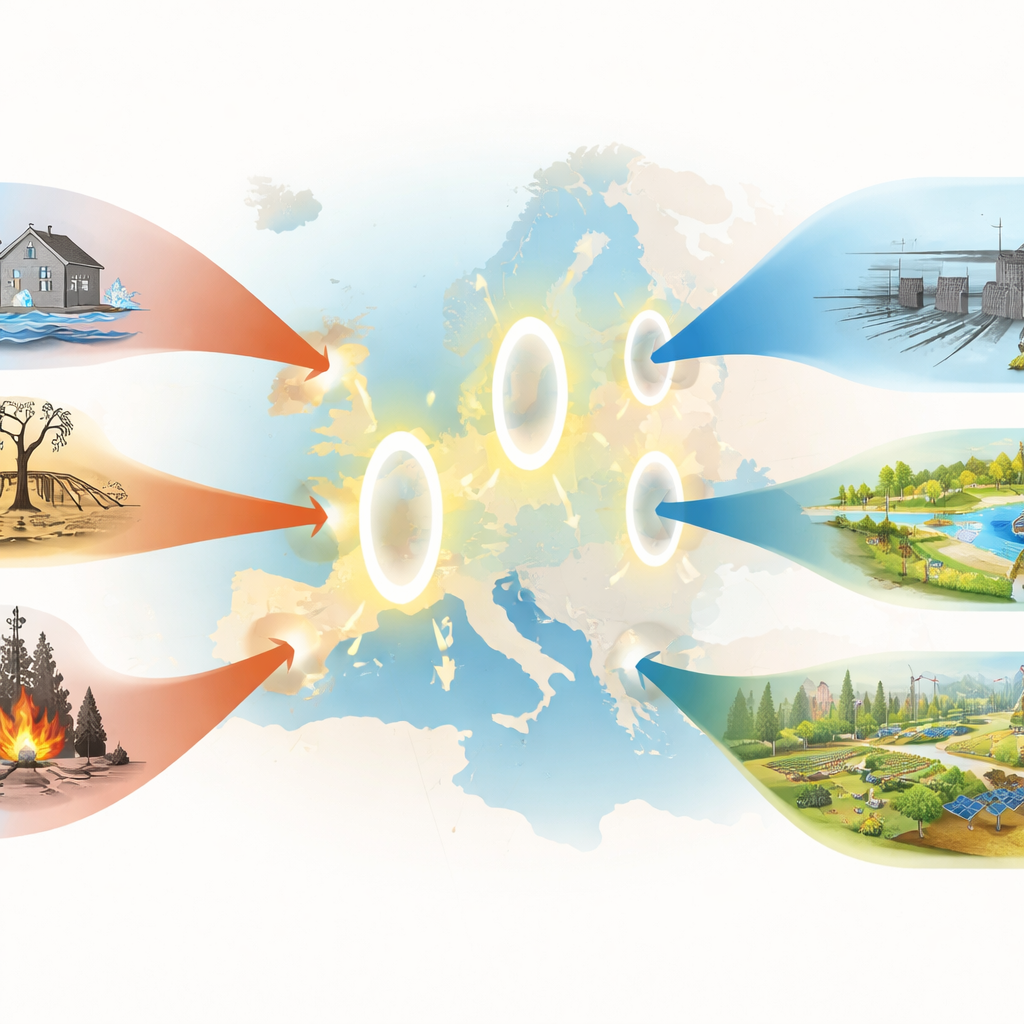
The authors define an opportunity window as a period when a climate adaptation measure becomes more feasible, affordable or socially desirable than usual. These windows are temporary: if action is not taken in time, the favourable conditions may fade, even if the underlying risk remains. Using scientific and policy literature, as well as data on large dams, the researchers build a practical typology of five kinds of opportunity windows. Each type captures a different reason why a measure suddenly becomes more attractive, from scheduled maintenance of old structures to shifts in public opinion after a disaster.
Five kinds of chances to improve safety
The first type, maintenance-driven windows, appears when existing defences such as dams or storm surge barriers near the end of their lifetime. Because they must be repaired or replaced anyway, it becomes cheaper and more acceptable to upgrade them for future climate conditions. Resource-driven windows open when money or natural materials are available, or when the economic benefits of a measure clearly outweigh its costs. Policy-driven windows arise when new laws, regulations or court decisions create pressure or incentives to adapt. Value-driven windows follow shifts in societal attitudes, for example when a major flood changes how people view risk. Finally, innovation-driven windows emerge when new technologies or pilot projects prove that fresh approaches, like nature-based solutions or floating housing, can work in practice.
Opportunities already appearing across Europe
Applying this framework, the study identifies 34 concrete opportunity windows across Europe, spanning the recent past, present and the rest of this century. Many are linked to aging dams and major sea barriers that will need upgrades or replacement, offering natural moments to rethink how rivers and coasts are managed. Others follow extreme events such as the 2021 floods in Western Europe, severe droughts between 2018 and 2022, or destructive wildfires in Greece, which unlocked large reconstruction funds and raised public support for stronger protection. Still others stem from European Union directives that set deadlines for improving water quality and reducing flood risk, effectively putting a timer on when certain adaptation measures must be in place.
How one window can open many others
The authors show that these five types of windows do not operate in isolation. A single event, such as a catastrophic flood, can trigger new public concern, open up emergency funding, and motivate governments to change policies—all at once. That combination can accelerate the spread of innovative solutions, from giving rivers more room to overflow safely to using engineered sand deposits and shellfish reefs to protect coasts. However, the same windows can also close again: public attention may drift after a few years without new disasters, political priorities can shift, and financial resources can dry up. Recognising these patterns helps explain why some countries capitalise on crises to transform their defences, while others miss the chance.

Planning paths that are ready to seize the moment
To make the most of opportunity windows, the study proposes weaving them into “adaptive pathways” planning. Instead of committing to a single long-term solution, planners map out sequences of possible actions that can be taken as conditions change. Opportunity windows can influence these paths in several ways: they can motivate earlier implementation of measures, extend the usefulness of existing defences, or open up entirely new sets of options. By monitoring signals such as infrastructure age, policy deadlines, public sentiment and emerging technologies, decision-makers can prepare detailed response plans in advance and activate them quickly when a window opens.
A more hopeful way to think about climate adaptation
Overall, the study argues that climate adaptation is not only about reacting to growing dangers, but also about being ready to take advantage of favourable moments before they pass. In Europe, at least 25 of the identified opportunities are open now, and more will appear as infrastructure ages, laws evolve and new ideas are tested. By deliberately searching for these windows, building them into long-term plans and scanning for early warning signs that they are opening or closing, societies can speed up action and keep more choices on the table. This opportunity-focused lens offers a more hopeful, proactive story: even in a warming world, there are many chances to steer toward safer, more resilient futures—if we are prepared to use them in time.
Citation: Di Fant, V., Middelkoop, H., de Bruin, K. et al. Opportunity windows accelerate action and expand options for climate adaptation in Europe. Commun Earth Environ 7, 321 (2026). https://doi.org/10.1038/s43247-026-03332-2
Keywords: climate adaptation, opportunity windows, adaptive pathways, European climate policy, resilient infrastructure