Clear Sky Science · en
Drought propagation as a nonlinear amplifier of ecohydrological damage
When Dry Spells Turn Into Ecological Shockwaves
Most of us think of drought as simply a lack of rain. But this study shows that once the air turns unusually dry, the resulting water shortage can ripple downward into the soil and into plants, dramatically amplifying the overall damage. By tracing these links across the globe, the researchers reveal that what starts as a meteorological problem in the atmosphere often becomes a much larger crisis for ecosystems and the services they provide to people.
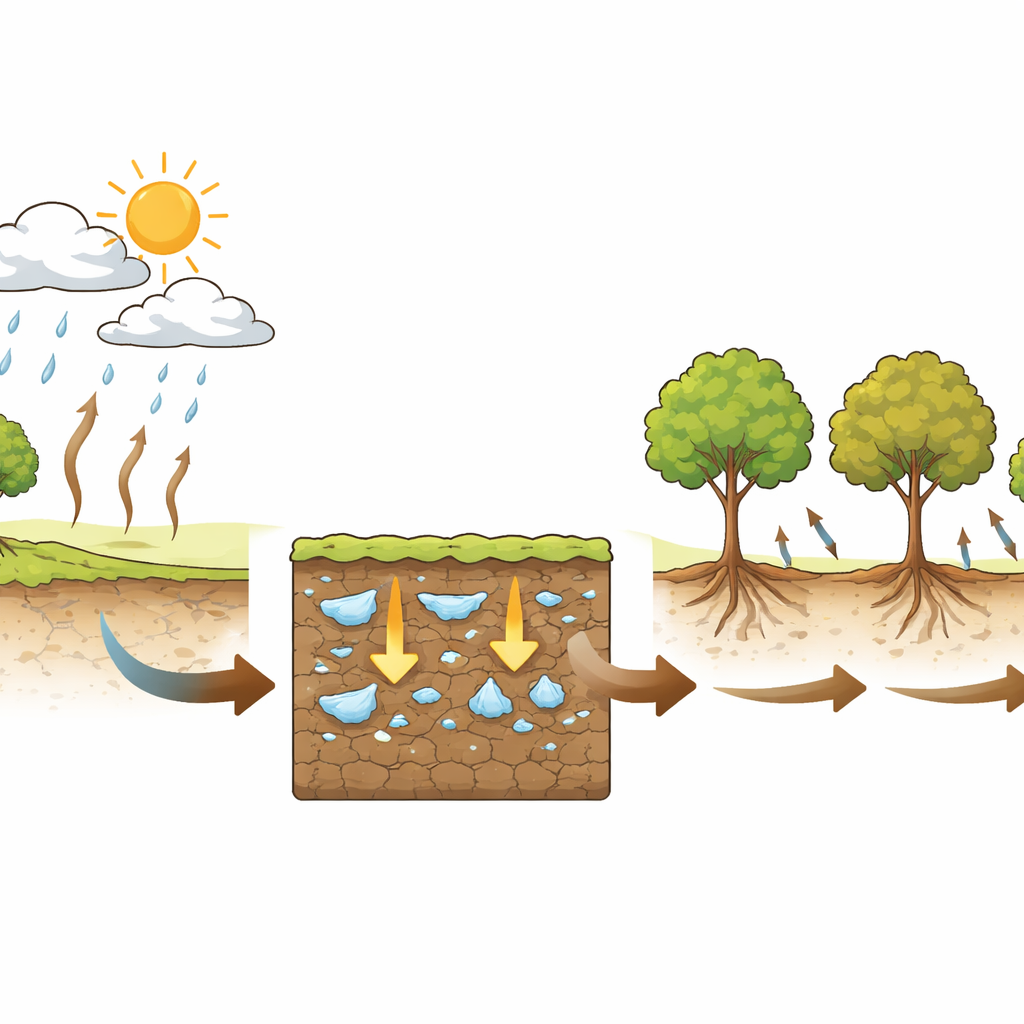
From Sky to Soil to Leaves
The authors focus on three connected kinds of drought: in the air (meteorological), in the ground (soil), and in vegetation (ecological). Using several decades of satellite and climate records, they tracked how a shortfall of rain or an excess of drying power in the atmosphere moves through this chain. They represented the atmosphere with a balance between rainfall and the air’s ability to evaporate water, the soil with root-zone moisture, and plants with leaf area, a measure of how much green surface is available to capture sunlight. By following the timing of these signals, they could see which kind of drought appeared first, how long each one lasted, and how intense each stage became.
Hidden Pathways of Growing Damage
The analysis shows that vegetation often reacts more readily to atmospheric dryness than soil does, but soil drought usually begins earlier when both soil and plants are affected. The team identified several typical pathways: some droughts moved from air to soil only, some from air directly to vegetation, and others followed longer chains, such as air → soil → vegetation or air → vegetation → soil. The most damaging route was the air → soil → vegetation pathway, which accounted for nearly a fifth of all events. Along this chain, the combined loss of soil moisture and plant greenness reached, on average, about three times the severity of the original atmospheric drought. Even in shorter chains, damage in soil and plants commonly outlasted and outpaced the initial dry spell in the air.
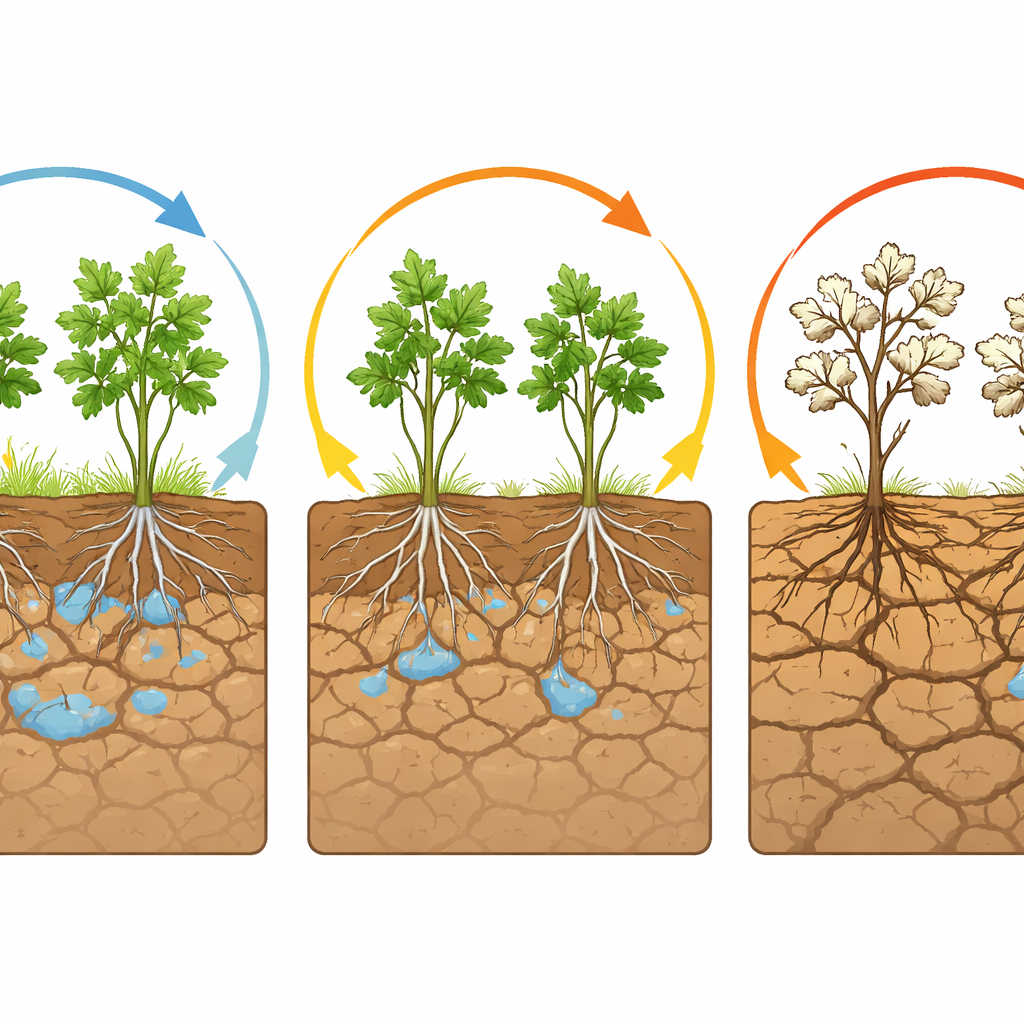
Why the Impact Grows Nonlinearly
A key finding is that the amplification of damage is not gradual but nonlinear. When atmospheric drought remains modest, the overall losses in soil moisture and plant greenness change little. Once the dryness crosses a certain strength, however, the picture flips: drought spreads faster, and the total ecohydrological damage climbs sharply. In many regions, especially across mid- and high latitudes in North America and Eurasia, damage was at least twice as large as the initial atmospheric deficit, and in about a third of affected areas it was more than tripled. This behavior is tied to the fact that soil and vegetation recover much more slowly than the atmosphere does, which means they “remember” drought and stay stressed long after the weather has started to improve.
Push and Pull Between Soil and Vegetation
The study also teases apart the outside forces that start droughts and the internal feedbacks that shape their evolution. When rainfall shortages dominate, soil responds quickly and strongly, and the water deficit tends to travel from soil up into plants. When the air’s drying power is unusually high, plants usually feel the stress first, because warmer, sunnier, drier air pulls water through leaves more efficiently. The researchers further show that once soil dries before plants, vegetation can accelerate its own decline by continuing to draw water from already thirsty ground. In contrast, when plants are hit first and lose leaves early, they use less water, which can slightly protect the soil beneath them. These differences help explain why some drought pathways are far more destructive than others.
What This Means for a Warming World
For non-specialists, the main message is that drought is not just about missing rain; it is a chain reaction that can turn a moderate dry spell into a severe ecological event. Because soils and vegetation are less resilient than the atmosphere, their stress accumulates, leading to longer and harsher impacts on crops, forests, and water supplies. As climate change increases temperature swings, rainfall variability, and the frequency of rapid “flash droughts,” these amplifying pathways are likely to become even more pronounced. Understanding where and how drought damage multiplies along the air–soil–plant continuum is therefore essential for improving early warning systems and planning land and water management that can better withstand the next big dry spell.
Citation: Qu, Z., Li, X., Peñuelas, J. et al. Drought propagation as a nonlinear amplifier of ecohydrological damage. Commun Earth Environ 7, 319 (2026). https://doi.org/10.1038/s43247-026-03330-4
Keywords: drought propagation, ecosystem resilience, soil moisture, vegetation stress, climate variability