Clear Sky Science · en
Dynamic rupture complexity explains observed azimuthal variability in earthquake source radiation
Why some small quakes shake harder in certain directions
When an earthquake strikes, we often picture ripples spreading evenly in all directions, like waves from a stone tossed into a pond. In reality, shaking can be much stronger in some directions than others, even for relatively small quakes. This study looks at dozens of modest earthquakes in Central Italy and shows that their complex breaking behavior deep underground can explain why certain towns feel stronger jolts, especially at high frequencies important for buildings and infrastructure.
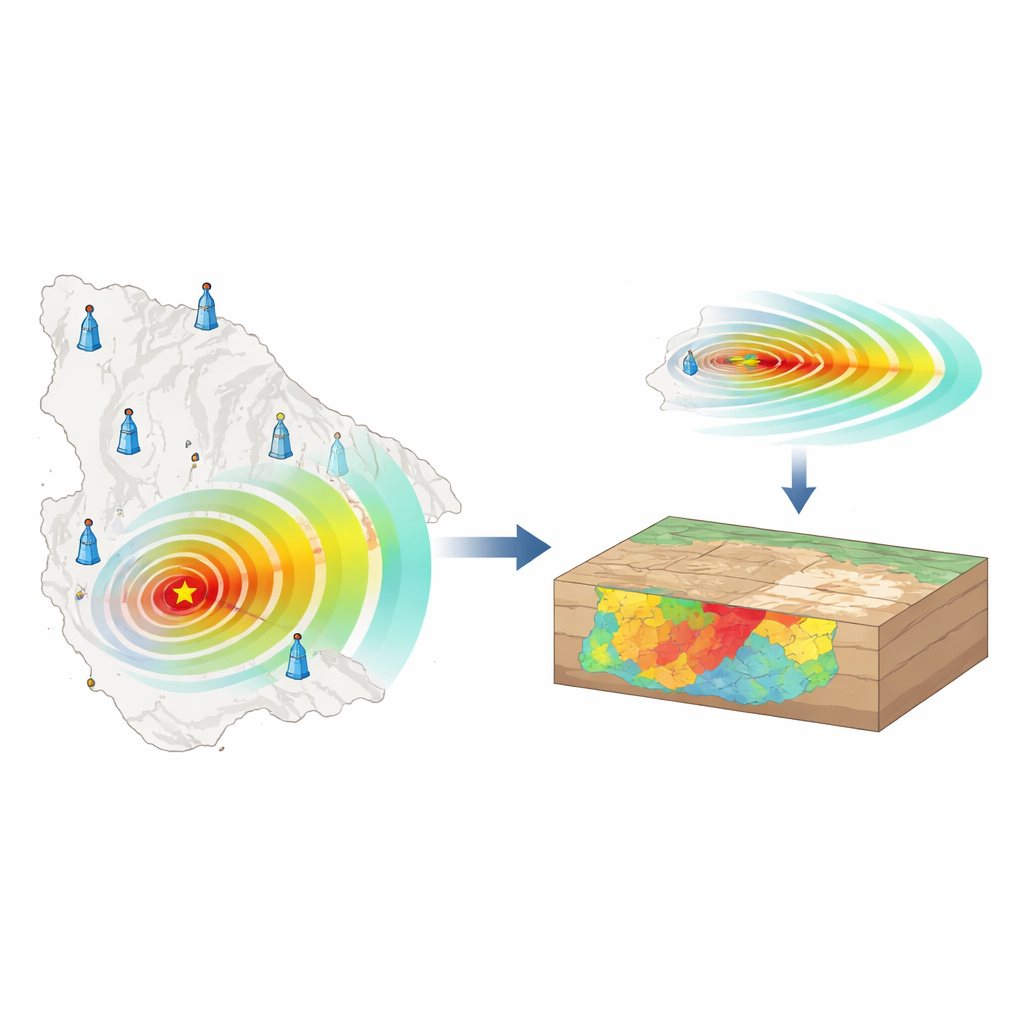
Looking closely at many small Italian earthquakes
The researchers analyzed 49 earthquakes of magnitude 3 to 5 that occurred during recent seismic sequences in Central Italy. These events were recorded by at least 80 stations each, giving a dense network of observations. By carefully removing the effects of the travel path and local soil conditions from the data, they isolated what is called the “apparent source spectrum” at each station: essentially, how strongly the earthquake radiated shaking at different frequencies in each direction. They found that both the characteristic frequency where the spectrum bends (the “corner frequency”) and how fast energy drops off at higher frequencies vary significantly with direction around each quake.
One-sided shaking and more even quakes
To illustrate these patterns, the team focused on two representative events. One showed strong directivity, meaning the rupture on the fault raced preferentially in one direction, sending more intense high-frequency shaking that way. Stations located along this forward path recorded higher corner frequencies and steeper high-frequency decay compared to those in the opposite direction. The second event, in contrast, radiated energy more evenly, with similar spectra in all directions and a gentler fall-off at high frequencies. Across all 49 earthquakes, the authors found that at each station, higher corner frequencies tended to go hand in hand with faster high-frequency decay, revealing a robust relationship that is usually hidden when data are averaged over stations.
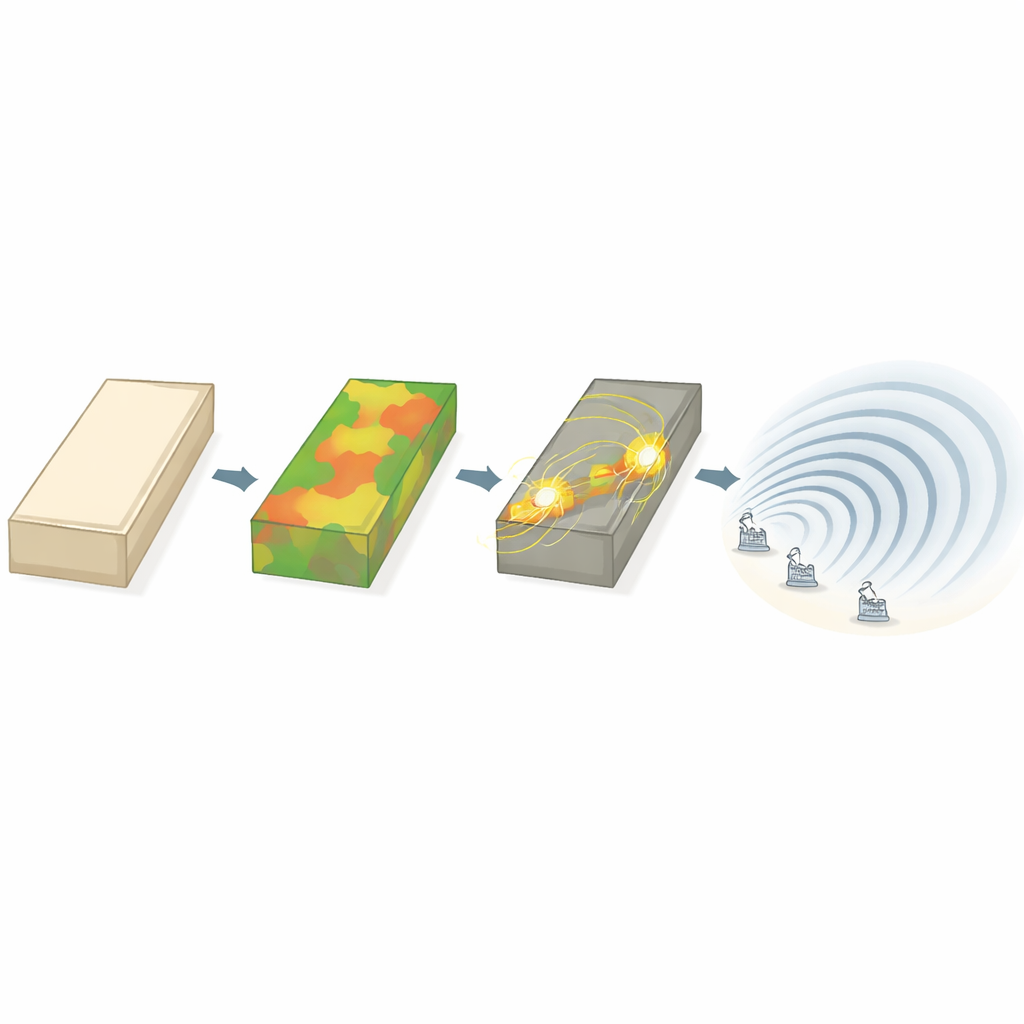
Simulating messy ruptures on real faults
To explain these observations, the researchers turned to physics-based computer simulations of how faults break. Instead of treating each quake as a smooth, uniform slip on a simple fault, they built thousands of models in which key fault properties—stress, strength, and how quickly the fault weakens as it slips—vary randomly in space, following realistic statistical patterns. These “rough” faults produce ruptures that speed up, slow down, and interact with small high-stress patches, generating bursts of intense slip and abundant high-frequency waves. By tuning how strong the small-scale variations are, they were able to reproduce not only the overall shapes of the observed spectra up to 25 hertz, but also the detailed directional differences and the positive link between corner frequency and high-frequency decay.
From simple patterns to a spectrum of behaviors
The simulations reveal that the familiar “omega-squared” spectral shape, often assumed in earthquake modeling, emerges only for certain levels of fault complexity. When the fault properties are nearly uniform, the rupture is smooth and the high-frequency shaking is too weak. As heterogeneity grows, high-frequency energy increases and the spectra more closely match what is measured in the Italian earthquakes. Very strong heterogeneity can produce especially strong high-frequency radiation and events whose spectra fall off more slowly than usual in all directions. Importantly, the models show that the same underlying physics can explain both strongly directive and more symmetric events, simply by changing the amount of small-scale complexity on the fault.
What this means for hazard and everyday risk
For non-specialists, the key message is that even small earthquakes are not simple cracks but intricate ruptures that can send stronger shaking toward some places than others. This study demonstrates that realistic, physics-based models that include small-scale complexity on faults can match the rich directional patterns seen in real data, including the way different spectral features are intertwined. By better capturing how and where high-frequency shaking arises, such models can improve predictions of ground motion for future earthquakes. In turn, they offer more reliable input for building codes and risk assessments, helping communities better prepare for the uneven and sometimes surprising ways the ground can shake.
Citation: Joshi, L., Gallovič, F. & Sgobba, S. Dynamic rupture complexity explains observed azimuthal variability in earthquake source radiation. Commun Earth Environ 7, 329 (2026). https://doi.org/10.1038/s43247-026-03326-0
Keywords: earthquake rupture, seismic spectra, ground motion, Central Italy, seismic hazard