Clear Sky Science · en
Multiple global change factors amplify nitrogen loss and croplands are at the highest risk
Why soil’s quiet nitrogen leak matters
Food production on land depends heavily on nitrogen, a key ingredient in fertilizers that helps crops grow. Yet a large share of this precious nutrient quietly escapes from soils into the air as invisible gases, wasting fertilizer, costing farmers money, and contributing to climate change. This study asks a crucial question: as the planet warms, carbon dioxide rises, fertilizer use grows, and rainfall patterns shift, how much faster will this nitrogen leak become—and which types of landscapes are most at risk?
Hidden gas pipes beneath our feet
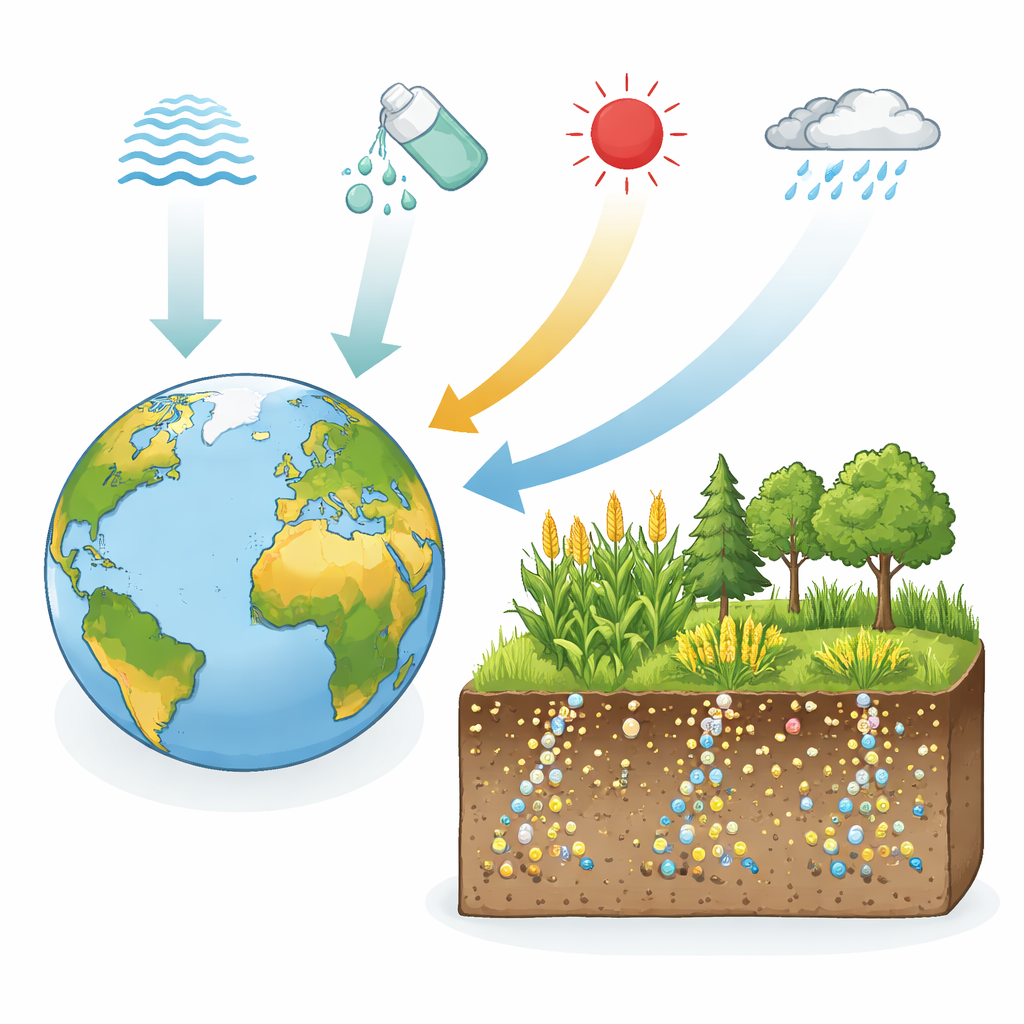
In every handful of soil, countless microbes act like tiny chemical engineers. Through processes known as denitrification and anammox, they transform plant-available nitrogen into gases that drift into the atmosphere. These transformations are natural and help keep ecosystems in balance, but when they speed up, more nitrogen is lost from the land, leaving less for crops and increasing emissions of potent greenhouse gases. Because human activities are changing temperature, rainfall, carbon dioxide, and nitrogen pollution all at once, the authors set out to see how these combined pressures are likely to reshape nitrogen losses worldwide.
Pulling patterns from experiments around the world
The researchers gathered 682 measurements from 127 field experiments conducted in forests, grasslands, and croplands across the globe. In these experiments, scientists had deliberately raised carbon dioxide, added nitrogen, warmed the soil or air, or changed rainfall amounts, sometimes using several of these treatments together. By pooling and re-analyzing the results, the team could look beyond the noisy, site-by-site variability and ask broad questions: Which global changes most strongly accelerate nitrogen loss? Do croplands behave differently from forests and grasslands? And are local climate and soil conditions important in shaping these responses?
When many pressures act together
The combined evidence shows that human-driven changes generally speed up microbial nitrogen loss from soils, with especially strong effects when several pressures act at once. Across all sites, a single global change factor increased denitrification rates by about one-third on average, but three or more factors together nearly doubled them. Nitrogen addition—representing fertilizer use and atmospheric deposition—was the most powerful driver, boosting both denitrification and anammox. Warming also enhanced denitrification, while shifts in rainfall and higher carbon dioxide alone had weaker and more variable effects. Importantly, the study found that these multiple drivers mostly add up in a straightforward way, rather than producing frequent runaway synergies or strong cancellations.
Croplands as the leakiest landscapes
Not all ecosystems responded equally. Croplands stood out as the most vulnerable to enhanced nitrogen loss, especially under extra nitrogen inputs and warming. Frequent fertilization, soil disturbance, and relatively low carbon-to-nitrogen ratios appear to prime agricultural soils for rapid microbial activity and gas production. Grasslands and forests also showed increases, but their responses were weaker or more patchy. The sensitivity of nitrogen loss depended strongly on local climate and soil traits, such as how wet a site typically is, soil pH, and nutrient content. For example, croplands and grasslands in drier settings tended to lose more nitrogen when extra fertilizer was added, while wetter regions saw stronger boosts in nitrogen loss under warming.
Mapping future risks and closing the nutrient loop
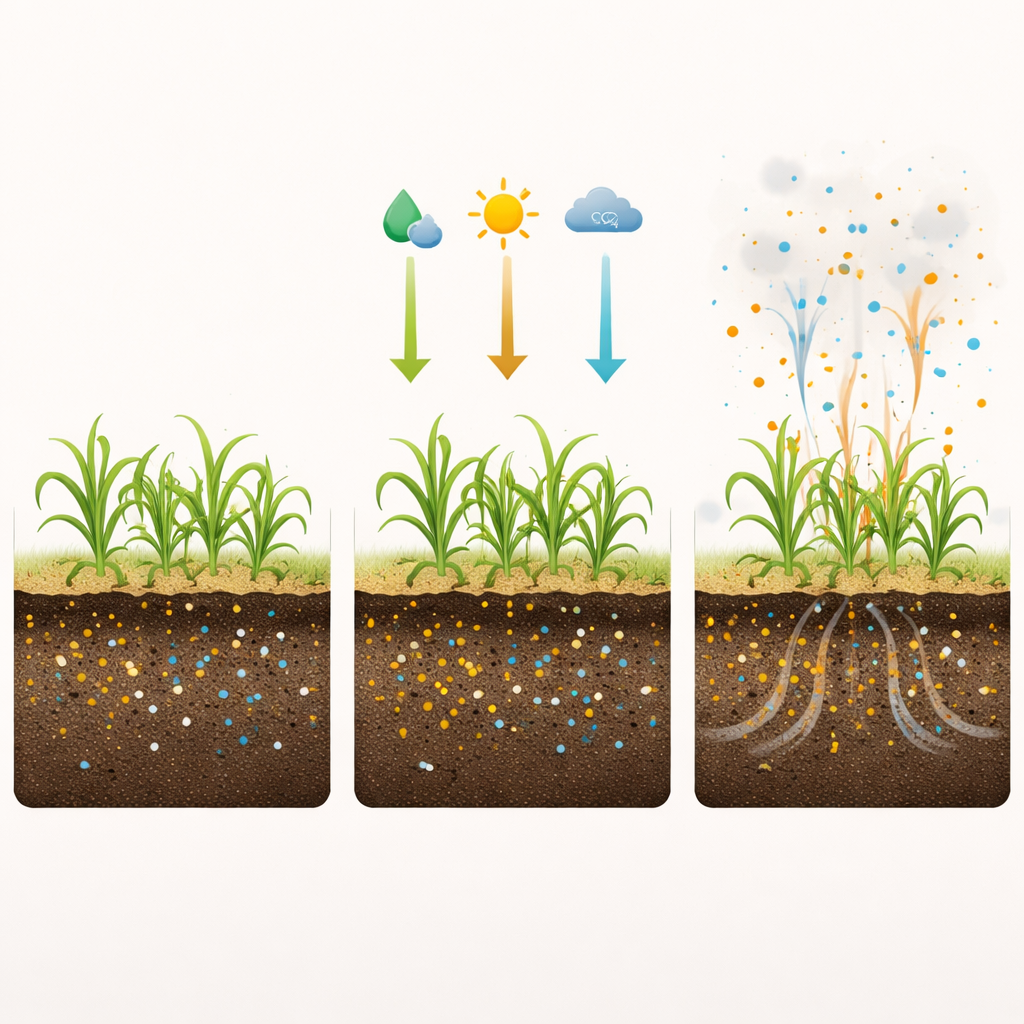
Using machine-learning models that tied experimental results to global maps of climate and soil properties, the authors estimated where nitrogen loss is likely to respond most strongly to rising carbon dioxide and added nitrogen. Their maps highlight substantial geographic variation, with many cropland regions in Africa and Australia projected to be particularly sensitive to extra nitrogen inputs. Although uncertainties remain—especially for rainfall changes and for anammox outside croplands—the message is clear: multiple, overlapping global changes are accelerating nitrogen leakage from land, and farmed landscapes are at the center of this trend. For a layperson, the takeaway is that smarter fertilizer management, better soil care, and more realistic climate models that include these microbial losses will be essential to keep more nitrogen in our fields and less in the air, safeguarding both food supplies and the environment.
Citation: Ding, B., Xu, D., Wang, S. et al. Multiple global change factors amplify nitrogen loss and croplands are at the highest risk. Commun Earth Environ 7, 288 (2026). https://doi.org/10.1038/s43247-026-03316-2
Keywords: nitrogen loss, croplands, global change, soil microbes, fertilizer management