Clear Sky Science · en
Heavy iron isotopes in arc rocks reveal anoxic sediment recycling in subduction zones
Ancient mud and modern volcanoes
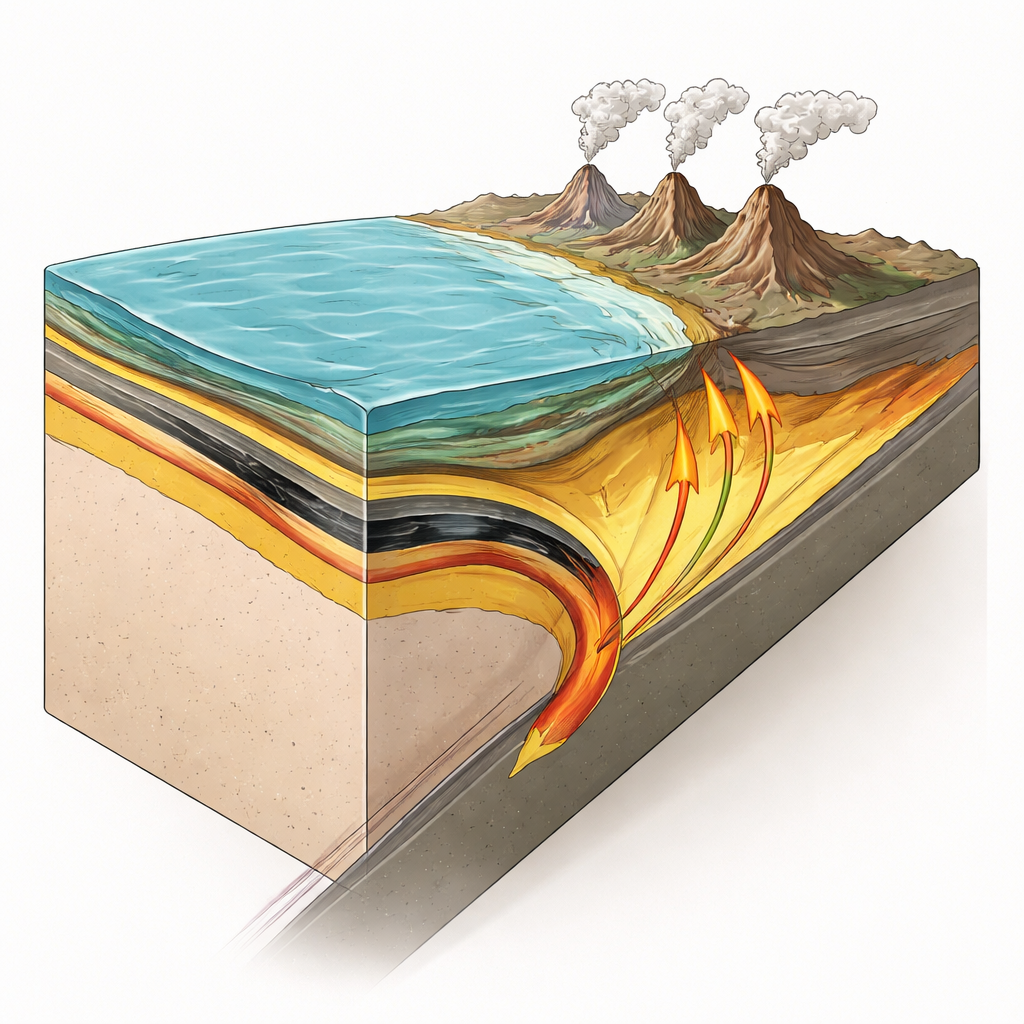
Volcanoes above subduction zones are powered by oceanic plates that dive back into Earth’s interior, dragging sediments from the seafloor down with them. This study explores how unusual ancient muds rich in iron, laid down in oxygen-poor seas, can leave a chemical fingerprint in the lavas that feed modern volcanoes. By reading that fingerprint, scientists gain new clues about how Earth recycles its surface materials deep into the planet and how the chemistry of our planet’s interior has evolved over time.
Rocks born in a tectonic crossroads
The researchers examined Early Jurassic volcanic rocks from the Fudong area of Northeast China, where an ancient Pacific plate once slid beneath the Asian continent. These rocks, mainly diorites, formed about 178 million years ago in a volcanic arc setting, the kind of environment that hosts explosive volcanism and many metal deposits today. Chemical analyses show that these rocks carry the classic signature of subduction-related magmas: enrichment in certain large, easily melted elements and depletion in others that tend to stay locked in solid minerals. Their strontium, neodymium, and hafnium isotopes also reveal that material from Earth’s crust—delivered by the subducting slab—played a key role in their origin.
Heavy iron that geology cannot easily explain
When the team measured iron isotopes in these arc rocks, they found values that are unusually “heavy,” meaning they contain slightly more of the heavier iron atoms than typical mantle-derived lavas. Most arc lavas worldwide actually show the opposite pattern, with relatively light iron. The authors systematically tested common explanations for such variations. Processes that happen as magma rises and cools near the surface—such as crystallizing minerals, mixing with continental crust, or later weathering—could not account for the heavy iron. Nor could differences in how much the mantle melted beneath the arc: both the iron and molybdenum isotope data show that partial melting alone produces changes far too small to explain the observations.
Tracing hidden sediments with iron and molybdenum
To track down the source of the heavy iron, the scientists compared their data with published measurements from arc lavas around the world. After filtering out samples influenced by known processes like hydration by serpentine, they found that iron isotopes in many mafic arc rocks correlate with radiogenic strontium and neodymium—signals that point toward recycled sediments. A second clue comes from molybdenum, another element whose isotopes are sensitive to environmental conditions at Earth’s surface. The Fudong rocks have relatively heavy molybdenum and high cerium-to-molybdenum ratios, a combination best explained by input from sediments that formed under oxygen-poor (anoxic) conditions, such as black shales and iron formations deposited in ancient restricted seas or lakes.
From anoxic seafloor to modified mantle
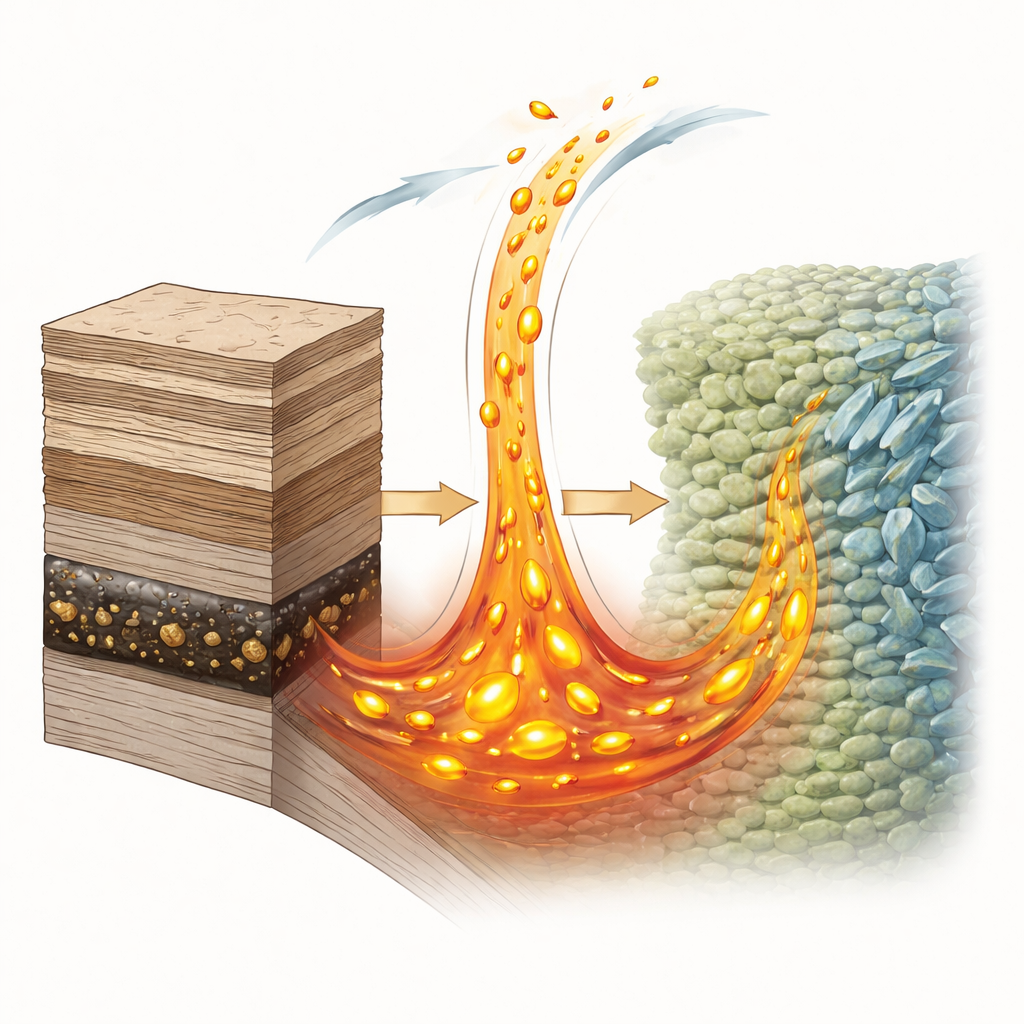
Black shales in China’s Three Gorges region, used here as a stand-in for such anoxic sediments, show both heavy iron and very heavy molybdenum isotopes. Modeling suggests that if only about one to ten percent of melts derived from these sediments mix into the mantle wedge above the subducting slab, they can reproduce the combined iron, molybdenum, strontium, and neodymium signatures seen in the Fudong arc rocks. As these sediment-derived, water-rich melts percolate through the mantle, they react with peridotite, transforming it into pyroxene-rich rock. Because pyroxene tends to be heavier in iron isotopes than olivine, this transformed mantle source naturally yields lavas with the observed heavy iron signal.
What this means for Earth’s deep recycling
In simple terms, the study shows that some volcanic rocks carry a chemical memory of ancient, oxygen-poor seafloors that were later dragged deep into the planet. The unusual iron and molybdenum isotope patterns in these arc lavas are best explained if melts from anoxic sediments infiltrate and reshape the mantle, then later melt again to feed volcanoes. This work provides direct geochemical evidence that such sediments are recycled in subduction zones and that they can significantly influence the chemistry of arc magmas. By decoding these subtle isotopic fingerprints, scientists gain a clearer picture of how Earth continually reworks its surface materials, linking bygone oceans and lakes to the magmas that build new crust today.
Citation: Wang, Z., Dai, LQ., Zhao, ZF. et al. Heavy iron isotopes in arc rocks reveal anoxic sediment recycling in subduction zones. Commun Earth Environ 7, 297 (2026). https://doi.org/10.1038/s43247-026-03315-3
Keywords: subduction zones, arc volcanism, anoxic sediments, iron isotopes, molybdenum isotopes