Clear Sky Science · en
Deciphering the origin of electron exchange capacities in floodplain sediments
Why the Mud Beneath Rivers Matters
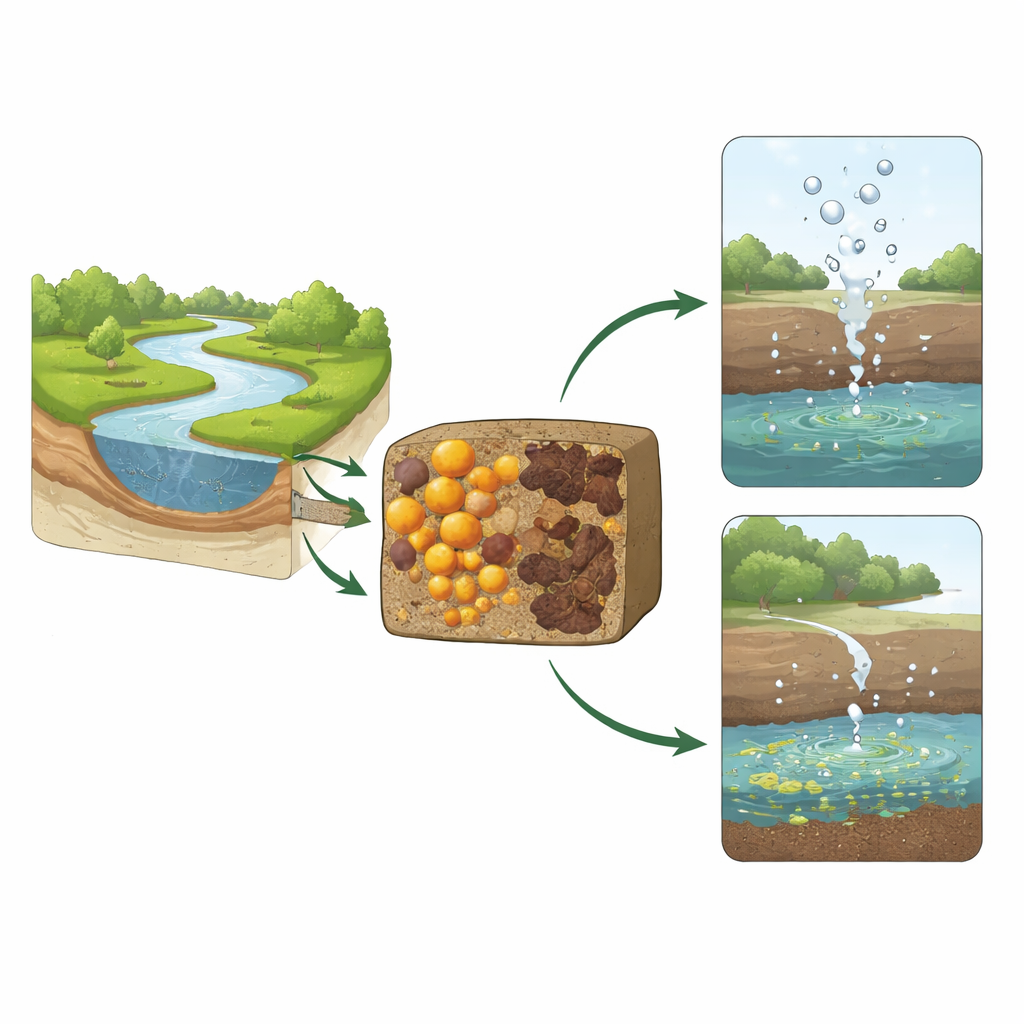
Floodplains – the low-lying lands that flank our rivers – quietly control how much pollution gets cleaned up underground and how much methane, a powerful greenhouse gas, escapes to the air. This study peered into the muddy sediments of two major floodplains along China’s Yangtze River to ask a deceptively simple question: where, exactly, are the electrons stored that fuel all these hidden chemical reactions? By tracking how different parts of the sediment accept and donate electrons, the researchers uncovered why some floodplains can suppress methane and help clean groundwater, while others are less effective.
What Makes Floodplain Sediments Special
Floodplain sediments sit at the shifting boundary between river water and groundwater, where oxygen levels constantly rise and fall as water tables move. These swings create ideal conditions for “redox” reactions – processes in which electrons are passed from one substance to another. The team focused on a key property called electron exchange capacity, which they split into electron-accepting capacity (how many electrons the sediment can take up) and electron-donating capacity (how many it can give away). They collected 45 sediment samples from farms, wetlands, lakeshores, riverbanks, and even a gasoline-contaminated aquifer, spanning depths down to more than 10 meters. Using advanced electrochemical tools, they measured how strongly each sample could accept or donate electrons, and then linked those measurements to the minerals and organic matter present in the mud.
Iron Minerals: The Main Electron “Sponges”
The results showed that most of the sediment’s ability to accept electrons comes from iron minerals. In particular, reactive forms of oxidized iron (similar to rust) bound up in iron oxides and certain clay minerals behaved as powerful electron “sponges.” When the researchers selectively dissolved different iron-bearing phases, they found that the fraction of iron that could be extracted under acidic conditions closely matched the measured electron-accepting capacity. However, not all iron was equal: a large share of the iron locked inside non-expandable clays was essentially redox “dead,” unable to take part in electron exchanges. This means that the way iron is built into mineral structures – its crystallinity, location, and accessibility – determines whether it can actually influence subsurface chemistry.
Dark Organic Matter: Hidden Electron Donors
In contrast, the ability of sediments to donate electrons was controlled mainly by solid organic matter inherited from soils and plants. The researchers separated this organic material into water-extractable compounds, lighter-colored fulvic acids, and darker, more soil-like humic acids. All of these contained redox-active molecules, but humic acids stood out as particularly strong electron donors. By examining their optical and molecular fingerprints, the team found that lignin-like compounds – remnants of woody plant tissue – in a reduced (electron-rich) state were especially important. Many of these molecules carried phenolic groups and had chemical traits indicating they were resistant to degradation but still capable of shuttling electrons. Altogether, organic matter was estimated to supply roughly 13–61% of the electron-donating capacity, with the rest provided by the small fraction of iron in clays that can actually participate in redox reactions.
Microbes Flip the Electron Balance
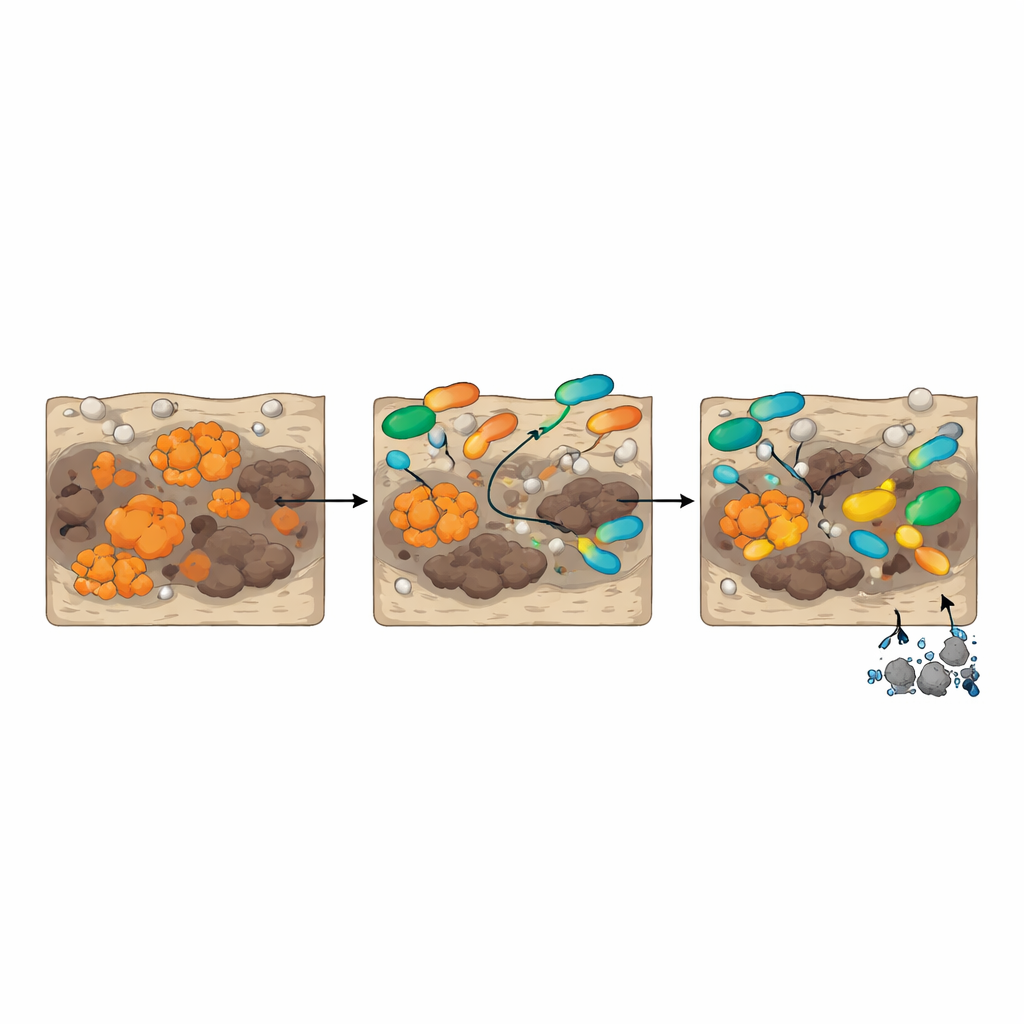
Because microbes are the main drivers of redox processes in sediments, the team incubated selected samples with an iron-reducing bacterium to see which electron-accepting pools are actually “usable” in nature. During these experiments, the sediment’s electron-accepting capacity shrank while its electron-donating capacity grew by a similar amount, showing that microbes were effectively converting oxidized iron and certain organic sites into reduced, electron-rich forms. Whether microbes tapped iron minerals, organic matter, or both depended on factors like how easily they could contact each pool and its inherent redox potential. Some sediments saw mainly iron oxides reduced; others saw organic matter play the dominant role. Crucially, much of the structurally bound iron in clays again remained inactive, confirming that only a subset of the total metal stock truly participates in microbial respiration.
Why This Affects Methane and Clean Water
The study’s conclusions carry clear environmental implications. As long as floodplain sediments still contain accessible electron-accepting pools in iron minerals and organic matter, microbes prefer to use those instead of producing methane, which requires more energy. The authors estimate that these buried electron sinks can markedly suppress methane emissions from floodplains and may even help consume methane that is already present. At the same time, the electron-donating side of the sediment – especially reduced iron and humic substances – helps activate oxidants used in cleaning up contaminated groundwater, shaping how fast pollutants are destroyed. In simple terms, the mix and “liveliness” of iron and organic matter in floodplain mud control whether that mud behaves more like a brake on greenhouse gases and a partner in remediation, or as a less reactive backdrop to environmental change.
Citation: Yu, C., Pu, S., Li, B. et al. Deciphering the origin of electron exchange capacities in floodplain sediments. Commun Earth Environ 7, 290 (2026). https://doi.org/10.1038/s43247-026-03307-3
Keywords: floodplain sediments, redox processes, iron minerals, humic substances, methane suppression