Clear Sky Science · en
Nitrogen deposition reduces grassland phyllosphere microbial diversity and network stability along a precipitation gradient
Why the tiny life on leaves matters
Across the world’s grasslands, every blade of grass is coated with invisible communities of bacteria, fungi, and single-celled organisms. These microscopic partners help plants grow, fend off disease, and cope with heat and drought. Yet human activities are steadily adding extra nitrogen to ecosystems through fertilizer use and air pollution. This study asks a simple but crucial question: does this invisible “nitrogen rain” quietly unravel the life on leaves, and with it, the stability of grassland ecosystems?
Testing global change in a real grassland
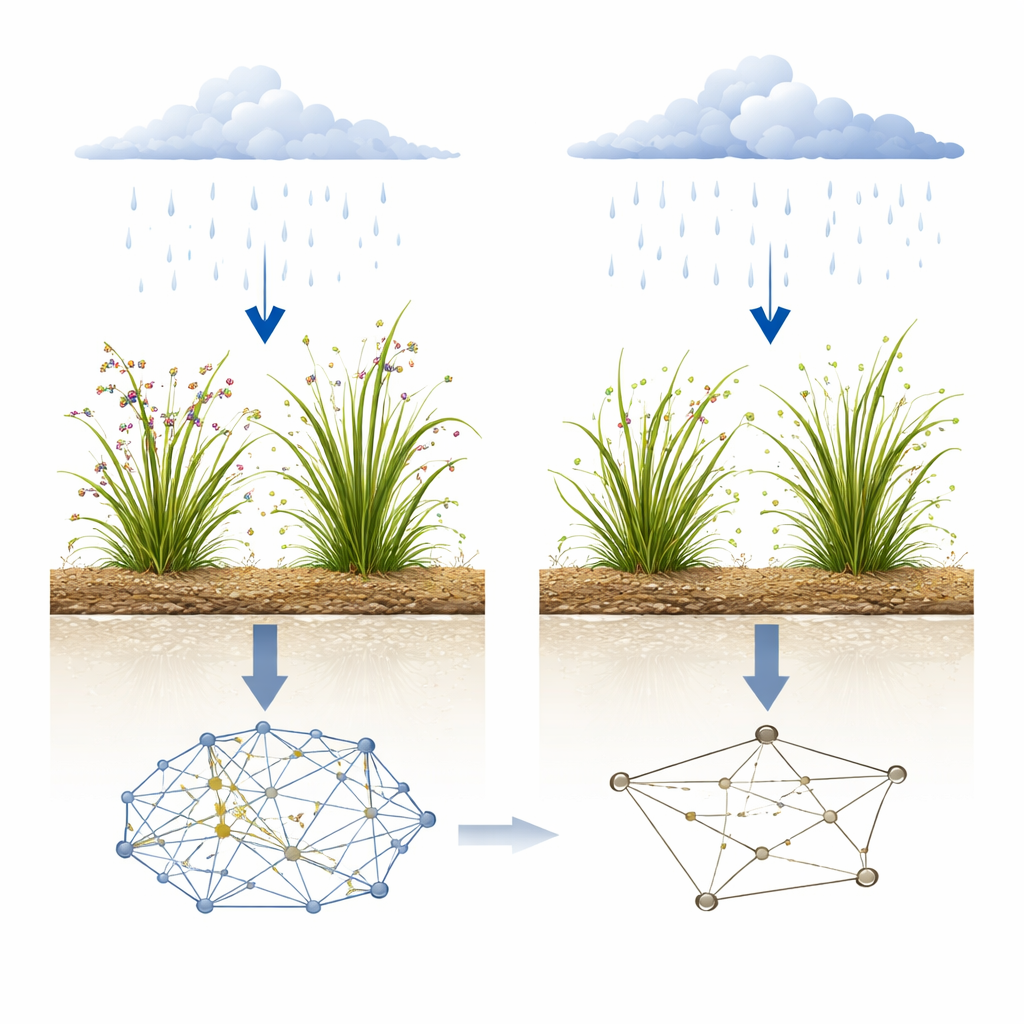
To find out, researchers set up a large outdoor experiment in a semi-arid steppe on China’s Mongolian Plateau, where plant growth is naturally limited by nitrogen. They manipulated rainfall across a wide range—from much drier than normal to much wetter—and added nitrogen to some plots at levels similar to heavy atmospheric deposition. On two dominant grassland plants, Artemisia frigida and Leymus chinensis, they sampled the organisms living on the leaf surface, then used DNA sequencing to catalog the full cast of bacterial, fungal, and protist species and to reconstruct how these species interact with one another.
Rain shifts communities, but nitrogen cuts diversity
Changes in rainfall did affect which microbes were present on leaves, especially for bacteria and fungi, but these shifts were relatively modest. Drier conditions altered community composition without clearly reducing diversity, suggesting that leaf-dwelling microbes in this semi-arid grassland are surprisingly resistant to drought. Extra rainfall, by contrast, slightly lowered bacterial diversity and changed bacterial and fungal communities, perhaps by washing microbes off leaves or favoring certain groups. Nitrogen addition, however, had far stronger and more consistent impacts. Across both plant species, added nitrogen sharply reduced the diversity of bacteria, fungi, and protists on leaves, and cut the number of unique species by roughly half or more in several groups. The strongest predictors of these losses were more inorganic nitrogen and more acidic soils—conditions known to stress many soil microbes, which are an important source of colonists for leaves.
Rewiring the leaf’s hidden social network
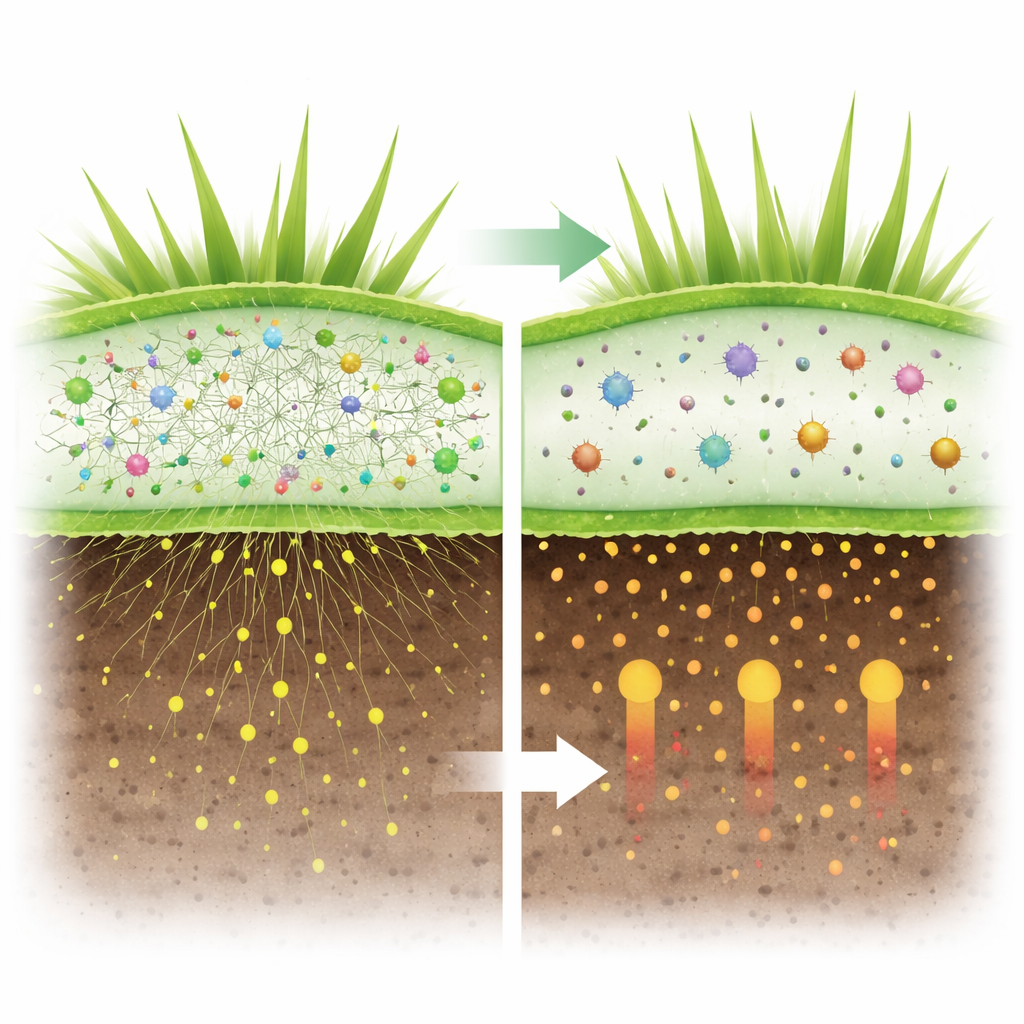
The team also looked at how these microbes are connected to one another, building “co-occurrence networks” that capture who tends to appear with whom. Under natural nitrogen levels, these networks were dense and intricate, with many connections and clear “keystone” species that linked different parts of the community. With nitrogen enrichment, the networks became thinner and more fragile: there were fewer connections, fewer partners per species, and a dramatic collapse in the number and abundance of keystone taxa. Simulations showed that these simplified networks were less robust to the loss of species and more vulnerable to disruption, meaning that the leaf microbiome is more likely to break down when conditions change.
Different microbes, different sensitivities
Not all members of the leaf community responded in the same way. Bacterial communities became more variable and more influenced by chance when nitrogen was added, as richer nutrient conditions on the leaf surface favored whichever bacteria arrived first. Fungal and protist communities, in contrast, appeared to be shaped more by consistent environmental filters, such as changes in leaf water status and nutrient levels. Beneficial microbes that can help fix nitrogen or protect plants against disease tended to decline under added nitrogen, while some groups with potentially harmful members increased. These shifts were closely linked with plant traits like photosynthesis and transpiration, highlighting a tight feedback between plant physiology, soil conditions, and the life on leaf surfaces.
What this means for grassland health
Despite the fact that added nitrogen boosted plant growth in the short term by relieving nutrient limitation, it simultaneously reduced the diversity and stability of the leaf microbiome and eroded its internal support structure. For lay readers, the message is that extra nitrogen acts like a fast but unbalanced fertilizer: it makes grasses grow now, but at the cost of thinning their microscopic “insurance policy” against stress and disease. The study shows that atmospheric nitrogen deposition can be a stronger driver of change in leaf microbiomes than shifts in rainfall, and that the invisible communities on leaves are key early-warning indicators of how global change may alter the resilience and functioning of grassland ecosystems.
Citation: Zhai, C., Yang, Y., Kong, L. et al. Nitrogen deposition reduces grassland phyllosphere microbial diversity and network stability along a precipitation gradient. Commun Earth Environ 7, 284 (2026). https://doi.org/10.1038/s43247-026-03306-4
Keywords: phyllosphere microbiome, nitrogen deposition, grassland ecosystems, microbial diversity, global change