Clear Sky Science · en
Functional composition and structural diversity enhance mangrove forest resilience in the Sundarbans
Why these coastal forests matter to everyone
Mangrove forests fringe tropical coastlines around the world, forming dense green buffers between land and sea. In the Sundarbans—a vast mangrove wilderness shared by Bangladesh and India—these trees shield millions of people from cyclones and storm surges, nurture fish and wildlife, and lock away huge amounts of carbon. But they are under growing pressure from rising seas, stronger storms, and human activity. This study asks a simple but urgent question: what makes some parts of the Sundarbans bounce back after damage, while others slowly fail? The answer can guide smarter protection and restoration of these life‑saving coastal forests.
Taking the pulse of a giant tidal forest
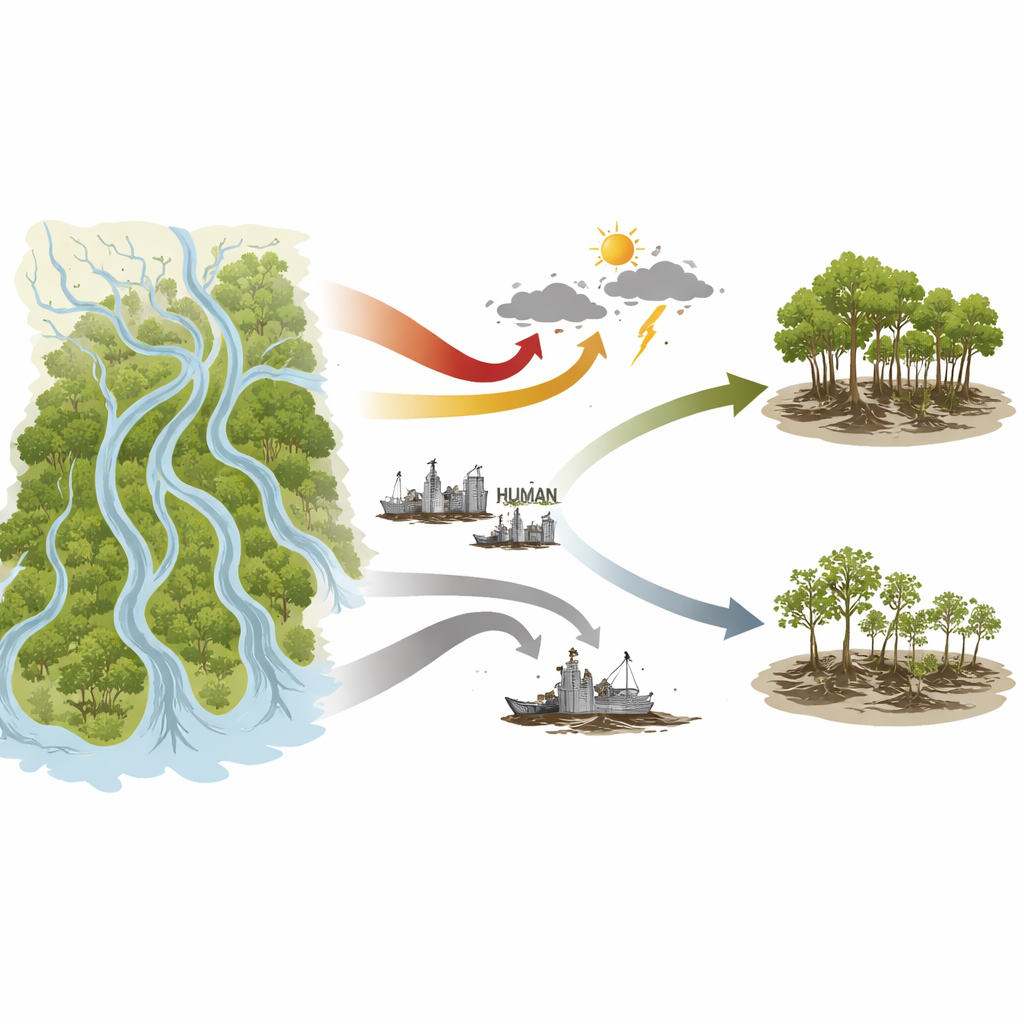
Instead of relying only on scattered field plots, the researchers treated the entire Sundarbans—over 10,000 square kilometers—as a living patient monitored from space. They used two decades of satellite images to follow how “greenness” changed over time in every 250‑meter patch of forest. By looking at how quickly greenness recovered after dips, and how much it fluctuated, they could infer how resilient each patch was. Areas that recovered quickly from shocks were considered more resilient; places that stayed depressed or became more unstable signaled weakening health and possible approach to a tipping point, where the forest could shift into a degraded state.
Where resilience is slipping
The satellite record revealed that no part of the Sundarbans escaped disturbance over the last 25 years: every location showed at least one major setback, often linked to tropical cyclones. Yet the forest did not respond evenly. Central and southeastern zones, especially near the open sea, showed the lowest resilience, while many northern, more inland stands fared better. Overall, roughly 10–15 percent of the Sundarbans—about 610 to 990 square kilometers—displayed clear signs of declining resilience. Some of the sharpest drops followed a string of powerful storms in the late 2000s, when large tracts shifted from highly resilient to only moderately or weakly resilient and took years to regain their former condition, if they recovered at all.
Traits of trees that help forests bounce back
To understand why some stands held up better, the team paired the satellite‑based resilience maps with on‑the‑ground measurements of tree species, sizes, and leaf traits, as well as local temperature, rainfall, and soil chemistry. Using a statistical framework that can capture both direct and indirect links, they found that the standout predictors of resilience were two simple features of the trees themselves: how tall the canopy tends to be, and how thin and expansive the leaves are (a property called specific leaf area). Forests dominated by tall species with “fast” leaves recovered more quickly after stress. These traits help trees capture light efficiently and rebuild foliage and wood after damage, much like a well‑designed sail that can catch the wind again after a storm.
Structure, variety, and the burden of repeated shocks
The physical structure of the forest also mattered. Stands with a rich mix of tree sizes—some large, some small—were modestly more resilient than uniform stands. Species richness played a supporting role by feeding this structural variety, but simply having many different species was less important than having the right ones with the right traits. On the negative side, areas hit more often by disturbances, such as frequent cyclones or other shocks, showed distinctly lower resilience, suggesting that repeated blows can overwhelm even well‑adapted forests. Climate and soils added further nuance: higher rainfall tended to bolster resilience, partly by supporting taller canopies and reducing disturbance frequency, while higher temperatures and excess phosphorus in the sediment were linked, overall, to weaker recovery.
Guiding smarter protection and replanting
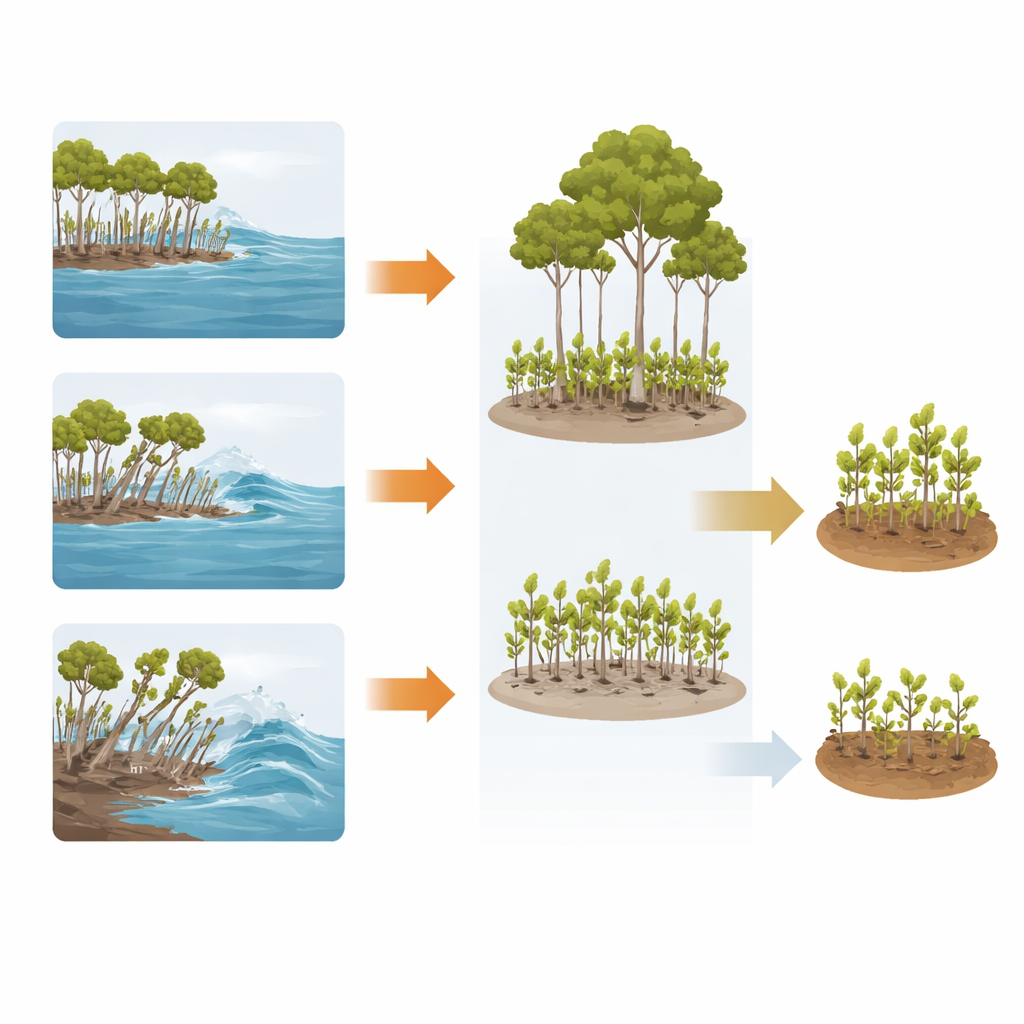
Together, these findings paint a hopeful but conditional picture. The Sundarbans can remain a powerful natural shield and carbon store, but only if its most robust tree communities are protected and imitated. The study suggests that conservation and restoration efforts should focus on maintaining and (re)establishing locally dominant, tall‑growing mangrove species with leaf traits that support rapid growth, complemented by a handful of other species that add structural variety. By designing mangrove stands that mimic this trait mix—and by limiting repeated damage from human activities—managers can greatly improve the forest’s ability to recover from cyclones, rising seas, and other stresses, helping safeguard both coastal people and the climate benefits these remarkable forests provide.
Citation: Rahman, M.M., Zimmer, M., Rahman, M.S. et al. Functional composition and structural diversity enhance mangrove forest resilience in the Sundarbans. Commun Earth Environ 7, 291 (2026). https://doi.org/10.1038/s43247-026-03305-5
Keywords: mangrove resilience, Sundarbans, coastal protection, forest restoration, climate impacts