Clear Sky Science · en
Meteoroid flux at sub-meter scales is homogeneous across the Lunar nearside and farside
Why Moon Dust Still Matters
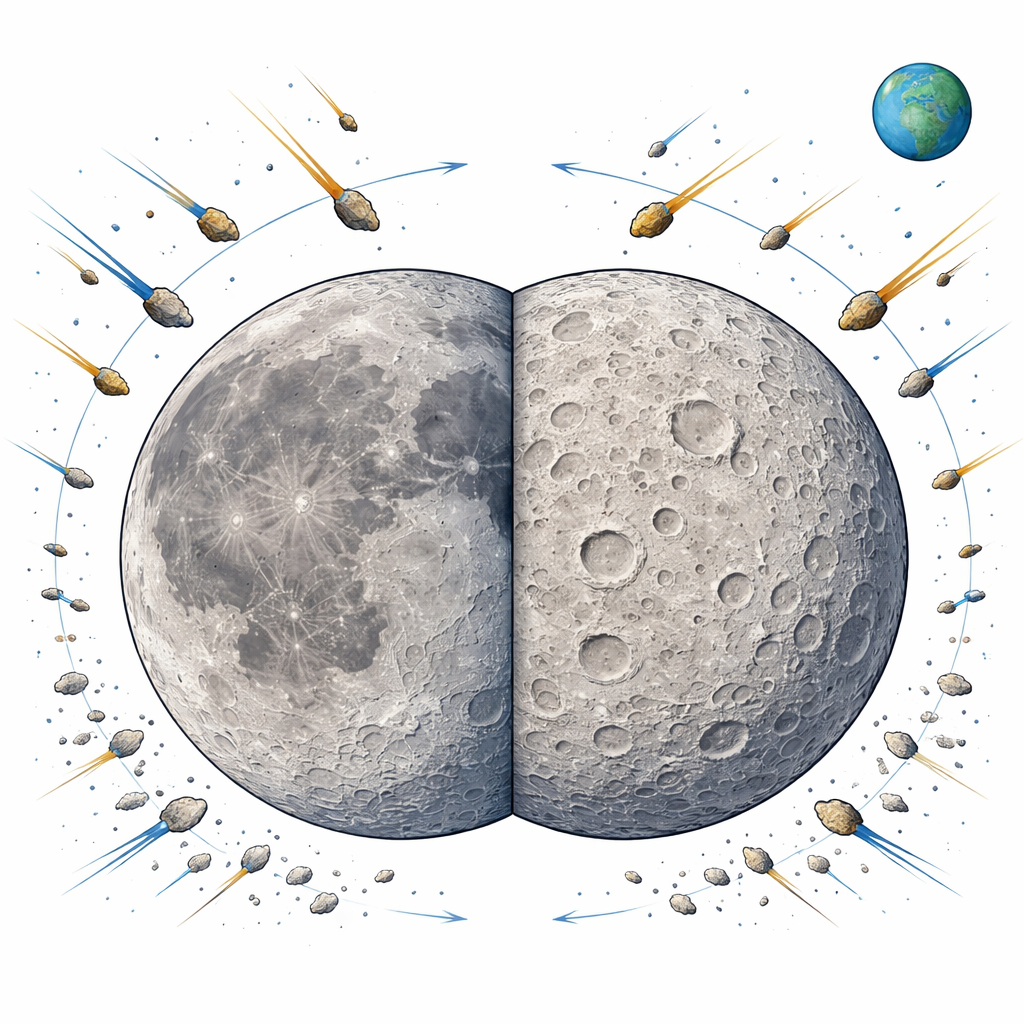
The Moon’s surface is constantly peppered by tiny space rocks, or meteoroids, which slowly grind, stir, and darken its soil. Understanding this invisible “rain” of debris is key to reading the Moon’s history and planning future lunar bases. This study uses China’s Chang’E‑6 mission to the Moon’s far side to ask a deceptively simple question: do small meteoroids hit the Moon’s near side and far side differently, or is the bombardment—and the way it churns the soil—essentially the same everywhere?
How Space Rocks Shape Moon Dust
Every meteoroid that slams into the Moon carves a tiny crater and blasts out a spray of broken rock and dust. Over millions of years, countless small impacts erode old craters, mix the loose surface layer (called regolith), and repeatedly expose fresh mineral grains to the harsh environment of space. Earlier work suggested that Earth’s gravity and the Moon’s locked rotation might make the near side, the side we see from Earth, a preferred target for impactors. If true at small scales, the near side and far side might have very different surface “weather” and, therefore, different stories recorded in their soils.
A New Window from the Far Side
The Chang’E‑6 spacecraft landed inside Apollo crater in the vast South Pole–Aitken Basin on the Moon’s far side and high southern latitudes. On the way down, its landing camera took hundreds of detailed images, which the team used to build a three‑dimensional map of the terrain with centimeter‑level resolution. Around the lander they identified a handful of main craters that supplied material to the site, especially one about 35 meters across formed roughly 17.5 million years ago. The lander’s engine plume brushed away the top centimeter of dust and scooped soil from about 1–4 centimeters deep—material that largely came from this single, relatively recent impact.
Counting Craters and Simulating Soil Stirring
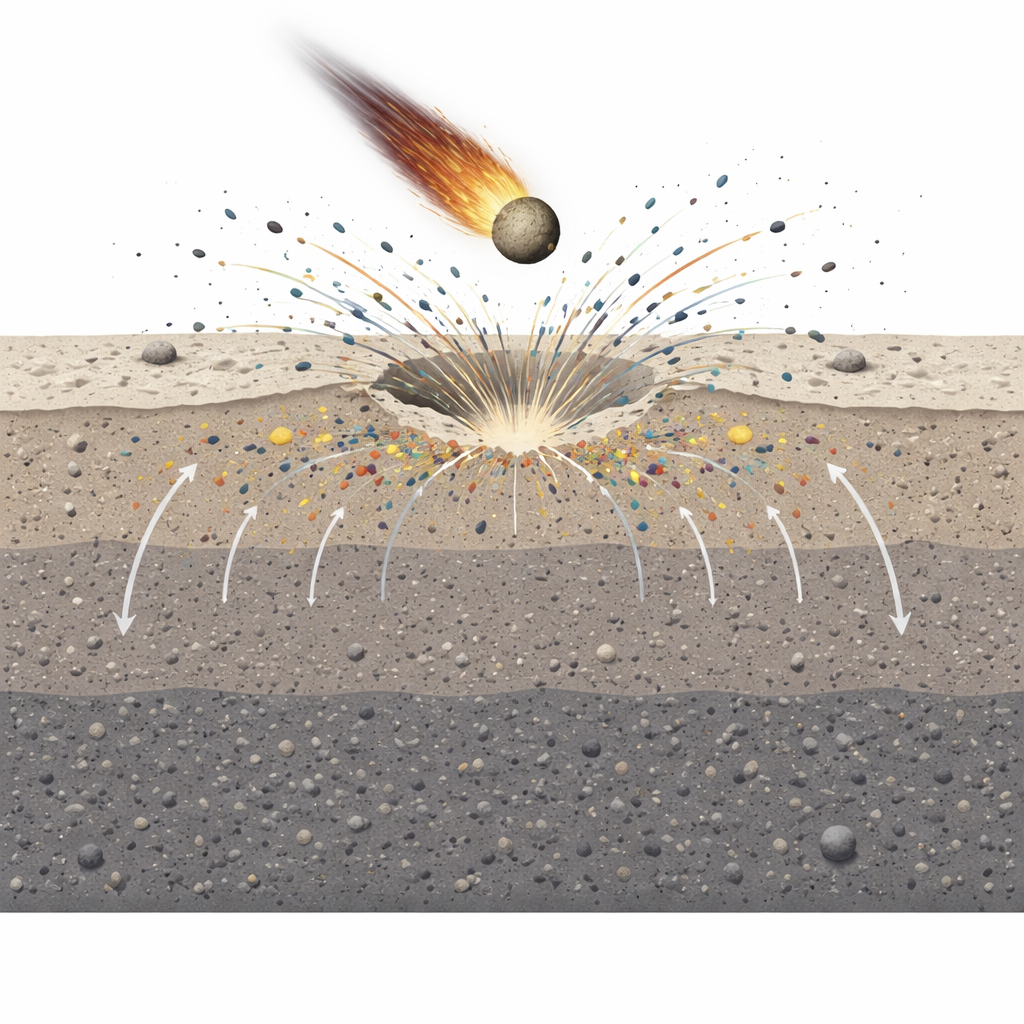
With the high‑resolution map in hand, the researchers counted all craters smaller than 5 meters across within about 15 meters of the lander. Because the ejecta from that 17.5‑million‑year‑old impact resurfaced the area, the number and sizes of newer craters act as a clock for how many meteoroids have struck since then. By comparing these crater counts with several independent models of meteoroid arrival rates, they found ages that all cluster near 17 million years, matching the age of the source crater. They then ran computer “gardening” simulations: over 17.5 million years of random impacts, the top ~75 centimeters of soil are stirred, and many grains from as deep as that are brought to within a hair’s breadth of the surface one or more times.
Measuring How Long Grains Saw the Sun
To test the simulations, the team analyzed tiny feldspar grains from the returned Chang’E‑6 samples. When grains sit at or very near the surface, high‑energy particles from the Sun leave microscopic damage trails inside them. By counting these trails in ultrathin slices of the grains and using a calibrated production rate, the researchers could infer how long each grain had been exposed. The measured exposure times range from about half a million to three and a half million years, with an average of roughly 1.8 million years—remarkably close to the 1.5‑million‑year average predicted by the gardening model for grains at the sampled depth.
What This Means for the Whole Moon
Taken together, the crater counts, soil‑mixing simulations, and grain exposure ages show that the flux of small meteoroids at the Chang’E‑6 far‑side site is essentially the same as that inferred for near‑side regions. Over million‑year timescales, the Moon’s near side and far side experience similar rates of tiny impacts, similar depths of soil “tilling,” and similar exposure histories for individual grains. In practical terms, the study suggests that the recent impact that last resurfaced an area largely controls how long its grains have been exposed—more than their location on the Moon. For scientists and future explorers, this means that lessons learned from one side of the Moon can, with care, be applied to the other.
Citation: Liu, R., Zhao, S., Xu, Y. et al. Meteoroid flux at sub-meter scales is homogeneous across the Lunar nearside and farside. Commun Earth Environ 7, 289 (2026). https://doi.org/10.1038/s43247-026-03270-z
Keywords: lunar regolith, meteoroid impacts, Chang'E-6, space weathering, Moon farside