Clear Sky Science · en
Discovery of stromatolite formation in post-impact hydrothermal lacustrine environments and its implications for early Earth
Rocks that Record Life After a Cosmic Crash
Asteroid impacts are usually cast as planet‑scarring catastrophes, but they may also have created sheltered pockets where life could thrive. This study examines a young impact crater in South Korea and finds that it once hosted thriving communities of microbes that built stromatolites—layered rock structures often called “living fossils.” By showing that these communities grew inside a post‑impact crater lake, the work hints that similar craters on the early Earth, and even on Mars, could have been unexpected havens for life and sources of oxygen.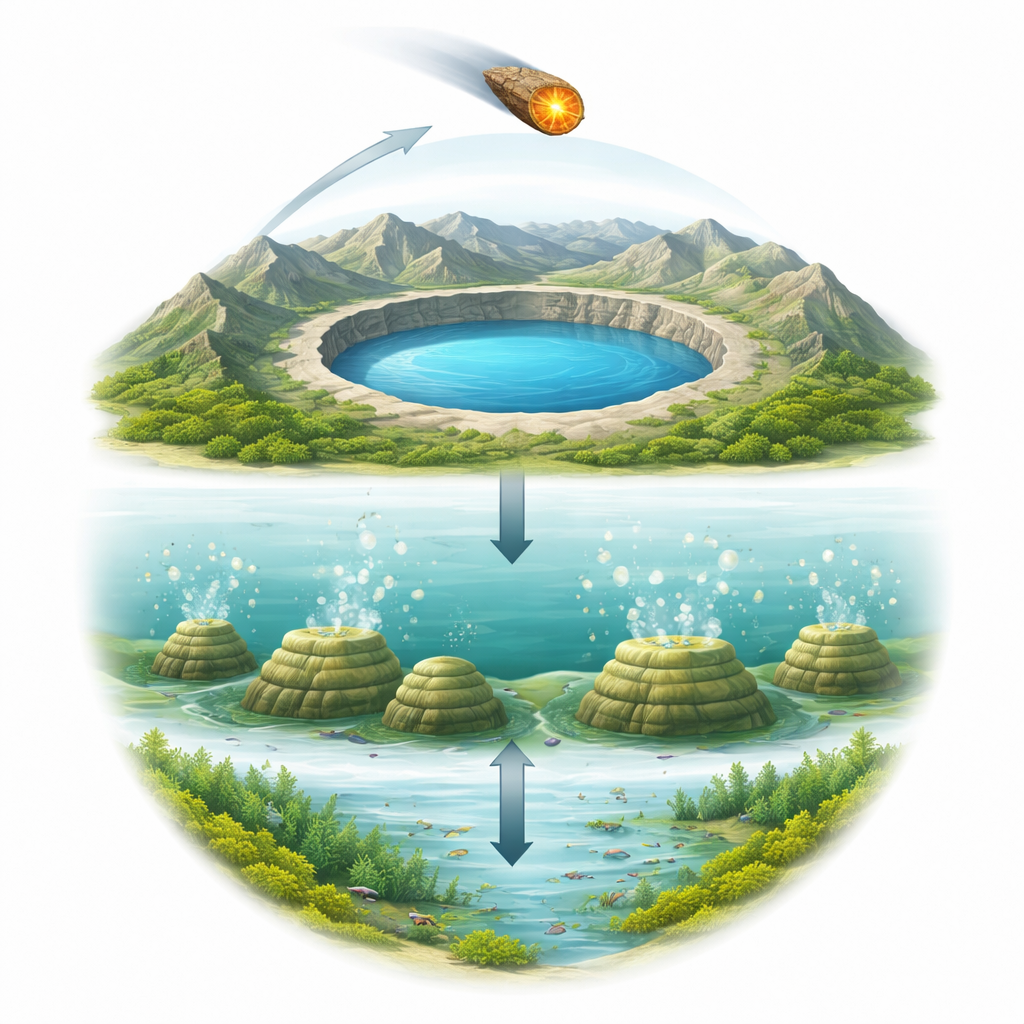
A Bowl in the Mountains Becomes a Lake
The research focuses on the Hapcheon impact crater, a bowl‑shaped basin ringed by mountains in southern Korea. Earlier work had shown that this basin formed when a meteorite struck Cretaceous‑age rocks, shattering them into impact breccia and leaving a gravity signature typical of a crater. After the collision, the hollow slowly filled with water to form a lake, while broken rock and debris slid down the slopes. By drilling a series of deep cores through the center and margins of the basin, the team reconstructed this history: dense impact debris at depth, overlain by tens of meters of lake muds, and topped by younger river and wetland deposits.
Ancient Microbial Mounds Along the Shore
Along small valleys on the inner crater rim, the team uncovered clusters of fossil stromatolites—rounded, layered mounds a few centimeters across, preserved within old lake‑shore gravels. Under the microscope, these rocks show a repeating pattern of thin, wavy layers rich in organic matter, quartz grains, and calcite. Element maps reveal that fine mineral grains are trapped in positions they would not reach by simple settling, a hallmark of sticky microbial mats that catch and bind sediment. Together with carbon‑rich layers and characteristic growth textures, these patterns point strongly to a biological origin: communities of microbes that built up the mounds over time in the shallow margins of the crater lake.
Dating the Lake’s Life and Heat
To work out when these communities lived, the researchers isolated organic matter from stromatolite layers and measured their radiocarbon ages. Individual mounds grew roughly between about 23,000 and 15,000 years ago, but the age pattern is not straightforward: some inner layers appear “older” than outer ones. The authors link this reversal to the way the lake recycled ancient carbon. After the impact, landslides and turbid flows repeatedly carried old plant fragments and charcoal from crater slopes into the lake. Microbes on the stromatolite surfaces trapped this recycled material, mixing it with fresh organic matter and making some layers seem artificially old. Despite this complication, the results show clearly that the stromatolites formed after the impact, during the lifetime of the crater lake. Chemical scans of the lake sediments add another piece: very high levels of calcium and calcite in the earliest lake muds, along with sulfur‑rich layers and DNA from heat‑loving, sulfur‑oxidizing microbes, point to long‑lived hydrothermal activity—essentially hot springs feeding the lake.
Fingerprints of Meteorites and Hot Springs in Stone
The stromatolites also carry traces of their fiery origin. Measurements of the element osmium and its isotopes show that the stromatolites and some lake sediments contain slightly more osmium, and a different isotopic mix, than the surrounding bedrock—exactly what is expected if a small fraction of meteorite material was mixed into the crater rocks and later washed into the lake. Rare‑earth element patterns provide a second clue. The stromatolites are strongly enriched in europium relative to neighboring elements, a signature commonly produced when hot, reducing fluids leach material from deep rocks and then precipitate minerals. That europium signal is strongest in the oldest stromatolite layers and weakens toward the outermost bands, suggesting that hydrothermal activity was vigorous soon after the impact and gradually faded over tens of thousands of years.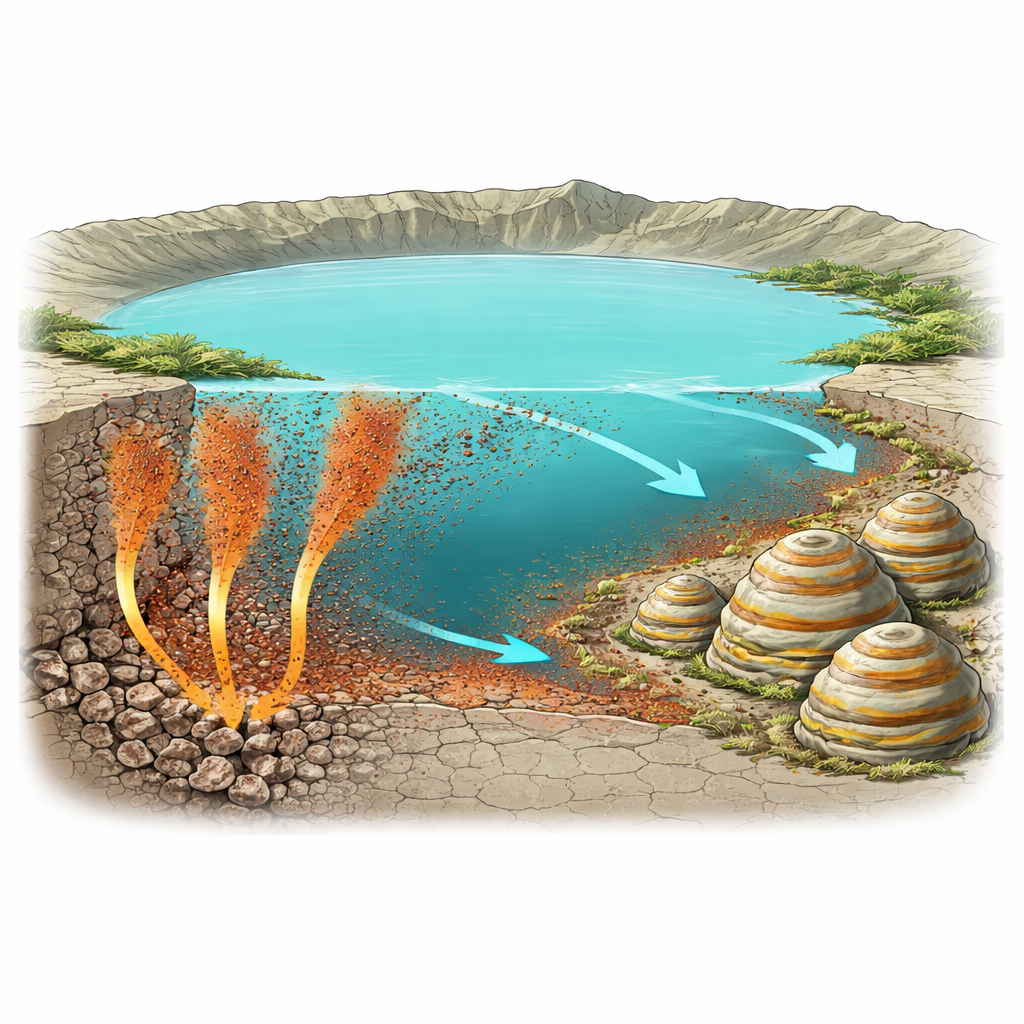
Impact Craters as Surprising Havens for Life
Taken together, these lines of evidence paint a picture of an impact crater that evolved from a devastated landscape into a warm, chemically rich lake rimmed with microbial mounds. The Hapcheon stromatolites are not themselves ancient—they formed during the late Ice Age, long after Earth’s atmosphere became oxygen‑rich. But they offer a real‑world example of how impact‑generated hot springs and lakes can support stromatolite “blooms.” On the early Earth, when asteroid strikes were far more common and oxygen‑producing microbes were just spreading, similar crater lakes may have acted as scattered “oxygen oases,” helping to nudge the planet toward a breathable atmosphere. The same logic makes crater lakes with layered, mound‑like deposits attractive places to search for traces of past life on Mars.
Citation: Lim, J., Kim, Y., Park, S. et al. Discovery of stromatolite formation in post-impact hydrothermal lacustrine environments and its implications for early Earth. Commun Earth Environ 7, 334 (2026). https://doi.org/10.1038/s43247-026-03206-7
Keywords: impact craters, stromatolites, hydrothermal lakes, early Earth, astrobiology