Clear Sky Science · en
Time delay neural networks reveal pressure-independent fault rupture processes in laboratory acoustic emission
Listening to Rocks Before They Break
Earthquakes may seem to strike without warning, but long before a fault suddenly slips, countless tiny cracks form and grow deep underground. In the laboratory, these miniature “rockquakes” release high‑frequency sounds that can be recorded and analysed. This study shows how a simple type of artificial intelligence can listen to those sounds and uncover a common three‑stage pattern of fault growth that appears largely independent of the pressure squeezing the rock—a potential step toward better understanding how big quakes build up.
How Tiny Cracks Tell Big Stories
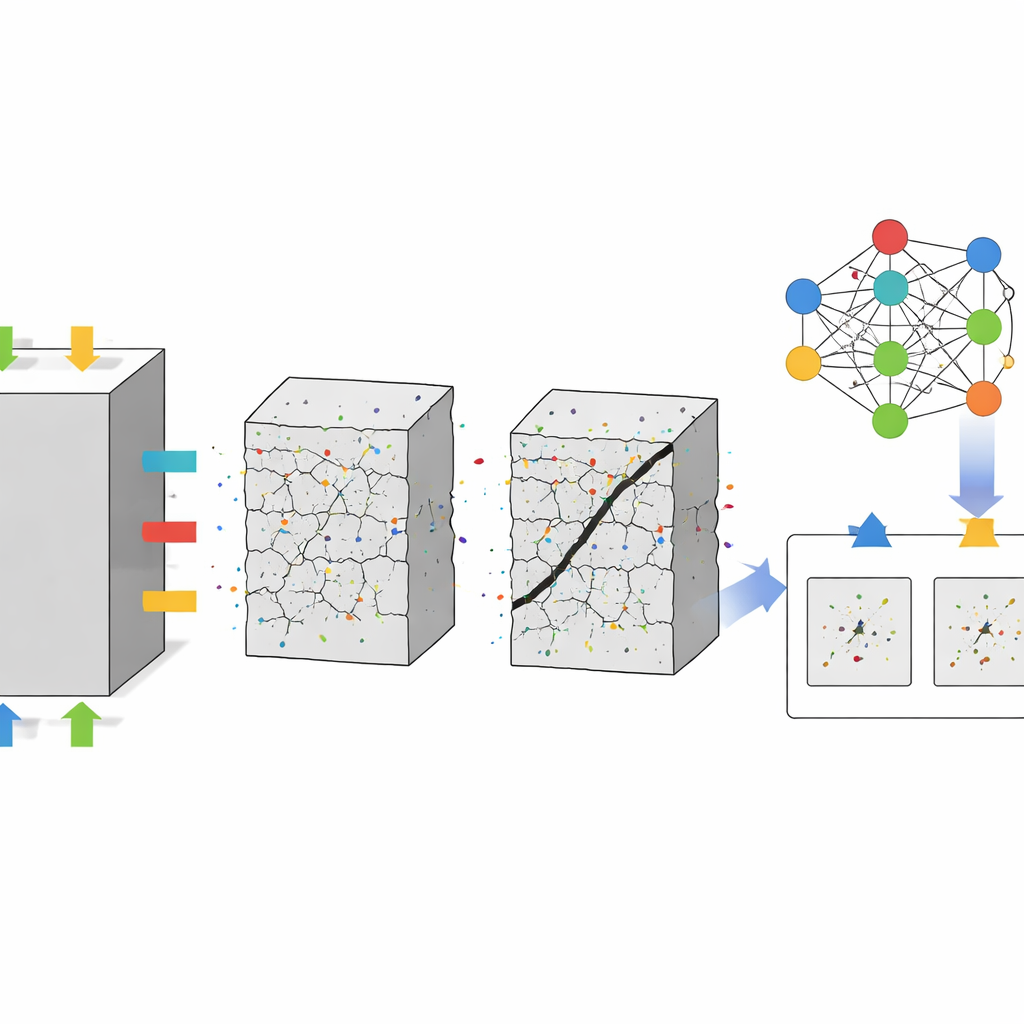
When a solid block of granite is squeezed until it fails, it does not shatter all at once. At first, small cracks pop open throughout the rock; later, they begin to organise, and finally they link up into a through‑going fault. Each microscopic crack emits a brief sound pulse, known as an acoustic emission, that carries information about where it occurred and how the wave travelled. By recording thousands of these signals with sensors around the sample, researchers can track how damage spreads, clusters and eventually focuses into a single fracture that mimics a natural fault.
Putting Rock Sounds into a Simple AI
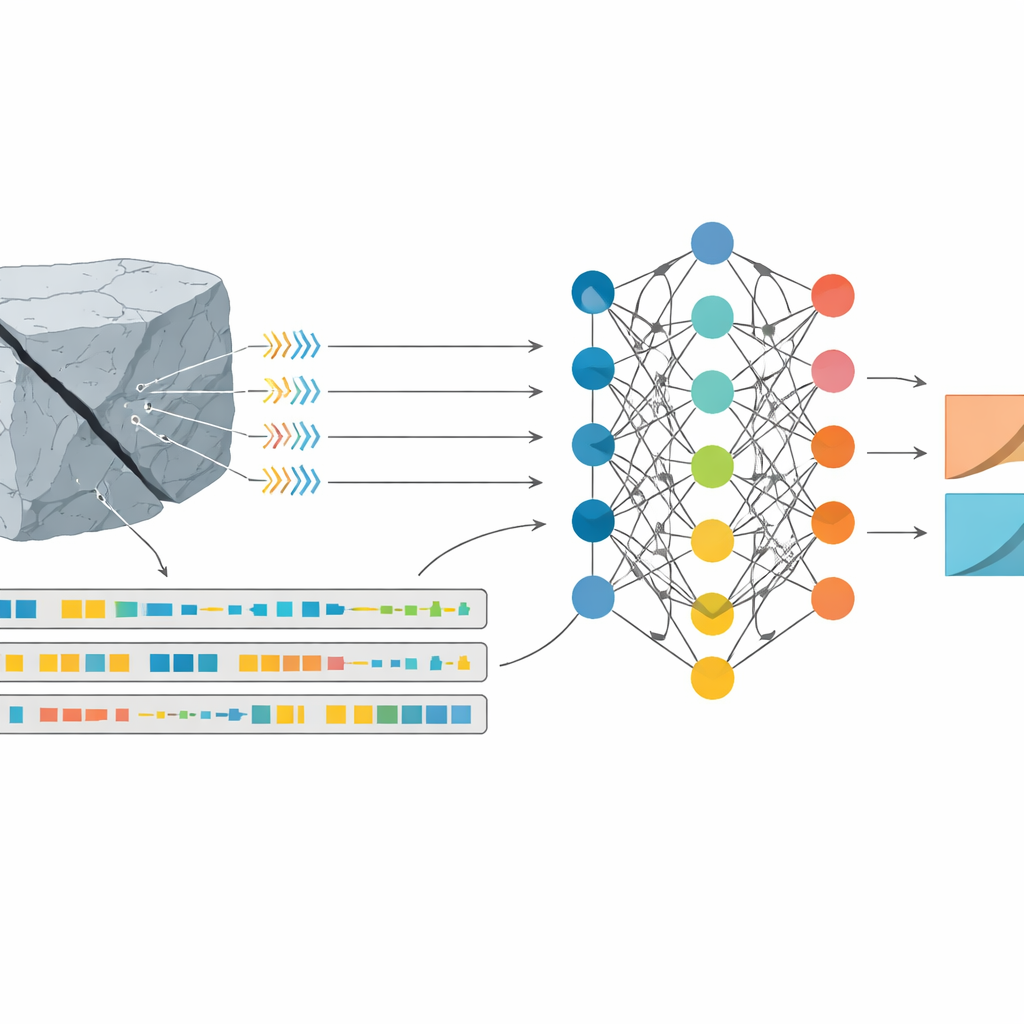
To interpret this acoustic “chatter,” the authors used a time‑delay neural network, a streamlined form of machine learning that is well suited to short time‑series data. Instead of throwing every possible number at a black‑box model, they carefully chose a handful of features that have clear physical meaning. Some describe how each sound wave looks as it travels through the rock—for example, how strongly it is scattered or how long it takes to reach its peak. Others summarise when and where events occur, such as how quickly they repeat, how their sizes are distributed, and how clustered their source locations are in space. Together, these features provide a multi‑faceted picture of how the internal structure of the rock evolves during loading.
Fault Growth Looks the Same Under Different Pressures
The team tested four granite cylinders at confining pressures ranging from relatively low to moderately high, conditions that produce different visible failure styles—from splitting straight up the sample to sliding along a slanted shear plane. They trained their network to predict how stress and strain (the rock’s deformation) changed through time using the acoustic features as inputs, always leaving one pressure case out for validation. Despite the small dataset, the model successfully reproduced the build‑up and release of stress and strain across all pressures and failure modes, including the main stress drop at failure. This cross‑testing showed that the key acoustic patterns that track fault development are largely independent of how much pressure surrounds the rock.
Three Hidden Stages Revealed
Because the time‑delay network is relatively simple, the authors could track which features the model relied on most strongly at each stage of loading. A clear three‑phase story emerged. In the earliest “nucleation” phase, when cracks are scattered and isolated, statistics that count and size events dominate: how often emissions occur and how their magnitudes are distributed. As loading continues into an “interaction” phase, the spatial clustering of events grows more important, signalling that cracks are beginning to influence one another and form networks. Near failure, in the “coalescence” phase, the model shifts its attention toward waveform‑based measures such as increased scattering and rapid changes in peak delay, reflecting a medium that has become highly fractured and channelises wave energy along an emerging fault.
Why This Matters Beyond the Lab
The study suggests that many aspects of fault growth—from scattered cracks to an organised rupture—follow a common pattern that does not depend strongly on the pressure conditions, at least for this granite. If similar acoustic features can be extracted from microearthquakes or active seismic surveys in the field, a comparable framework could help identify which phase a natural fault is in, and whether it is transitioning toward coalescence. While scaling from centimetre‑sized samples to crustal‑scale faults is challenging, the work demonstrates that relatively transparent machine‑learning tools can bridge laboratory observations and real‑world monitoring, offering a more physically grounded way to listen for the subtle signals that precede major earthquakes.
Citation: King, T., Vinciguerra, S.C. Time delay neural networks reveal pressure-independent fault rupture processes in laboratory acoustic emission. Commun Earth Environ 7, 338 (2026). https://doi.org/10.1038/s43247-025-03003-8
Keywords: earthquake precursors, acoustic emissions, fault mechanics, machine learning in geoscience, rock fracture experiments