Clear Sky Science · en
Uniaxial structural flexibility of an anisotropic Br adlayer structure on Au(100) electrodes revealed by video-rate STM
Why crowded surfaces matter
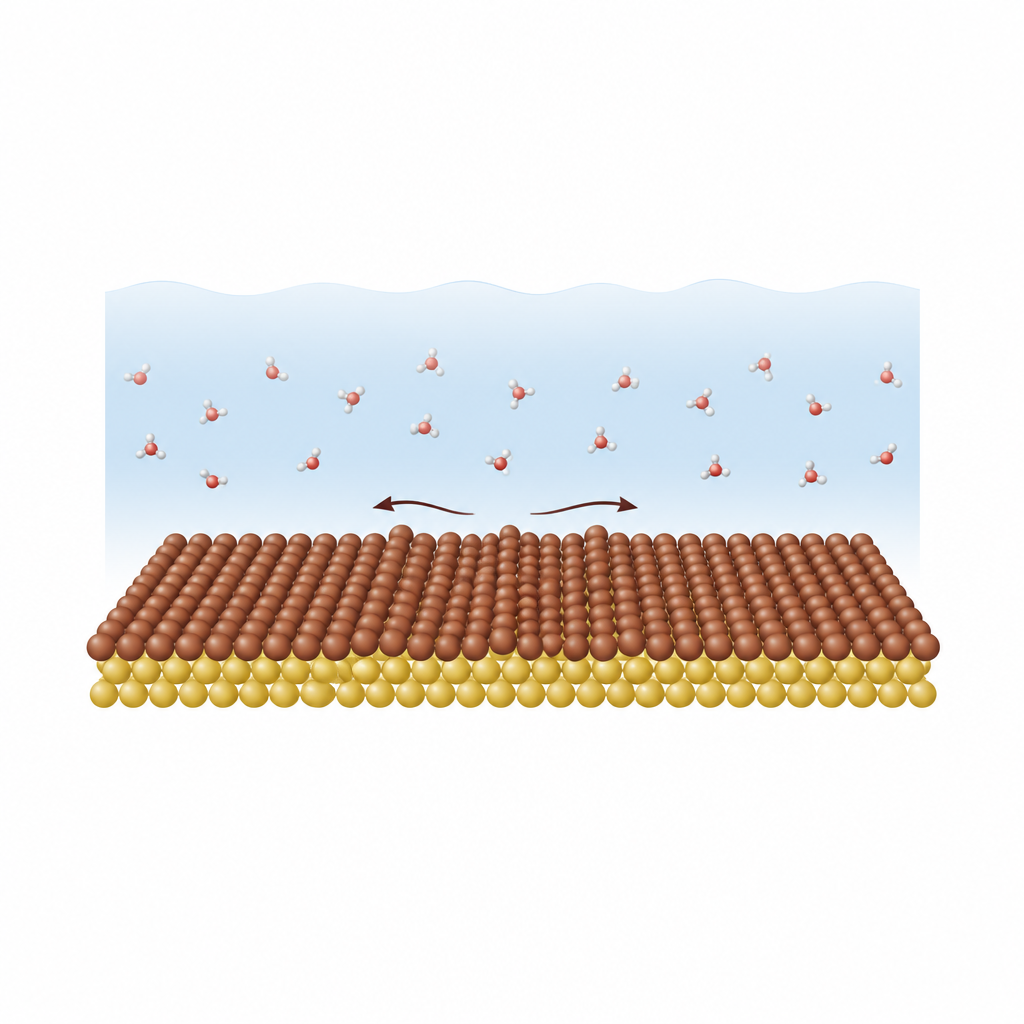
From car exhaust treatment to metal corrosion and battery operation, many key technologies depend on how atoms and molecules move across solid surfaces that are already packed with other atoms. This study looks at how a tightly packed layer of bromine atoms on a gold surface can still flex and rearrange itself, creating tiny pathways that help other species move even when the surface seems full.
A packed layer that is not rigid
On a flat gold surface, bromine atoms arrange themselves into an orderly pattern that looks almost hexagonal but is slightly stretched in one direction. At first glance this dense layer appears frozen in place, with little room for anything to move. Using a high-speed scanning tunneling microscope in a liquid solution, the researchers watched this bromine layer in real time and found that it is far from rigid. Along one particular direction on the surface, rows of bromine atoms could shift back and forth, while rows in other directions stayed put. These shifts were fast enough that the microscope often recorded them as blurred streaks rather than sharp spots.
Hidden defects create sliding lanes
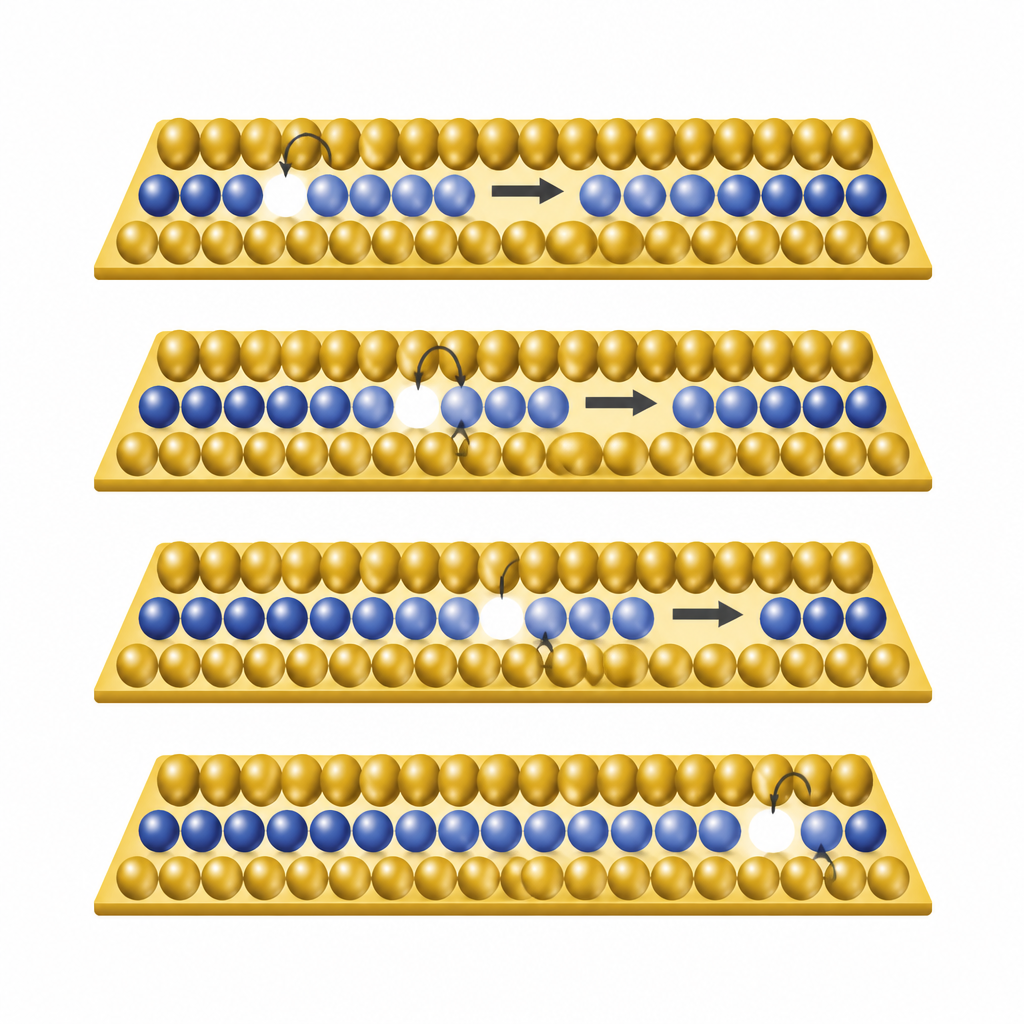
The team traced this motion to special defects they call fractional vacancies. Instead of a full empty site where an atom is missing, a fractional vacancy acts more like a half-space that allows a nearby bromine atom to slide sideways by a tiny distance. When such a defect forms at a step in the gold surface, at the boundary between differently oriented domains, or next to a larger surface complex, it can travel along a single row like a bead sliding along a wire. As this vacancy moves, each bromine atom in the row briefly shifts into a slightly offset position before returning, so that the whole row flickers between two nearly equivalent patterns.
Watching fluctuations near steps and molecules
Because fractional vacancies originate at specific structural features, the motion they enable is highly localized and directional. Near straight steps in the gold surface, the authors observed an alternating pattern of calm and flickering bromine rows: one row remained static, while the next showed rapid motion, and so on. The blurring was strongest at the step edge and gradually faded over a few nanometers, consistent with a vacancy that tends to stay close to where it was created. Next to larger gold–bromine surface complexes, the behavior of nearby rows could switch between still and fluctuating as these complexes shifted or rotated, highlighting a close interplay between the motion of the defects and the motion of embedded species.
Calculations that explain the easy motion
To understand why the bromine layer can flex this way without falling apart, the researchers used quantum mechanical calculations. They compared the energies of different bromine patterns on the gold surface and found that the two arrangements involved in the fluctuations are almost equally favorable. Shifting an entire row into the alternate pattern costs very little energy per atom, and the barrier for a vacancy to move along a row is also low. In contrast, moving defects between neighboring rows is noticeably harder. This supports the picture of rapid, one-dimensional diffusion along a single direction, rather than motion that spreads evenly in all directions.
What this means for crowded surfaces
In simple terms, the study reveals that even a densely packed surface layer can behave like a flexible sliding lattice, provided its structure is slightly anisotropic and it hosts the right kind of tiny defects. These fractional vacancies open up narrow lanes along which atoms can shuffle, allowing the layer to adapt to steps, domain boundaries, and embedded molecules without needing large empty spaces. Similar behavior is likely in other systems where different surface patterns have nearly the same energy. Understanding these subtle motions is important because they can influence how atoms and molecules travel, react, and assemble on real, crowded surfaces that underlie catalysis, corrosion, and electrochemical technologies.
Citation: Yang, C., Wendorff, F., Buttenschön, S. et al. Uniaxial structural flexibility of an anisotropic Br adlayer structure on Au(100) electrodes revealed by video-rate STM. Commun Mater 7, 138 (2026). https://doi.org/10.1038/s43246-026-01195-w
Keywords: surface diffusion, bromide adlayer, gold electrodes, scanning tunneling microscopy, density functional theory