Clear Sky Science · en
Partially carbonised carbon fibres as improved electrodes for structural battery applications
Stronger parts that also store energy
Imagine if the body of your car or the shell of your laptop could double as the battery that powers it. This study explores a new kind of carbon fiber that can both hold a structure together and store electrical energy, opening the door to lighter vehicles, phones and drones that squeeze more function out of every gram of material.
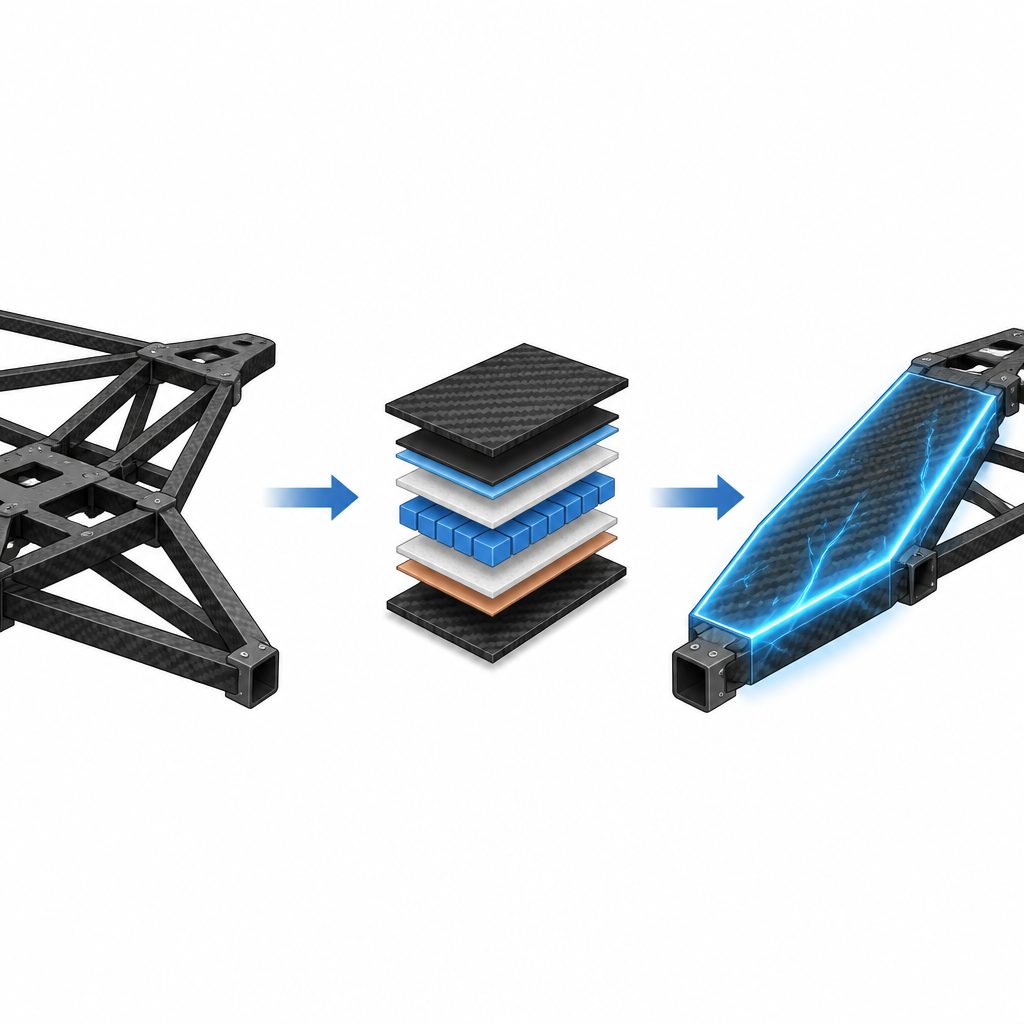
Why make structures that act like batteries
Engineers are keen on structural batteries, where load bearing parts also store energy. Instead of carrying a heavy, separate battery pack, the frame itself helps power the device. Carbon fibers are prime candidates because they are already used to reinforce aircraft, cars and sporting goods, and they can also host lithium ions like the negative electrode in a regular battery. The catch has been a trade off: carbon fibers optimized for strength usually do not store much energy, and fibers tuned for better energy storage tend to lose mechanical performance.
A different way to cook carbon fibers
The authors tested a fresh manufacturing strategy called partial carbonisation. They started with the same polymer precursor used in many commercial fibers and then heated it to different maximum temperatures between 800 and 1100 degrees Celsius, creating four new fiber types. These were compared with standard high performance fibers, including a widely used grade known for its good balance of stiffness and battery behavior. By carefully measuring density, surface area, chemical makeup and internal structure, the team tracked how the fibers changed as the heat treatment increased.
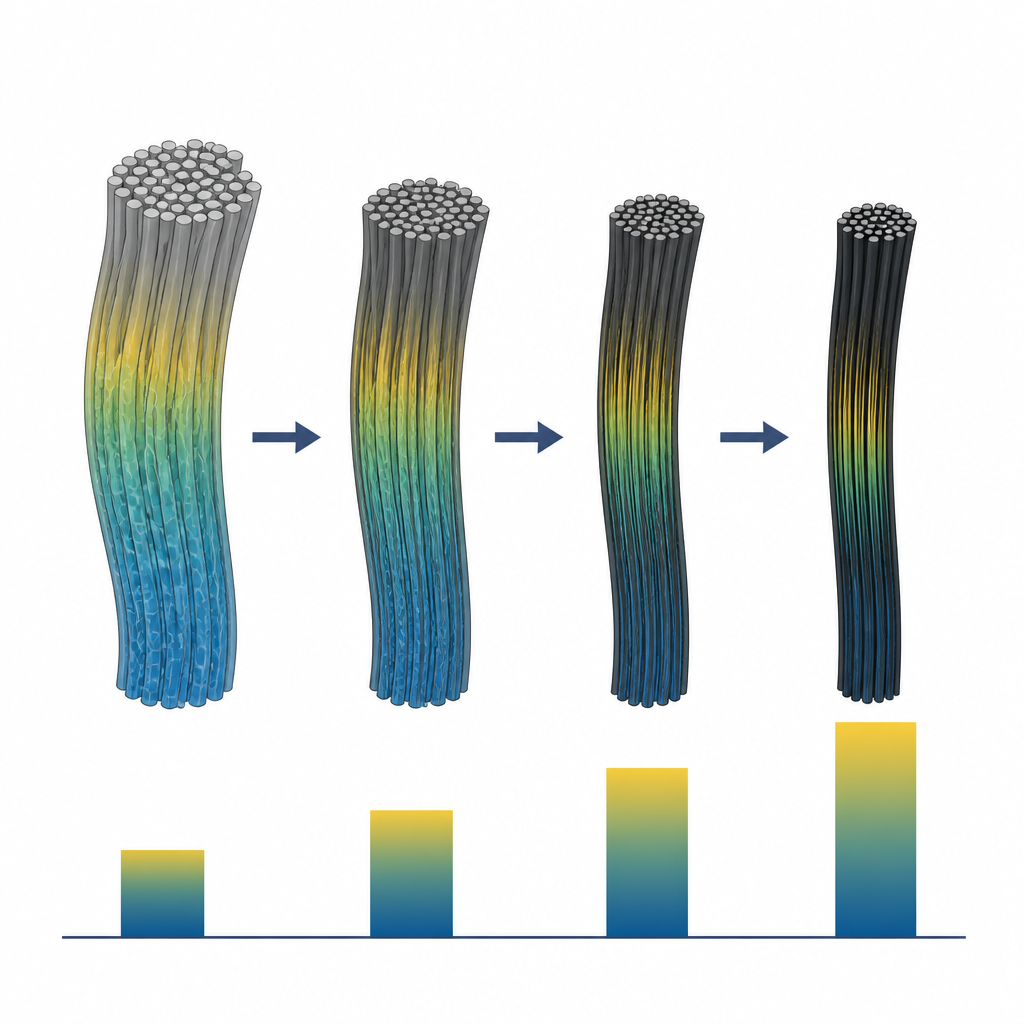
How structure inside the fibers shapes their behavior
Microscopy, Raman spectroscopy and X ray scattering revealed that, as carbonisation temperature rose, the fibers gradually shifted from a highly disordered carbon network toward more ordered graphitic regions. The layers of carbon atoms moved closer together, crystallite blocks grew thicker, and their alignment along the fiber axis improved. At the same time, excess hydrogen, nitrogen and oxygen atoms were driven off. These changes made the fibers stiffer and stronger, confirming that higher processing temperatures build a more efficient load bearing skeleton inside the material.
Better energy storage without giving up strength
The team then tested the fibers in small battery cells against lithium metal. Fibers made at the lowest temperature were too poorly conducting to work as electrodes, but those treated at 900, 1000 and 1100 degrees Celsius all cycled lithium reliably. Remarkably, they delivered up to 40 percent higher reversible capacity than the state of the art carbon fiber used in structural batteries, while maintaining very high efficiency over more than 100 charge discharge cycles. Electrochemical tests showed that fibers treated at the highest temperature combined the best electrical conductivity with the best long term capacity, making them especially attractive for real devices.
What this means for future energy storing structures
By partially carbonising the fibers rather than pushing them all the way to the most graphitic state, the researchers discovered a sweet spot where mechanical strength and energy storage both improve together instead of competing. The resulting fibers keep enough defects and tiny cavities to host lithium ions while gaining a more ordered carbon framework that carries load and electrons efficiently. This work maps out how processing temperature tunes that balance and suggests that lighter, more energy dense structural battery components for vehicles, drones and portable electronics are within reach.
Citation: Tavano, R., Randall, J.D., Le Thao, N.N. et al. Partially carbonised carbon fibres as improved electrodes for structural battery applications. Commun Mater 7, 135 (2026). https://doi.org/10.1038/s43246-026-01194-x
Keywords: structural batteries, carbon fibres, multifunctional materials, lithium-ion storage, lightweight structures