Clear Sky Science · en
GENIUS: an agentic AI framework for autonomous design and execution of simulation protocols
Smarter Tools for Discovering New Materials
Designing better batteries, catalysts, and electronic devices increasingly depends on computer simulations that predict how materials behave before they are ever made in the lab. Yet running these simulations usually demands a specialist who knows intricate software commands and thousands of technical options. This paper introduces GENIUS, an artificial intelligence system that acts like an expert assistant, turning plain-language requests from scientists into working simulation setups automatically. By lowering the technical barrier, GENIUS aims to let many more researchers use powerful quantum‑level calculations in their everyday work.
The Hidden Friction Behind Virtual Experiments
Modern materials research leans heavily on atom‑by‑atom simulations to test ideas quickly and cheaply. Programs such as Quantum ESPRESSO can now match experimental accuracy for many crystals, but their everyday use is often limited to specialists. Setting up a single calculation can require digging through dense documentation, choosing compatible parameters, and debugging cryptic error messages. Even experienced users may spend hours wrestling with input files instead of thinking about the science. This gap between what the software can do and what most scientists can comfortably use is often called the “know‑do gap” and it slows the translation of theory into real‑world technologies.
An AI Middle Layer Between People and Code
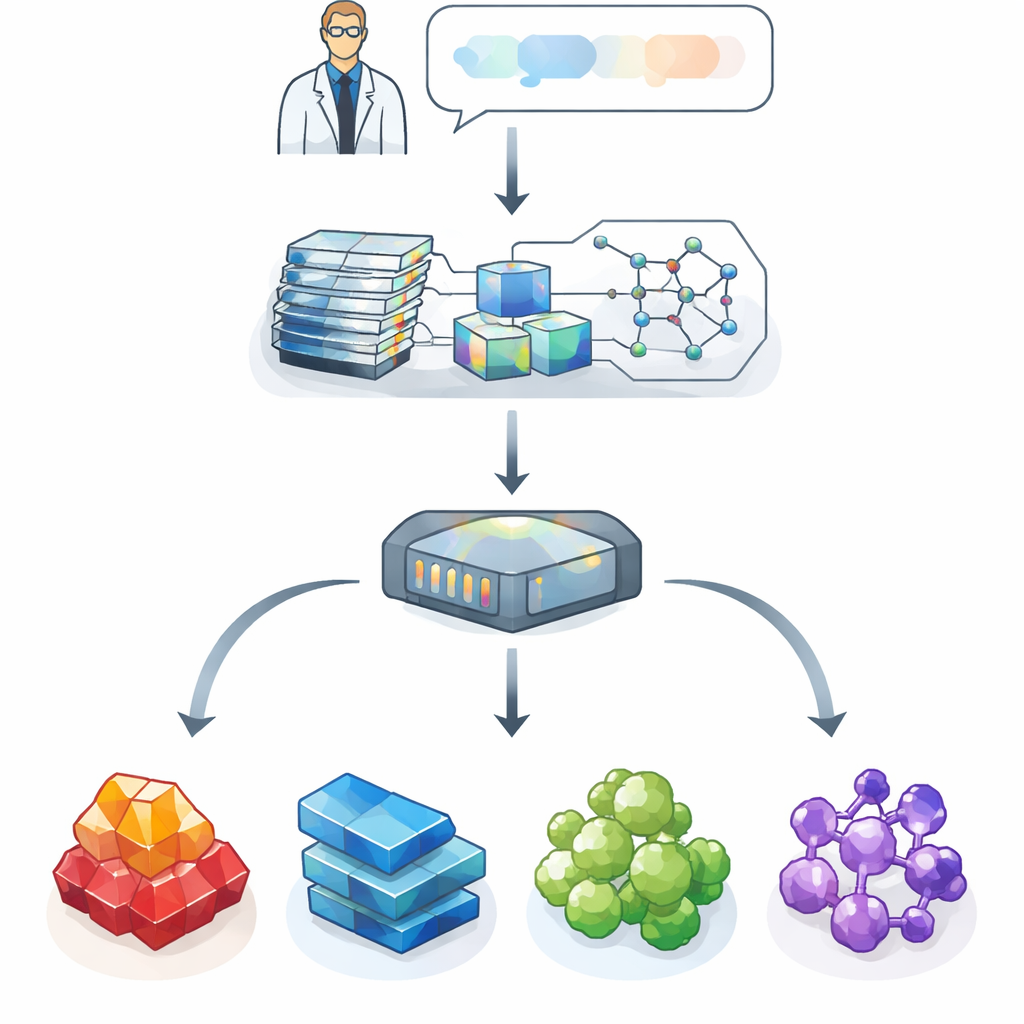
GENIUS is designed as an intelligent middle layer that sits between the researcher and the simulation program. A user starts with a free‑form request, such as asking for a geometry optimization of a specific two‑dimensional material with a given quantum method. GENIUS breaks this request down using large language models and a structured “knowledge graph” that encodes how Quantum ESPRESSO’s 247 key settings relate to one another and to the underlying physics. From this, it drafts a complete input file that respects the software’s syntax and internal rules. Crucially, GENIUS does not rely on the language model’s memory alone; it grounds its choices in curated documentation and database information about the actual material being studied, which sharply reduces made‑up or inconsistent settings.
Learning from Mistakes Without Human Debugging
Even carefully prepared simulations can fail on the first try. To handle this, GENIUS includes an automated error‑recovery loop. When Quantum ESPRESSO rejects an input, the program produces an error message. GENIUS reads that message, consults its knowledge graph to interpret what went wrong, and proposes a corrected version of the input. A simple but disciplined control system tracks these attempts, deciding when to retry with the same language model, when to restart from a clean template, and when to escalate to a more powerful model. This loop continues until the simulation passes early checks or the system concludes that further attempts are unlikely to help. Throughout this process, logs record each decision, providing a clear trail for later inspection or human intervention.

How Well the System Performs in Practice
To see how robust GENIUS is, the authors collected 295 real prompts from chemists and physicists who regularly use quantum simulations, but not necessarily Quantum ESPRESSO itself. These prompts ranged from simple to highly detailed tasks. The team measured whether GENIUS could turn each request into an input file that the program could parse and start to run within a short, one‑minute validation window. About 80 percent of all prompts led to a working setup. Roughly 14 percent succeeded on the very first attempt, while most of the rest were salvaged by the automated error‑handling loop. The chance of “rescuing” a failed run dropped quickly with each additional attempt and settled near a 7 percent baseline, showing that most fixable problems are resolved early. Simple language‑model baselines, without the knowledge graph and control logic, rarely produced valid inputs at all, highlighting the value of GENIUS’s architecture rather than just bigger models.
Opening Advanced Simulations to More Scientists
From a lay perspective, GENIUS is a step toward making highly technical quantum simulations as approachable as a modern search engine. Instead of memorizing arcane commands, researchers describe what they want, and the system assembles, tests, and repairs the necessary instructions automatically. Under the hood, GENIUS combines structured domain knowledge, multiple language models, and a careful retry strategy to keep errors in check. While the current work focuses on one widely used simulation package, the same design could be adapted to other codes wherever clear documentation and error messages exist. By shrinking the know‑do gap, frameworks like GENIUS could help more labs, companies, and students bring advanced computational tools into everyday materials discovery.
Citation: Soleymanibrojeni, M., Aydin, R., Guedes-Sobrinho, D. et al. GENIUS: an agentic AI framework for autonomous design and execution of simulation protocols. Commun Mater 7, 115 (2026). https://doi.org/10.1038/s43246-026-01167-0
Keywords: materials simulation, autonomous workflows, agentic AI, density functional theory, Quantum ESPRESSO