Clear Sky Science · en
Synthesis and helium separation performance of polycrystalline membranes of the high precision molecular sieve MIL-116(Ga)
Why saving helium matters
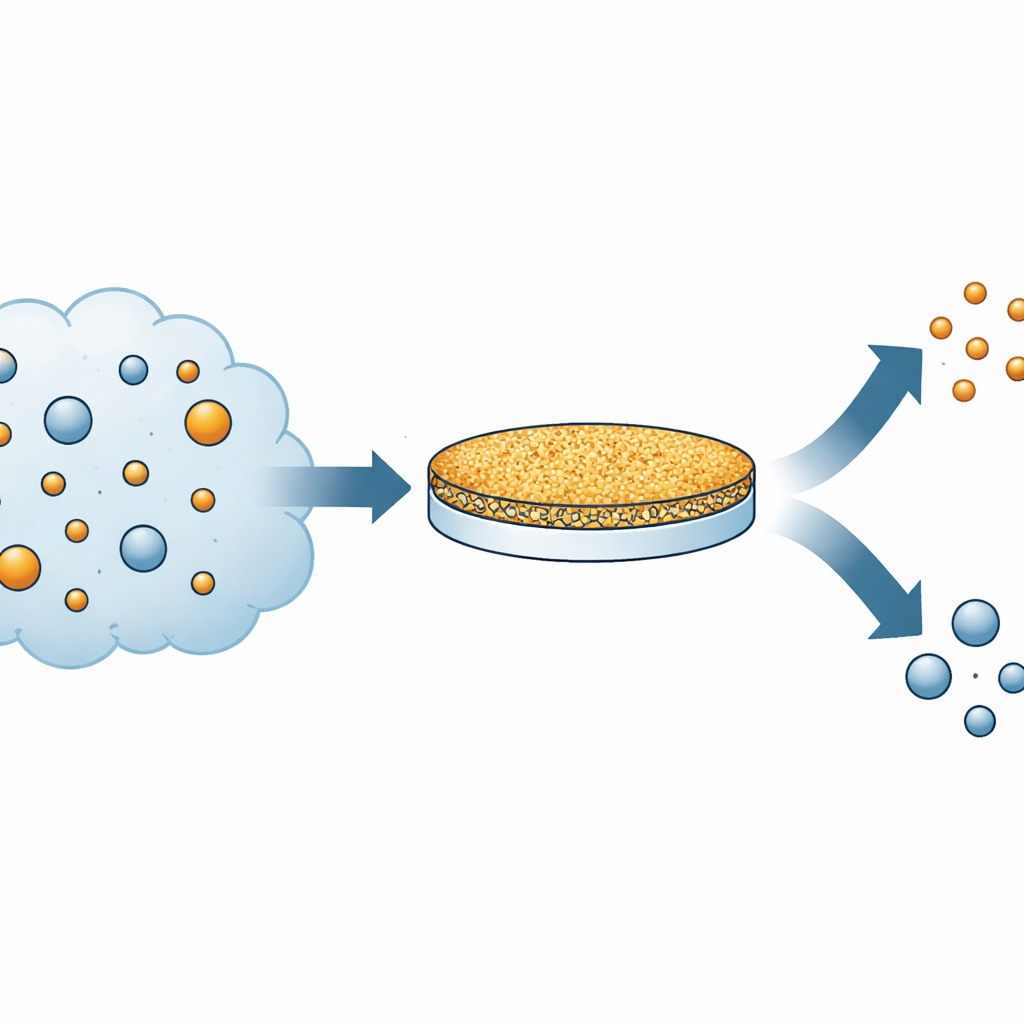
Helium might be best known for making balloons float, but it is far more important as a cooling and shielding gas for hospitals, research labs, and advanced electronics. Because it escapes Earth’s atmosphere once released and cannot be made in bulk, every bit of helium we waste is gone forever. Today, purifying helium from natural gas relies on energy-hungry cooling plants. This study explores a different route: thin, solid filters called membranes that could recover helium using far less energy, helping to stretch this irreplaceable resource.
A smarter filter for tiny atoms
The core of this work is a special crystalline material called MIL-116(Ga), built from metal centers and organic linkers arranged in a repeating pattern. At first glance it appears “dense,” meaning it does not soak up common test gases the way many porous materials do. Yet its internal structure contains extremely narrow channels about the size of a helium atom. The researchers realized that, although larger gases cannot easily enter these channels, helium and hydrogen might slip through, making MIL-116(Ga) a promising candidate for highly precise gas filtering.
Growing a thin crystal skin
To turn this material into a working membrane, the team grew a thin polycrystalline film of MIL-116(Ga) on top of robust ceramic disks. They first treated the ceramic surface to encourage the initial crystal “seeds” to attach, then used a carefully tuned heated solution to grow these seeds into closely packed grains that form a continuous layer about eight micrometers thick. Electron microscope images show that each visible “bump” on the surface is itself made from many tiny, needle-like crystals that interlock into a dense, broccoli-like crust, firmly anchored to the ceramic support underneath.
Tiny channels and their weak points
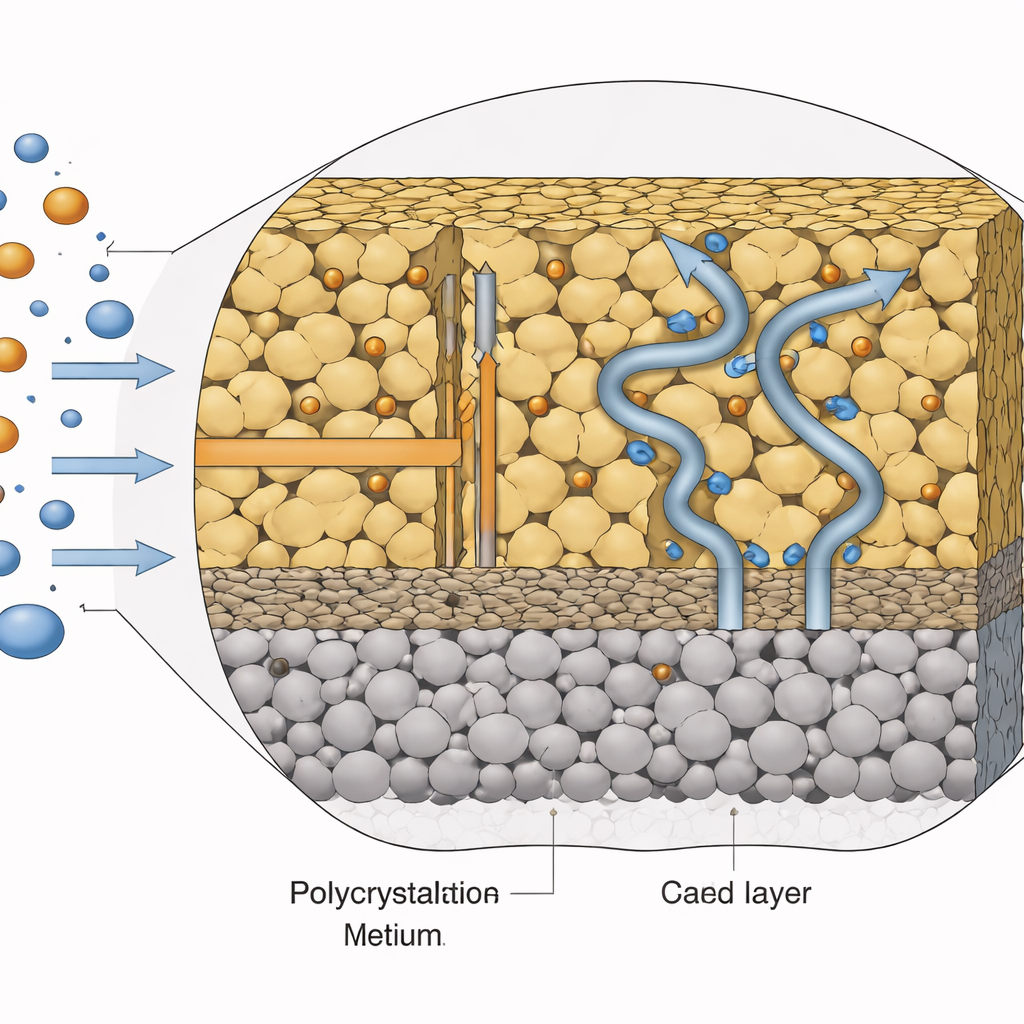
By examining cross-sections of the film, the authors mapped how different elements are distributed and reconstructed how the membrane grows. An initial seed layer spreads over the support, then gives rise to spherical clusters that merge into a full coating. Where these many grains meet, narrow gaps called grain boundaries appear. Inside each grain the channels are so tight that only the smallest, non-sticky gases can move quickly. However, the grain boundaries form more complex pathways where slightly larger molecules can sneak through. These hidden corridors are both a strength and a weakness: they still block most larger gases, but they limit how close the membrane comes to an ideal, perfectly selective sieve.
Putting the membrane to the test
The researchers measured how well different gases crossed the membrane at modest temperature and pressure. Helium and hydrogen moved through much faster than methane, carbon dioxide, or nitrogen, revealing a sharp size-based cutoff. When helium or hydrogen were tested alone against methane, the membrane favored the small gases by factors above one hundred. In more realistic mixtures, where helium was only four percent of a helium–methane blend, the membrane still enriched helium strongly, while allowing only a trickle of methane to pass. Simple calculations suggest that a large-scale module packed with such membranes could upgrade low-grade natural gas streams to helium levels high enough for further polishing in a second step, with far less energy than deep-cooling methods.
What this means for future helium supplies
To a non-specialist, the key message is that a carefully engineered crystal coating can act like an exceptionally picky strainer for gas molecules, letting helium through while largely holding back bulk natural gas. Although tiny imperfections between grains prevent the membrane from being perfectly selective, it already outperforms previous materials of its kind by a wide margin. With further work to tame these grain boundaries and to scale up production, such dense-crystal membranes could become a practical, energy-saving tool to safeguard our helium supply for medical scanners, space technology, and scientific instruments.
Citation: Komal, A., Calderón Rodríguez, L., Scheffler, F. et al. Synthesis and helium separation performance of polycrystalline membranes of the high precision molecular sieve MIL-116(Ga). Commun Mater 7, 111 (2026). https://doi.org/10.1038/s43246-026-01156-3
Keywords: helium separation, gas membranes, metal-organic frameworks, natural gas upgrading, energy-efficient purification