Clear Sky Science · en
Multifunctional zinc-ion capacitors for energy storage
Powering Everyday Gadgets More Safely
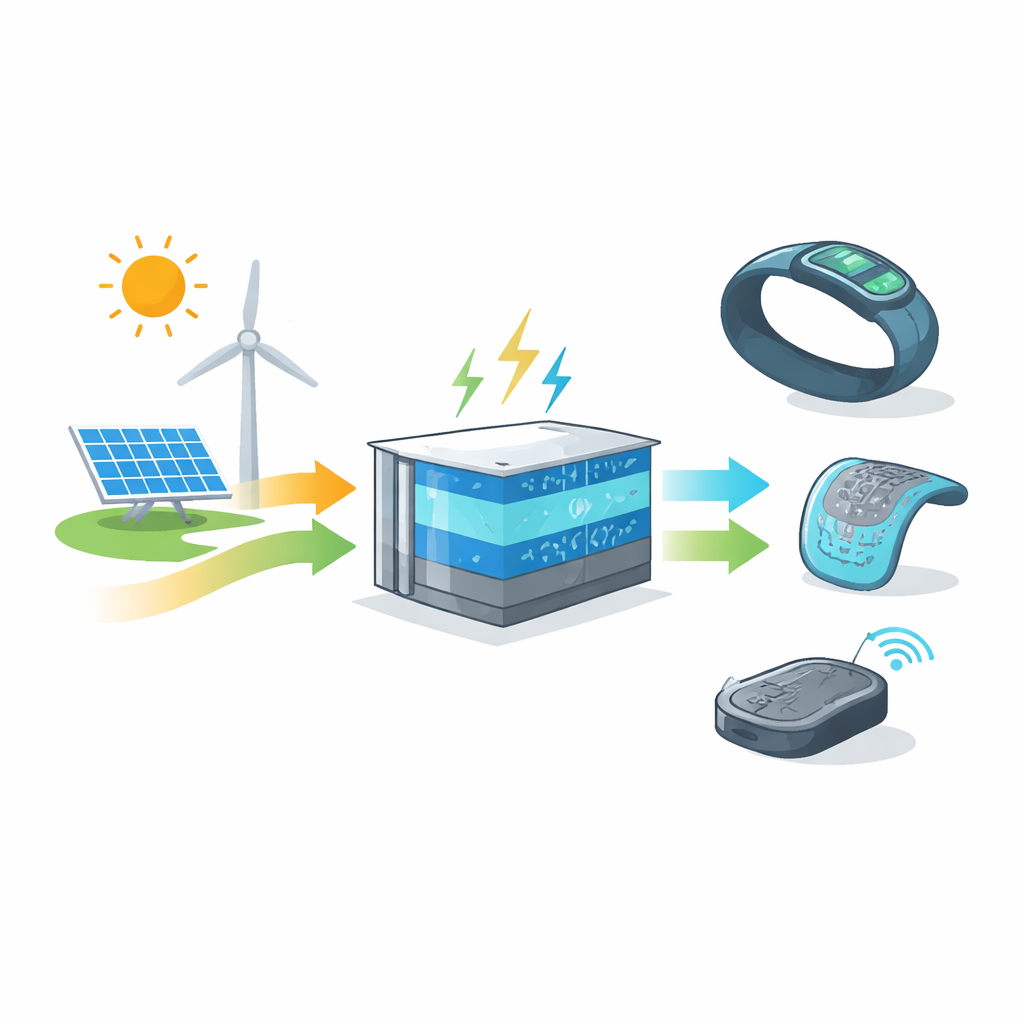
As our lives fill up with smart watches, electronic patches, and tiny sensors connected to the Internet of Things, we need small power sources that are safe, long‑lasting, and cheap. This review article looks at a rising candidate: zinc‑ion capacitors. These devices blend the fast charge–discharge of supercapacitors with the higher energy of batteries, using zinc, a common and relatively harmless metal. The authors explain how researchers are turning basic zinc‑ion capacitors into “multifunctional” versions that can bend, stretch, recharge themselves from sunlight or motion, change color as they store energy, or double as sensors.
How These Tiny Power Packs Work
Zinc‑ion capacitors store energy by shuttling charged zinc species between two solid electrodes through a liquid or gel electrolyte. One side behaves more like a classic capacitor, quickly adsorbing and releasing ions on its surface; the other acts more like a battery, where ions slip into and out of the material. This mixed design allows both high power (fast charging and discharging) and decent energy storage. The review describes two main layouts: one with a capacitor‑type positive side and zinc metal negative side, and another that swaps these roles. Each choice affects how quickly ions can move, how stable the device is over many cycles, and how much energy it can realistically store.
Shaping Power for Wearable and Mini Devices
To fit into flexible and wearable gadgets, zinc‑ion capacitors must twist, bend, and even stretch without failing. Researchers have built deformable devices using special carbon structures, two‑dimensional materials called MXenes, and soft hydrogels that hold the electrolyte. These can be woven into fibers, wrapped onto stretchable films, or arranged in coaxial shapes similar to cables. The challenge is to pack in enough active material to reach useful energy levels while keeping the devices thin and soft. At even smaller scales, “micro” zinc‑ion capacitors place interlocking positive and negative fingers on a single flat chip. This shrinks internal resistance, improves power output, and makes them good partners for tiny sensors, especially when combined with modern printing and 3D‑printing techniques.
Devices That Charge Themselves and Show Their Charge
Another branch of work aims to let zinc‑ion capacitors gather their own energy from the environment. Some versions use light‑absorbing materials so they can directly convert sunlight into stored electrical energy in a single unit, instead of linking separate solar cells and batteries. Others draw on oxygen in the air or on mechanical motion captured by triboelectric generators to refill their charge. At the same time, electrochromic zinc‑ion devices change color as ions move in and out of special coatings. These can serve as smart windows or displays that both store energy and visually reveal their state of charge through shifts in visible or infrared transparency, with designs spanning inorganic oxides and colorful organic polymers.

When Power Sources Also Sense the World
The review also covers zinc‑ion capacitors that double as sensors. By carefully choosing electrode and gel materials, the overall device can respond to pressure, stretching, temperature, or even chemical signals such as glucose levels in sweat. In some demonstrations, a single thin patch on the skin stores energy, powers its own temperature and glucose sensors, and sends data wirelessly. Other systems work in extreme cold, low‑pressure conditions similar to near‑space, proving that these devices can operate reliably in harsh environments. These integrated designs reduce the number of separate parts in a system, cutting weight and size while simplifying how wearable or remote devices are powered and monitored.
From Lab Prototypes to Real‑World Use
The authors conclude that multifunctional zinc‑ion capacitors are promising building blocks for future electronics but are not yet ready for mass deployment. Key hurdles include boosting how much energy they store per area or volume, ensuring long lifetimes under real bending and stretching, and agreeing on standard ways to measure performance so different studies can be fairly compared. Just as important are cost and environmental impact: some advanced materials require harsh chemicals or complex processing. The review argues that greener fabrication methods, better matching between materials and device designs, and scalable manufacturing will be crucial. If these issues are solved, zinc‑based capacitors that flex, sense, and even change color could become common power sources in smart wearables, sensors, and energy‑saving buildings.
Citation: Guo, P., Tang, Y., Deng, Z. et al. Multifunctional zinc-ion capacitors for energy storage. Commun Mater 7, 99 (2026). https://doi.org/10.1038/s43246-026-01152-7
Keywords: zinc-ion capacitors, flexible energy storage, self-charging devices, electrochromic windows, wearable sensors