Clear Sky Science · en
Stochastic switching time constant and instability in nanomagnets
Magnetic Dice for Future Computers
Many emerging computers will not just crunch numbers; they will harness randomness itself. Tiny magnetic devices, only billionths of a meter across, can naturally flip back and forth like microscopic dice. This paper investigates how quickly those flips can happen and why a long-standing rule of thumb about their timing is wrong—an insight that matters for faster, more reliable probabilistic and neuromorphic hardware.
Why Timing Matters in Tiny Magnets
When a reaction takes place in chemistry or a magnet flips its direction, the average waiting time is often described by an Arrhenius-type law: the higher the energy barrier, the slower the process. Hidden inside this law is a key number called the “attempt time,” which sets the basic clock speed of the random process. For decades, researchers assumed that for nanometer-scale magnets this time was about one billionth of a second. That convenient guess shaped how engineers estimated the stability of magnetic memories and the operating speed of emerging stochastic magnetic tunnel junctions, devices that use random magnetic flips as information carriers.
Measuring Random Flips Directly
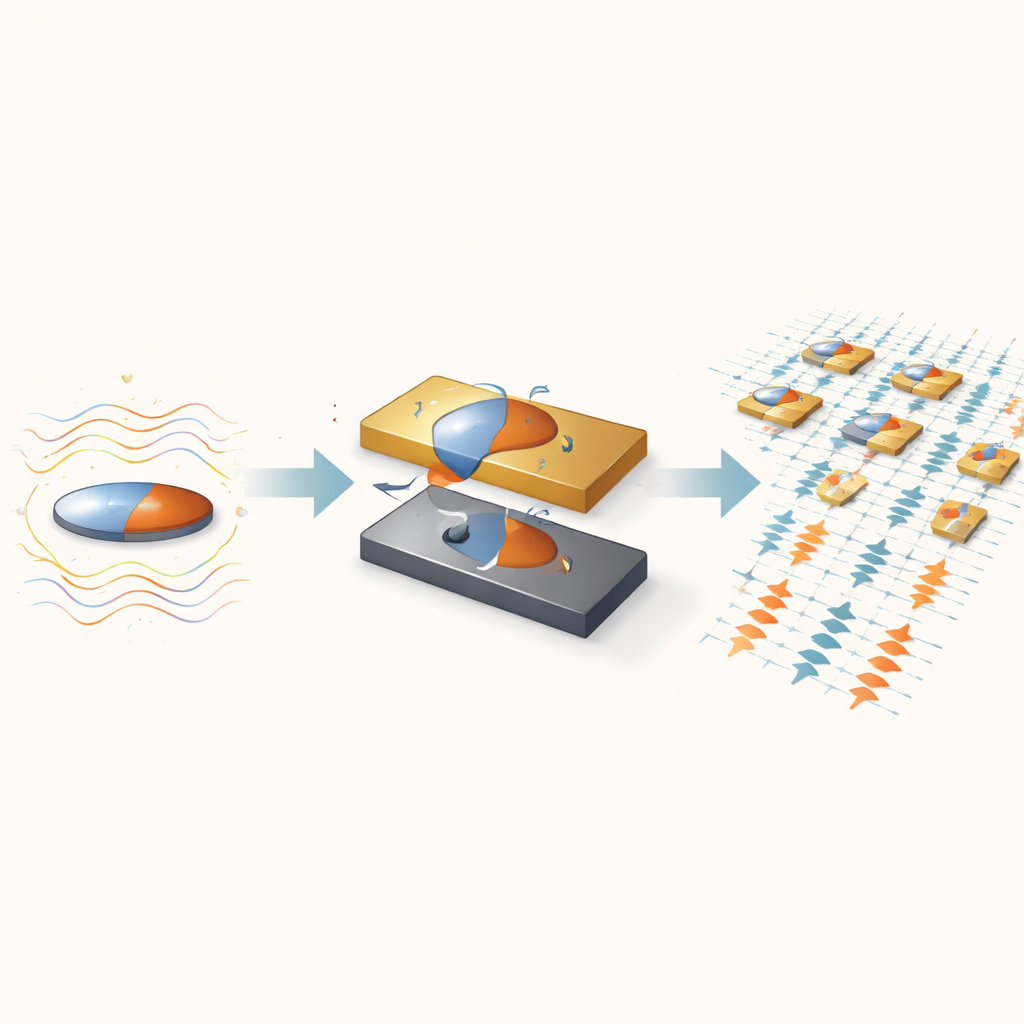
The authors build and study magnetic tunnel junctions in which a thin magnetic layer has an easy direction within the plane of the film but also feels a competing preference to tilt out of plane. By carefully adjusting the layer thickness, they tune this perpendicular tendency without changing the basic device design. An external magnetic field is then applied along a direction that is “hard” for the magnet to follow. This sideways field reshapes the energy landscape separating the two favored magnetic orientations and thus stretches or shrinks the average waiting time between flips.
Listening to Telegraph Noise
These magnets constantly jump between two resistance states, producing a noisy signal known as random telegraph noise—a series of sudden up-and-down steps in time. Using a circuit that separates fast and slow components of this signal, the team records switching events over an enormous range of timescales, from billionths of a second to several seconds, all at room temperature. By compiling statistics of the intervals between flips as the sideways field is swept, they extract how the effective energy barrier changes and, crucially, how the baseline attempt time must be chosen so that all the data collapse into a consistent Arrhenius-like trend.
A New Clock Speed and a Hidden Slowdown
The analysis overturns the traditional assumption. Instead of a fixed one-nanosecond clock, the attempt time is found to lie between roughly four and twelve nanoseconds, depending systematically on the strength of the perpendicular magnetic preference. That means real devices can be several times slower at their most fundamental level than many earlier designs assumed. To understand why, the authors go beyond simple “single-block” models of the magnet and consider collective excitations called spin waves. During a thermally driven flip, the uniform magnetic motion can become unstable and spill energy into these rippling spin waves—a process known as Suhl instability. Numerical simulations that couple the overall magnet to these internal waves show that this energy leakage significantly delays the actual reversal, matching the long attempt times seen in experiments.

Design Rules for Randomness-Based Chips
By revealing that internal magnetic ripples can slow down switching without changing the energy barrier itself, this work reframes how engineers should design nanomagnets for probabilistic computing, true random number generators, and brain-inspired circuits. The attempt time is not a fixed universal constant but a tunable quantity controlled by material choices and geometry—for example, by adjusting perpendicular anisotropy, device size, or exchange stiffness to suppress unwanted spin waves. In practical terms, the study provides both a measurement recipe and a physical roadmap for building faster, more energy-efficient stochastic magnetic tunnel junctions, ensuring that future randomness-based computers roll their microscopic dice at just the right speed.
Citation: Kanai, S., Hayakawa, K., Elyasi, M. et al. Stochastic switching time constant and instability in nanomagnets. Commun Mater 7, 112 (2026). https://doi.org/10.1038/s43246-026-01149-2
Keywords: stochastic magnetic tunnel junctions, nanomagnet switching, attempt time, spin-wave instability, probabilistic computing