Clear Sky Science · en
The ideal substrate for yttrium iron garnet films in quantum magnonics
Why tiny magnetic ripples matter
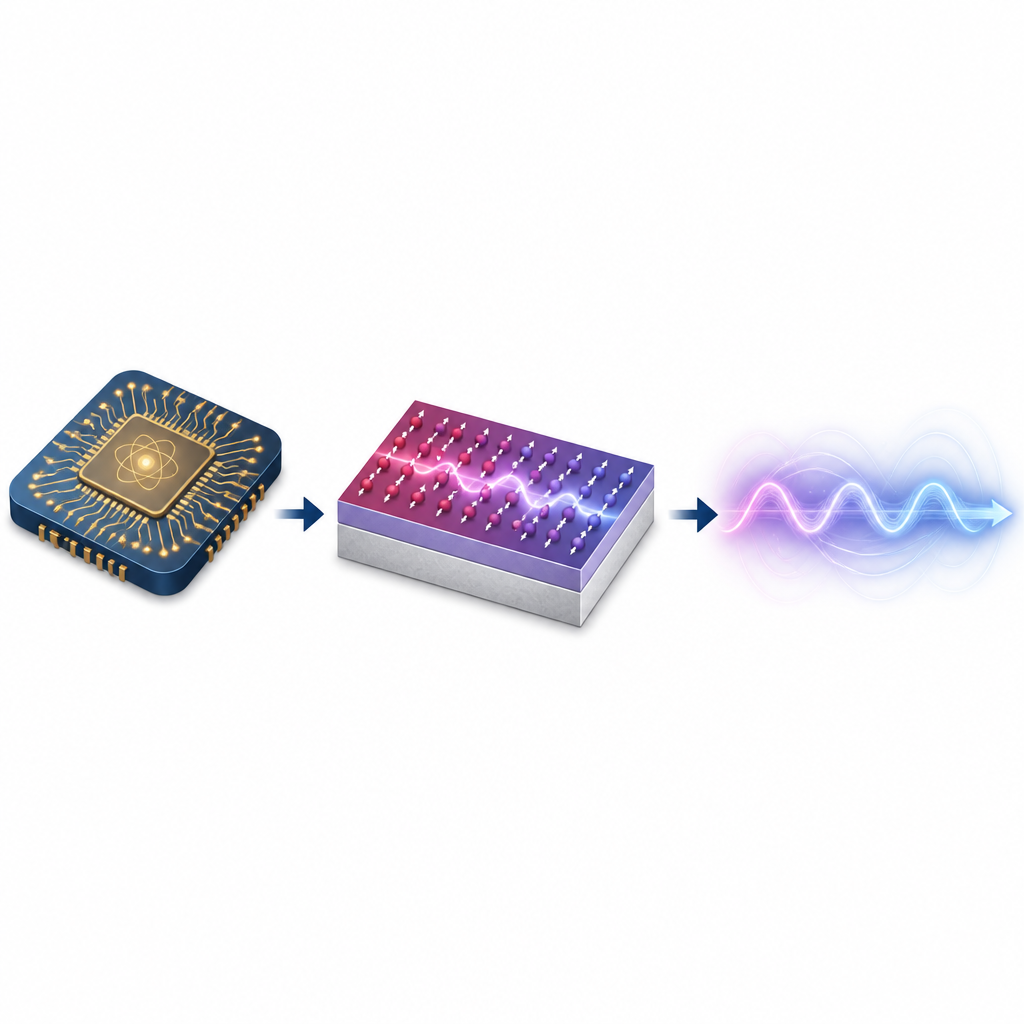
Quantum computers need fragile quantum states to survive long enough to do useful work. One promising way to carry quantum information is through magnons, tiny ripples of magnetism that can travel through a solid. This study asks a very practical question: what kind of supporting crystal should we use so these ripples can glide with as little energy loss as possible, even at the ultra-cold temperatures where quantum devices operate?
The search for a better playground
Magnons behave like waves on a pond, except the pond is a magnetic material and the waves are made of spinning electrons. For years, the workhorse material for such experiments has been a crystal called yttrium iron garnet, or YIG, grown as a thin film. YIG is famous because its magnetic ripples fade very slowly at room temperature, which is great for carrying signals. Traditionally, these films are grown on a support crystal called gadolinium gallium garnet, or GGG, whose atomic spacing matches YIG very well. That good match keeps the film smooth and low loss under everyday conditions.
The hidden problem at icy temperatures
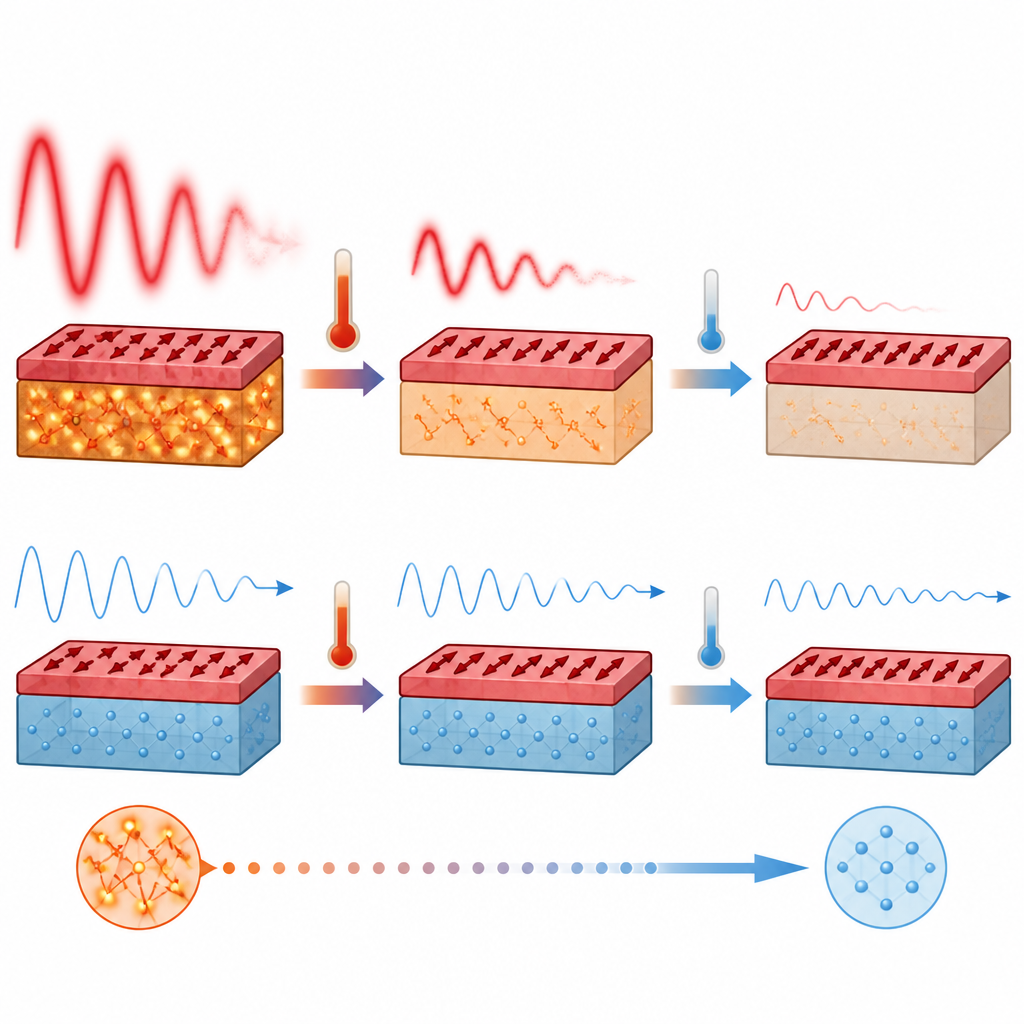
Quantum technology rarely operates at room temperature. Instead, many experiments cool devices to just a few thousandths of a degree above absolute zero. At these frigid temperatures, GGG develops its own magnetic response and becomes easily magnetized. That hidden magnetism leaks into the YIG film and creates a patchy magnetic landscape. The result is extra friction for the magnons: their signals broaden and die out faster, shortening the time over which quantum information can stay coherent. Previous work showed that this extra loss in YIG on GGG becomes severe at low temperatures, undermining its usefulness for quantum circuits.
A new quiet partner crystal
The authors explore a different support crystal, called YSGAG, that was designed to keep the same crystal structure and spacing as YIG while remaining essentially non-magnetic. Because YSGAG is diamagnetic, it does not develop a strong magnetic moment when a field is applied, even at millikelvin temperatures. The team grew very thin YIG films on this new material and, for a fair comparison, also prepared nearly identical YIG films on standard GGG. They then used a technique called ferromagnetic resonance, which measures how sharply the magnetic ripples respond across a wide range of frequencies and temperatures, from room temperature down to a few hundredths of a kelvin.
Measuring how quietly waves travel
At room temperature, both types of samples performed similarly well: the magnon waves in YIG on YSGAG and YIG on GGG both showed very low energy loss, comparable to the best films and even bulk crystals used in earlier studies. As the samples were cooled, however, their behavior diverged. In YIG on GGG, the signal peaks broadened strongly, indicating that the waves were losing energy much more quickly. In YIG on YSGAG, the broadening stayed small across nearly the entire temperature range. The researchers did see a modest bump in loss around tens of kelvin, which they attribute to tiny amounts of rare earth impurities, but at the coldest temperatures the losses fell again and stayed low.
What this means for future quantum devices
The key outcome is that YIG films grown on the new YSGAG crystal keep their low-loss behavior from room temperature all the way down to millikelvin temperatures. In simple terms, the support crystal is no longer adding magnetic noise that would sap the energy of the magnon waves. This makes YSGAG an excellent platform for building chips that route single magnons in quantum networks or connect to superconducting qubits. With further refinements to the film quality, the lifetimes of magnons in these structures could approach those seen in the best bulk samples, helping pave the way for practical magnon-based elements inside future quantum technologies.
Citation: Serha, R.O., Dubs, C., Guguschev, C. et al. The ideal substrate for yttrium iron garnet films in quantum magnonics. Commun Mater 7, 134 (2026). https://doi.org/10.1038/s43246-026-01146-5
Keywords: quantum magnonics, yttrium iron garnet, low-temperature damping, ferromagnetic resonance, diamagnetic substrates