Clear Sky Science · en
Engineering enzymatically active spider silk materials from high-yield expression to IgG-cleaving hydrogels and fibers
Spider Silk That Does More Than Just Stretch
Spider silk is famous for being light, strong, and gentle to living tissues, which makes it attractive for medical uses. This study takes the idea a step further by turning spider silk into a material that not only holds things together but also performs a useful chemical task: cutting specific antibodies. For a layperson, this means silk-like gels and fibers that could one day help doctors fine-tune the immune system or process antibody drugs more easily.
Building Smarter Protein Materials
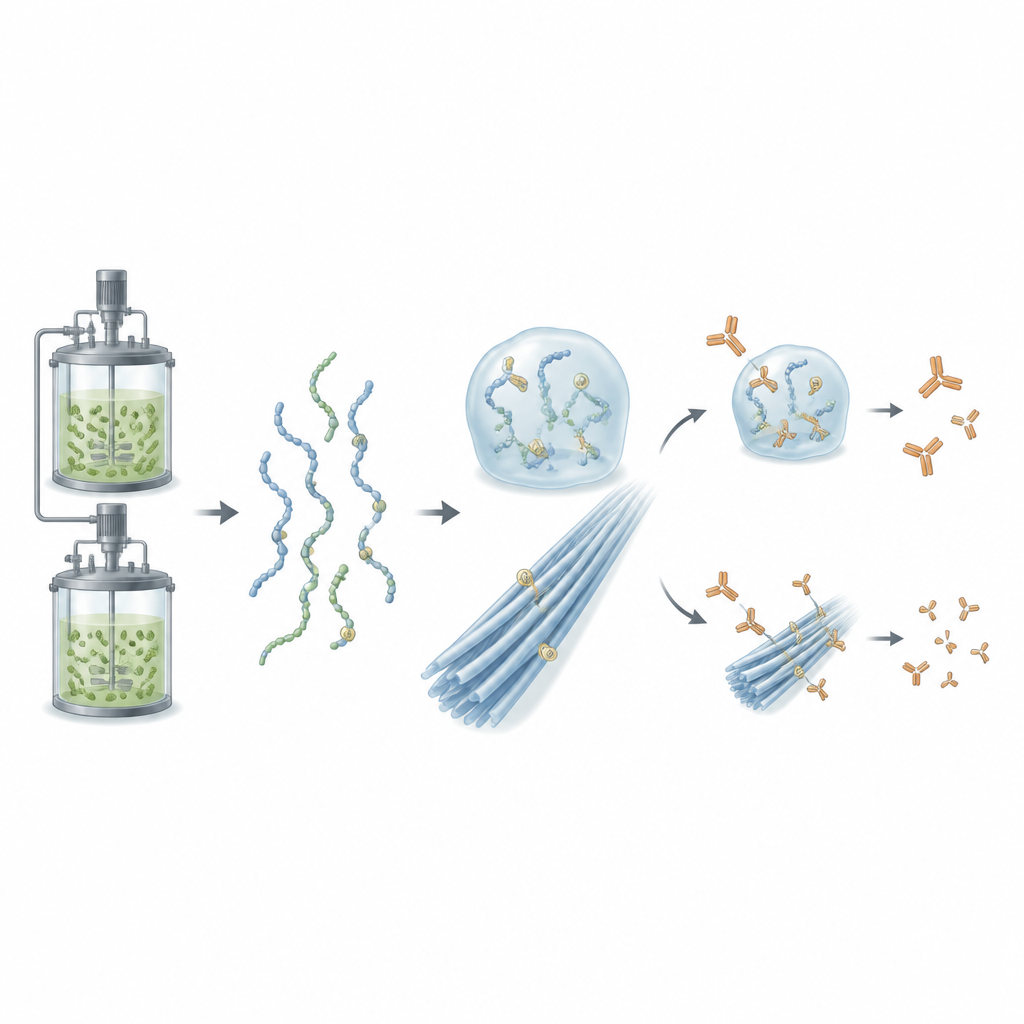
Modern biomaterials often combine two roles in one molecule: one part forms a sturdy structure and another part performs a biological job. Here, the structural part is an engineered spider silk protein that naturally assembles into gels and fibers under gentle, water-based conditions. The functional part is an enzyme from a bacterium that precisely clips a common antibody type, called IgG, into defined pieces. By fusing these two protein parts into a single chain, the researchers created a “self-immobilizing” enzyme that can lock itself into a solid silk network without harsh chemicals or extreme processing.
Mass Producing the Fusion Silk in Bacteria
For any medical or industrial use, such a designer protein must be made reliably and in large amounts. The team expressed their fusion protein in common laboratory bacteria grown in both shaking flasks and a controlled bioreactor. In the bioreactor, they reached high production levels similar to some commercial protein drugs, and the protein stayed dissolved at very high concentration in mild salt solutions. Detailed measurements showed that the enzyme portion kept its proper three-dimensional shape and worked almost as efficiently as the free enzyme, cleanly cutting human IgG antibodies into expected fragments over minutes to hours. This showed that attaching the enzyme to the silk did not cripple its performance.
Silk Gels That Keep Cutting Antibodies
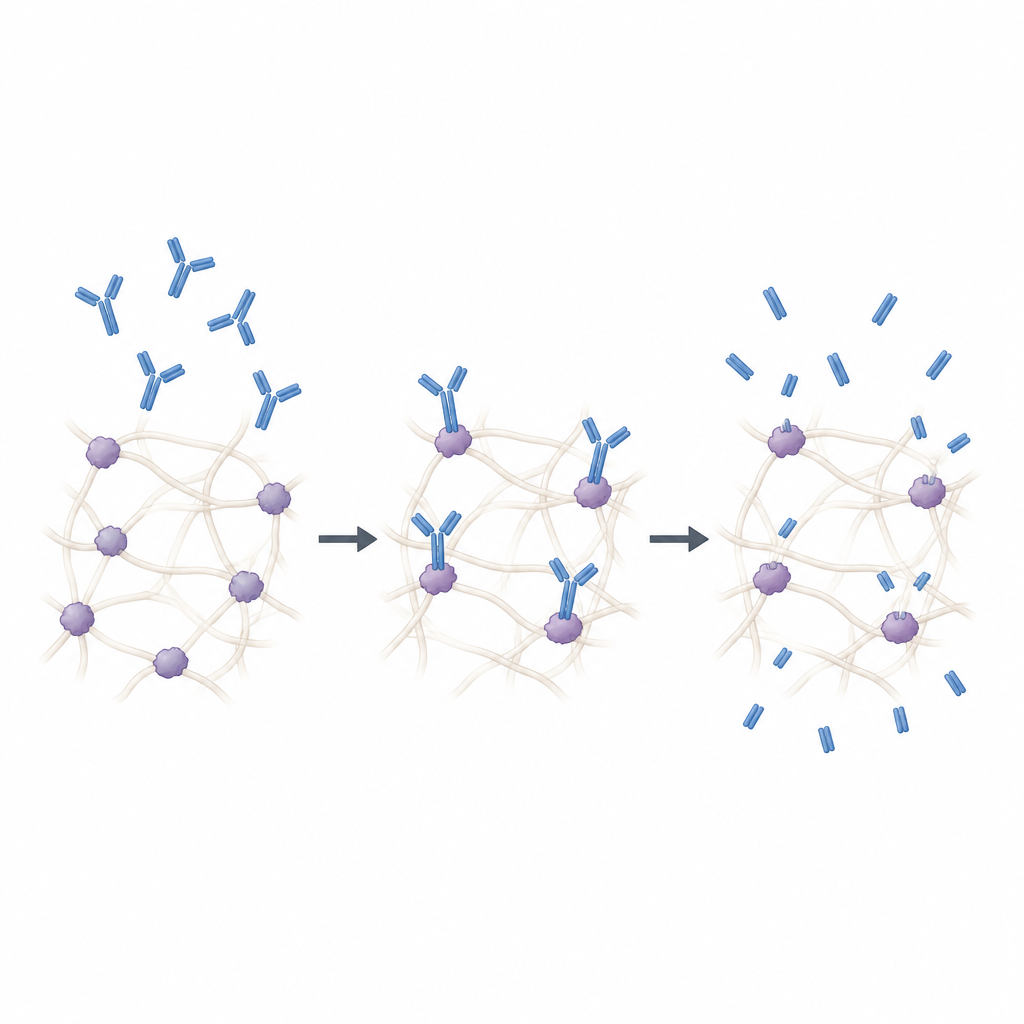
Next, the researchers tested whether the fusion protein could form stable, working hydrogels. Concentrated solutions of the fusion protein were simply warmed to body temperature in water-based buffer. Above a certain concentration, they quickly turned into soft, self-supporting gels without any added crosslinking chemicals. When these gels were washed repeatedly to remove loose protein and then exposed to human antibodies, the antibodies were gradually broken down, indicating that the enzyme trapped inside the gel was still active. Even after the gels were stored in buffer for nearly three weeks, they continued to cut antibodies, suggesting that such soft silk-based materials could serve as long-lasting, bioactive platforms.
Spider Silk Fibers with Hidden Enzymes
The team also explored a more familiar silk format: fibers. They mixed the fusion protein with plain spider silk protein and pushed the thick solution through a tiny nozzle into a mildly acidic salt bath, mimicking how spiders spin their threads. This produced continuous fibers that could be reeled in and tested. Fibers containing up to ten percent of the enzyme-bearing silk retained mechanical strength and toughness on par with earlier artificial spider silk fibers, meaning they were strong and flexible enough for practical handling. Remarkably, after being dried for a month, then soaked in salty water for two more months, the fibers still broke down antibodies, and the active enzyme largely stayed locked inside the fiber instead of leaking out.
Why This Matters for Future Medicine
In simple terms, this work shows that it is possible to weave an active enzyme directly into spider silk inspired materials and keep it working for long periods. Because the silk fusion protein can be produced at high yield in bacteria and processed into gels and fibers using only water and mild conditions, the approach is attractive for sustainable manufacturing. In the future, similar designs could lead to smart wound dressings, filters, textiles, or scaffolds that not only support or protect tissues but also gently reshape antibody activity or carry out other precise biochemical tasks inside or outside the body.
Citation: Bohn Pessatti, T., Schmuck, B., Karlsson, E. et al. Engineering enzymatically active spider silk materials from high-yield expression to IgG-cleaving hydrogels and fibers. Commun Mater 7, 133 (2026). https://doi.org/10.1038/s43246-026-01144-7
Keywords: spider silk, enzyme materials, IgG cleavage, bioactive hydrogels, protein-based fibers