Clear Sky Science · en
Continuous manipulation of the interfacial inversion symmetry in SrRuO3/SrTiO3 atomic layer superlattices
Why this tiny interface matters
Modern electronics and future spin-based technologies depend not only on what a material is made of, but also on how different materials touch each other. This study shows that by carefully controlling atomic mixing at the contact between two oxide materials, researchers can continuously tune a hidden symmetry of the system and dramatically alter its magnetic and electrical behavior. Such control could offer new ways to design low-power, information-rich devices that rely on the motion of electron spins rather than just electric charge.
Building a carefully stacked sandwich
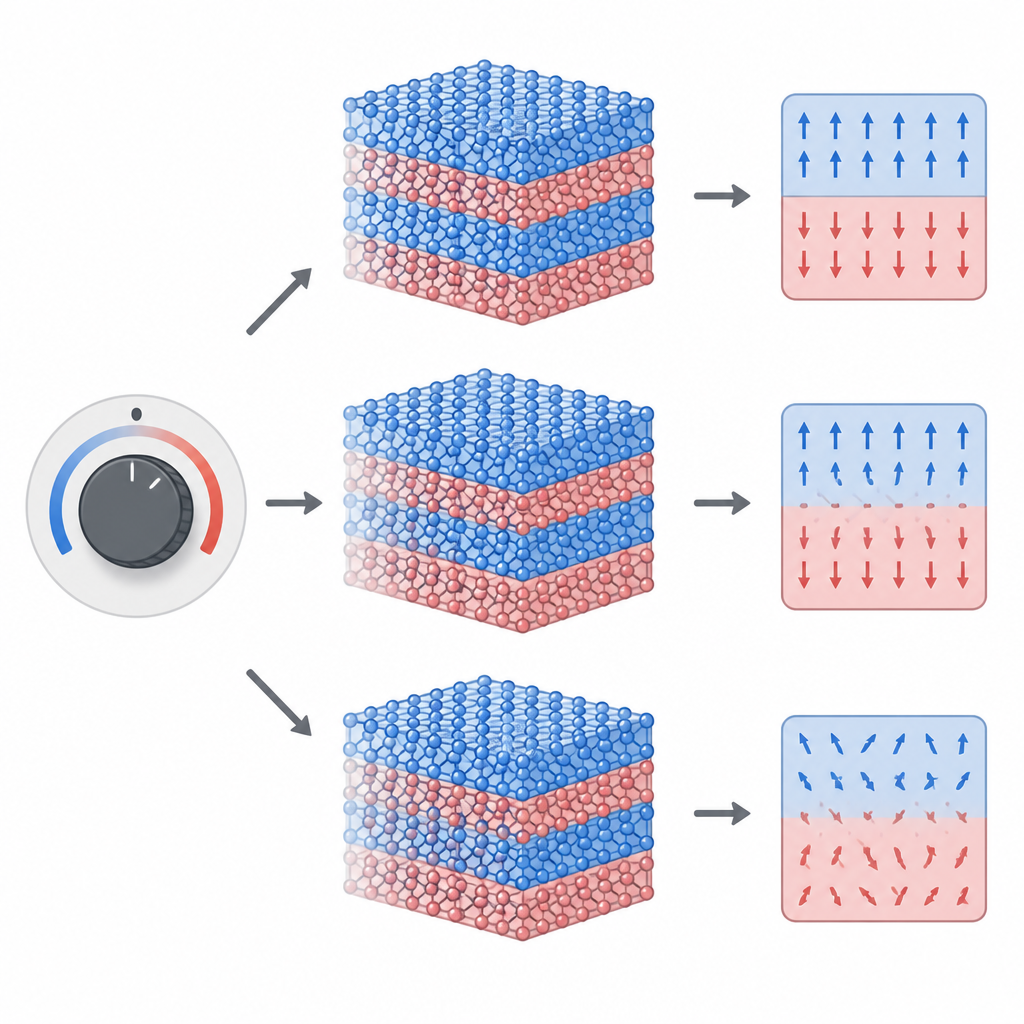
The researchers worked with a superlattice, a highly ordered “sandwich” made by stacking two oxide materials, SrRuO3 and SrTiO3, in repeating blocks only a few atoms thick. Each block contained two atomic layers of the magnetic metal oxide SrRuO3 followed by two of the nonmagnetic insulator SrTiO3. They grew many copies of this block on a SrTiO3 crystal using pulsed laser deposition, a technique where short laser bursts knock material from a target and let it settle, atom by atom, onto the surface. By varying how often the laser pulsed, they changed how long the surface could rearrange between bursts, which in turn controlled how much the atoms of ruthenium (Ru) and titanium (Ti) could exchange places across the interfaces.
Fine-tuning atomic mixing and symmetry
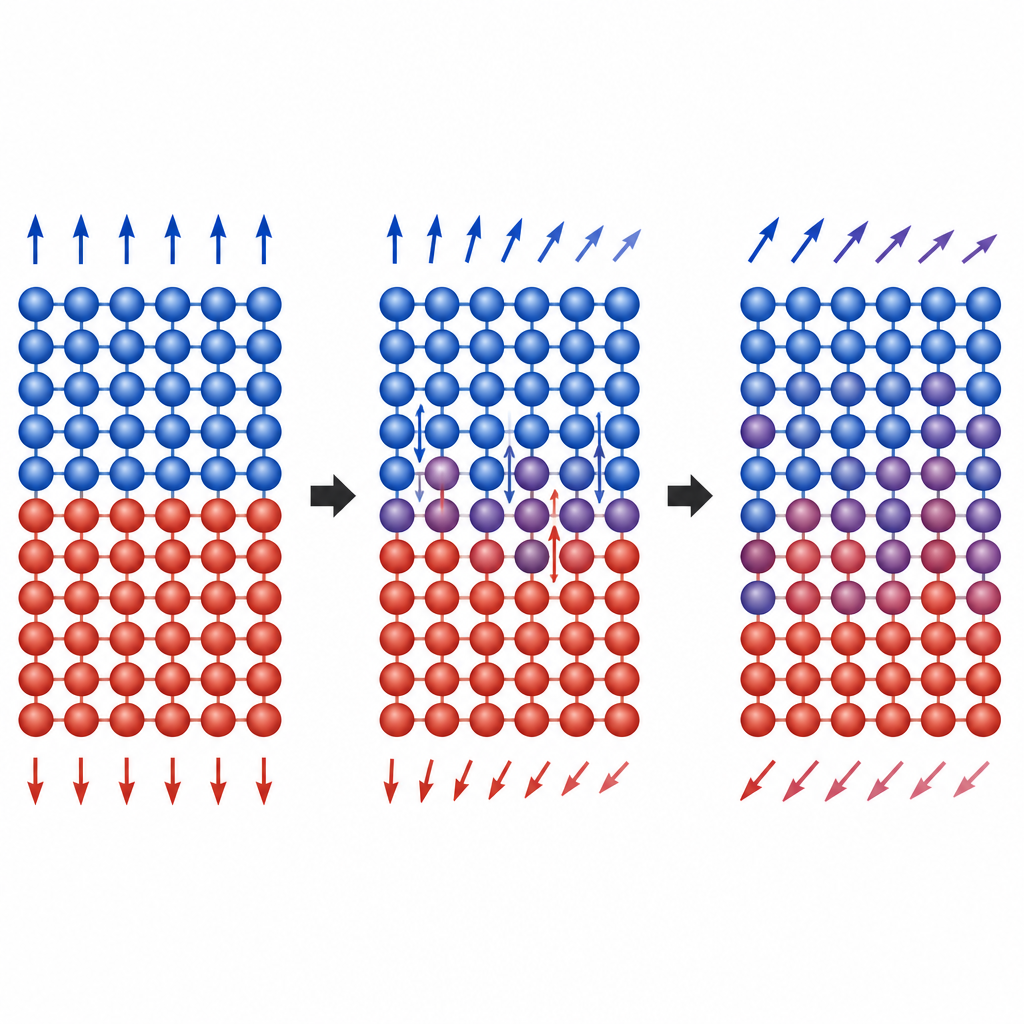
High-resolution electron microscopy combined with elemental mapping allowed the team to see where the different atoms actually sat in the superlattice. They found that at every repeating unit, the two SrRuO3 layers were not equivalent: the first Ru-containing layer always showed more Ti atoms mixed in than the second one. This imbalance meant the top and bottom interfaces within each block were no longer mirror images of each other, so inversion symmetry was broken and could be tuned by changing the laser frequency. Detailed analysis showed that lower laser frequencies, which give atoms more time to move, led to stronger Ru–Ti intermixing and therefore stronger asymmetry between the two interfaces.
From atomic structure to magnetic behavior
The next question was how this subtle structural asymmetry affected magnetism and charge transport. Measurements of electrical resistivity and magnetization as the samples were cooled showed that all superlattices remained metallic above a certain temperature but became more resistive and less strongly magnetic as the laser frequency decreased and intermixing increased. The team focused on the anomalous Hall effect, a voltage that appears when electric current and magnetization interact. This effect is sensitive to a quantity called Berry curvature, which captures how electrons “feel” the underlying symmetry of the crystal. As the interfacial mixing became more asymmetric, the anomalous Hall resistivity grew by more than a factor of fifteen, signaling a large change in the electronic landscape even though the overall composition barely changed.
Revealing hidden magnetic moments
To understand which atoms carried the magnetism in these mixed interfaces, the researchers turned to synchrotron X-ray techniques that can probe specific elements. X-ray absorption and magnetic circular dichroism measurements showed that Ti, normally nonmagnetic in SrTiO3, gained a measurable magnetic moment as more Ru–Ti mixing occurred. This suggested that the Ti atoms at or near mixed interfaces were being pulled into the magnetic network of the SrRuO3 layers. Complementary computer simulations using density functional theory backed this picture: they indicated that configurations with strong Ru–Ti mixing were energetically favored and naturally produced enhanced Ti magnetism, with Ti spins aligned opposite to neighboring Ru spins.
What it means for future devices
In everyday terms, this work demonstrates a new “knob” for tuning how electrons move and align their spins in complex oxides. Instead of requiring perfectly sharp boundaries and special three-material stacks to remove inversion symmetry, the authors show that controlled atomic mixing at two-material interfaces can achieve the same goal in a continuous, adjustable way. By dialing in how much Ru and Ti intermix at each interface, they can steadily reshape the Berry curvature and magnetic behavior without changing the base materials. This approach opens the door to designing a wider range of oxide-based components in which tiny changes at the atomic contacts give engineers precise control over spin-dependent signals.
Citation: Bao, M., Zhu, H., Zhou, R. et al. Continuous manipulation of the interfacial inversion symmetry in SrRuO3/SrTiO3 atomic layer superlattices. Commun Mater 7, 139 (2026). https://doi.org/10.1038/s43246-026-01141-w
Keywords: oxide interfaces, superlattices, anomalous Hall effect, spintronics, Berry curvature