Clear Sky Science · en
A design strategy to significantly improve the lifetime of sustainable supercapacitors
Why greener power storage matters
From fitness trackers to environmental sensors, a growing number of small electronic devices need quick bursts of power without leaving behind toxic waste. This study explores a new way to build long-lasting, repairable "supercapacitors" using ingredients related to food and natural materials instead of harsh chemicals, pointing toward electronics that can work for months and then safely fade away.
Building a power device from everyday materials
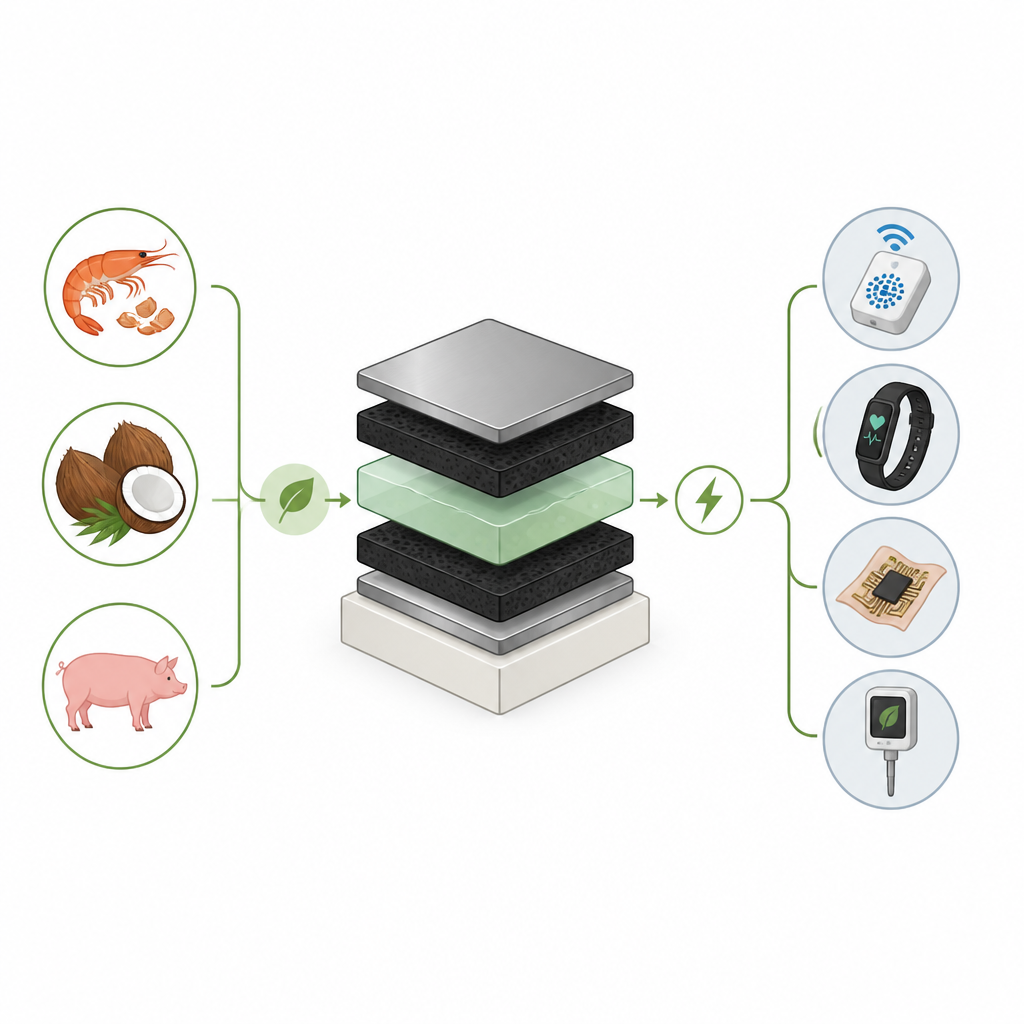
The researchers designed a layered energy storage device using only widely available, low-impact components. The current-carrying backbone is a plastic sheet with thin copper and graphite layers. On top of this they placed a porous carbon electrode made from coconut shells, held together with chitosan, a substance obtained from shrimp shells that acts like a natural glue. Between two identical carbon layers they added a soft gel made from gelatin, glycerol, and sodium acetate, all familiar from food and pharmaceutical uses. This gel lets charged particles move while keeping everything solid and leak-free.
Letting the device rest to work better
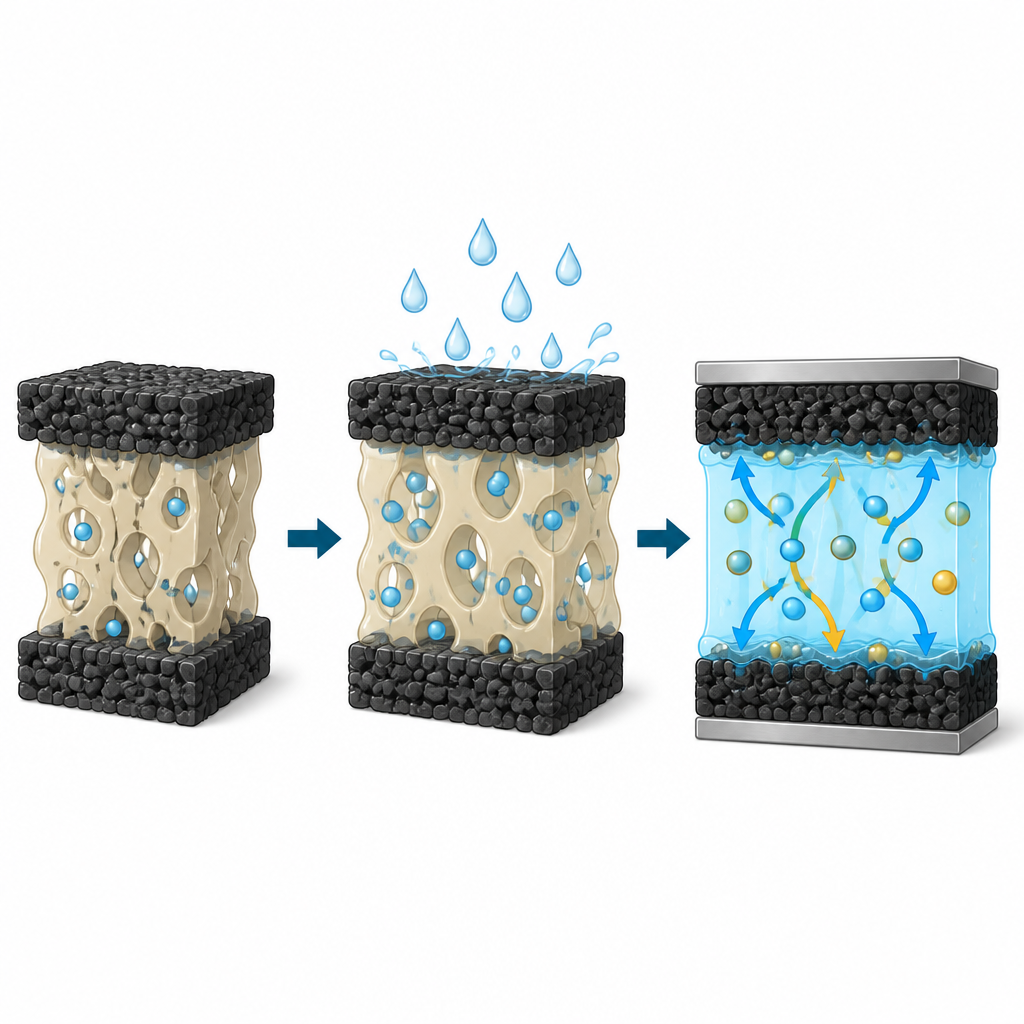
A key idea in the study is surprisingly simple: do not rush the assembly. After making the carbon electrodes, the team let them rest in normal room air for a week, then briefly re-soaked them in water before adding the gel and closing the device. During this pause, the natural binder in the electrode slowly relaxes and dries in a controlled way. When it is later rehydrated, its internal structure opens up and becomes more welcoming to the gel and the moving ions it carries. This "rehydrated delayed-assembly" step is purely physical, needs no extra chemicals, and was tested against devices that were assembled immediately without resting.
Sharper performance from a gentle tweak
Measurements showed that this simple timing change has a large impact. Devices built with the resting-and-rehydration step had about 70 percent lower internal resistance than freshly assembled ones, meaning less energy lost as heat and quicker charge and discharge. Their ability to store charge per unit mass rose by about 40 percent, and the energy they could deliver increased by roughly 45 percent, while still providing very high power output for short bursts. Careful tests using voltage sweeps, constant current charging, and frequency-based probing all pointed to the same picture: ions can reach more of the carbon surface, move more easily through the gel, and encounter fewer bottlenecks at the interfaces.
Self-healing and long life without harsh chemistry
Beyond raw performance, the rested devices showed remarkable stamina and a kind of built-in self-repair. When cycled hundreds of thousands of times, they kept about 95 percent of their original charge storage ability after around 550,000 cycles, a figure that places them among the most durable eco-friendly supercapacitors reported so far. Pausing the cycling and letting the device sit allowed some of the lost performance to return on its own. The authors link this recovery to reversible hydrogen bonds inside the gelatin-based gel, which can break and reform, and to slow rearrangement of the natural polymers and water inside the structure. Eventually the gel dries out too much and performance drops for good, but at that point the remaining materials are either biodegradable or inert.
What this means for future green gadgets
To a non-specialist, the message is that careful handling of time and moisture can turn simple, safe ingredients into a powerful and enduring energy component. By combining coconut-derived carbon, shell- and skin-based biopolymers, and a mild salt solution, then letting the electrodes rest and be gently rehydrated, the team created a supercapacitor that stores substantial energy, delivers quick power bursts, heals part of its own wear, and eventually breaks down with low environmental impact. This design strategy could help future wearables, sensors, and other small devices rely on power sources that are not only efficient, but also kinder to the planet.
Citation: Landi, G., Barone, C., La Notte, L. et al. A design strategy to significantly improve the lifetime of sustainable supercapacitors. Commun Mater 7, 127 (2026). https://doi.org/10.1038/s43246-026-01140-x
Keywords: eco-friendly supercapacitor, hydrogel electrolyte, self-healing energy storage, biopolymer electronics, sustainable IoT power