Clear Sky Science · en
Opposite pressure effects on magnetic phase transitions in NiBr2
Why squeezing crystals can change magnetism
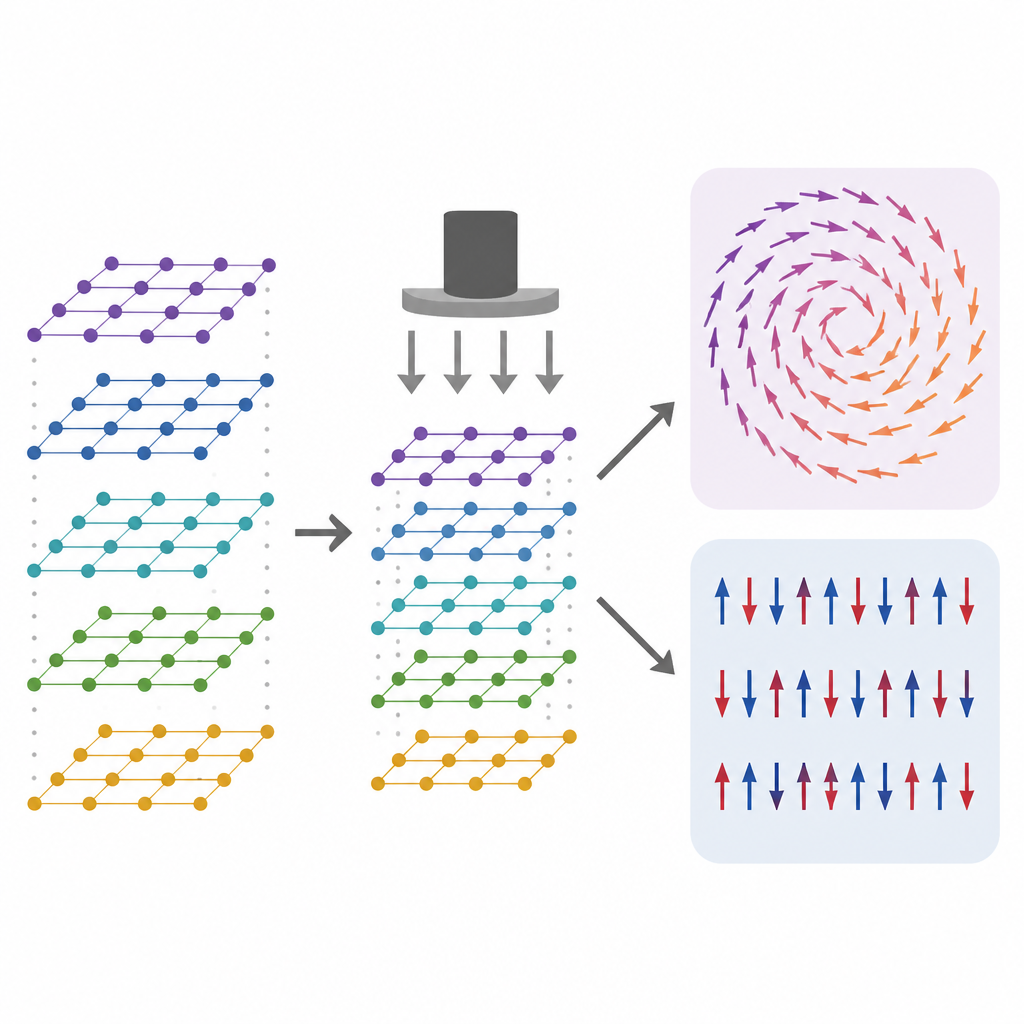
Many modern technologies, from data storage to future spin based electronics, rely on how tiny magnetic moments inside crystals line up. This study looks at a layered material called nickel bromide, NiBr₂, and asks a simple question with a surprising answer: what happens to its magnetism when you squeeze it? By turning pressure into a clean, controllable "knob," the researchers uncover how delicate magnetic patterns can flip from one form to another in an unexpectedly asymmetric way.
A tale of two magnetic patterns
At low temperatures, NiBr₂ hosts two different kinds of magnetic order. At higher low temperatures, its atomic magnets arrange in a straight, back and forth pattern called antiferromagnetic order, where neighboring spins point in opposite directions. When cooled further, they instead twist into a helix like pattern, forming a spiral wave of spins that also gives the crystal an electric polarization and makes it multiferroic. Earlier work on its chemical cousin nickel iodide, NiI₂, showed that pressure strengthens both of these ordered states, pushing their transition temperatures much higher.
Opposite responses under pressure
Using precise AC magnetic susceptibility measurements, the team tracked how the two magnetic transitions in NiBr₂ shift as they applied hydrostatic pressure up to 3 gigapascals. They found that the temperature at which the straight antiferromagnetic pattern appears rises dramatically, from about 44 kelvin at ambient pressure to nearly 100 kelvin, with an unusually steep growth rate and no sign of leveling off. In sharp contrast, the lower temperature helical state is fragile. Its transition temperature drops quickly with pressure and the helical pattern disappears entirely above about 0.8 gigapascal, much earlier than simple expectations or prior estimates had suggested.
Peering inside with computer models
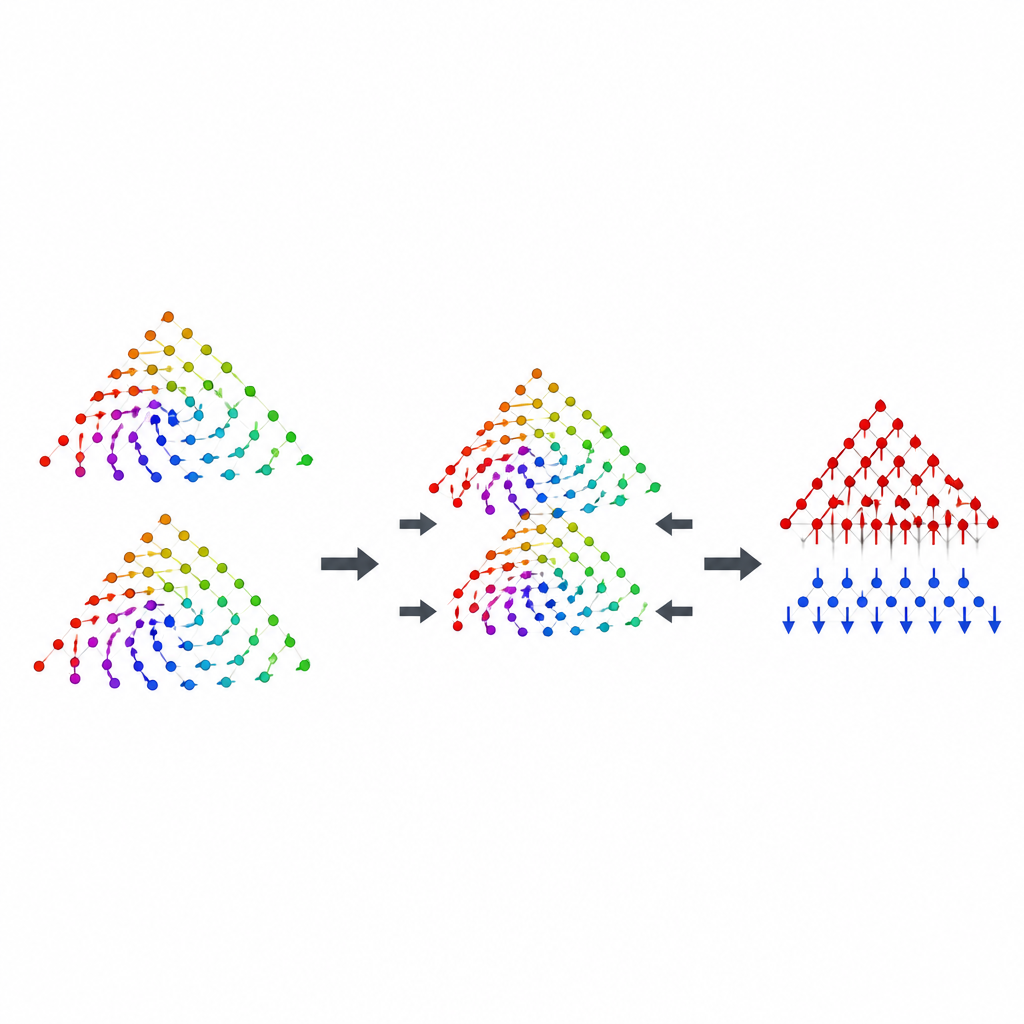
To explain why pressure helps one magnetic pattern while erasing the other, the authors turned to detailed computer simulations based on quantum mechanical calculations. They constructed a spin model that includes how nickel atoms interact within a layer and between layers in the stacked crystal. By adjusting these interaction strengths according to pressure, they simulated how spins prefer to arrange themselves. At ambient pressure, the model reproduces a spiral like ground state, while at higher pressure it switches to layers that are magnetically uniform inside but alternate between pointing up and down from layer to layer, giving an overall antiferromagnetic state with no net magnetization.
The hidden power of between layer links
The key insight from the calculations is that small changes in the couplings between layers control which magnetic pattern wins. In NiBr₂, a particular second neighbor interaction that links atoms across the van der Waals gap between layers grows strongly with pressure and stabilizes the straight antiferromagnetic stacking. At the same time, the balance of interactions within each triangular layer leaves the helical state only marginally favored at low pressure, so it can be overturned by relatively modest squeezing. In NiI₂, by contrast, the in plane couplings favor the helical pattern much more strongly, so pressure can boost both the helical and collinear orders over a wider range.
What this means for future magnetic devices
In simple terms, the study shows that pressing on NiBr₂ sharply raises the temperature where its simple antiferromagnetic state appears, while quickly snuffing out the more delicate spiral state that gives it multiferroic behavior. This opposite response of two related magnetic phases, driven mainly by how layers talk to each other across tiny gaps, sets NiBr₂ apart from similar materials. Understanding and modeling this sensitivity provides a roadmap for engineering layered magnets whose properties can be tuned by pressure, strain, or stacking, which could one day help design new low power electronic and spintronic components.
Citation: Qureshi, P.A., Pokhrel, K.K., Prchal, J. et al. Opposite pressure effects on magnetic phase transitions in NiBr2. Commun Mater 7, 128 (2026). https://doi.org/10.1038/s43246-026-01138-5
Keywords: NiBr2, magnetic phases, pressure tuning, van der Waals magnets, helimagnetism