Clear Sky Science · en
Small-scale water energy harvesting for sustainably-powered distributed electronics
Power from Everyday Water
From a light drizzle on your umbrella to waves lapping at a harbor wall, small movements of water are constantly happening around us. This review article explores how those gentle motions, temperature differences, and even air humidity can be turned into tiny trickles of electricity. That power is not meant to run cities, but to feed the growing world of low-power electronics—sensors, wearables, and smart devices that could work for years without batteries.
Why Tiny Water Power Matters
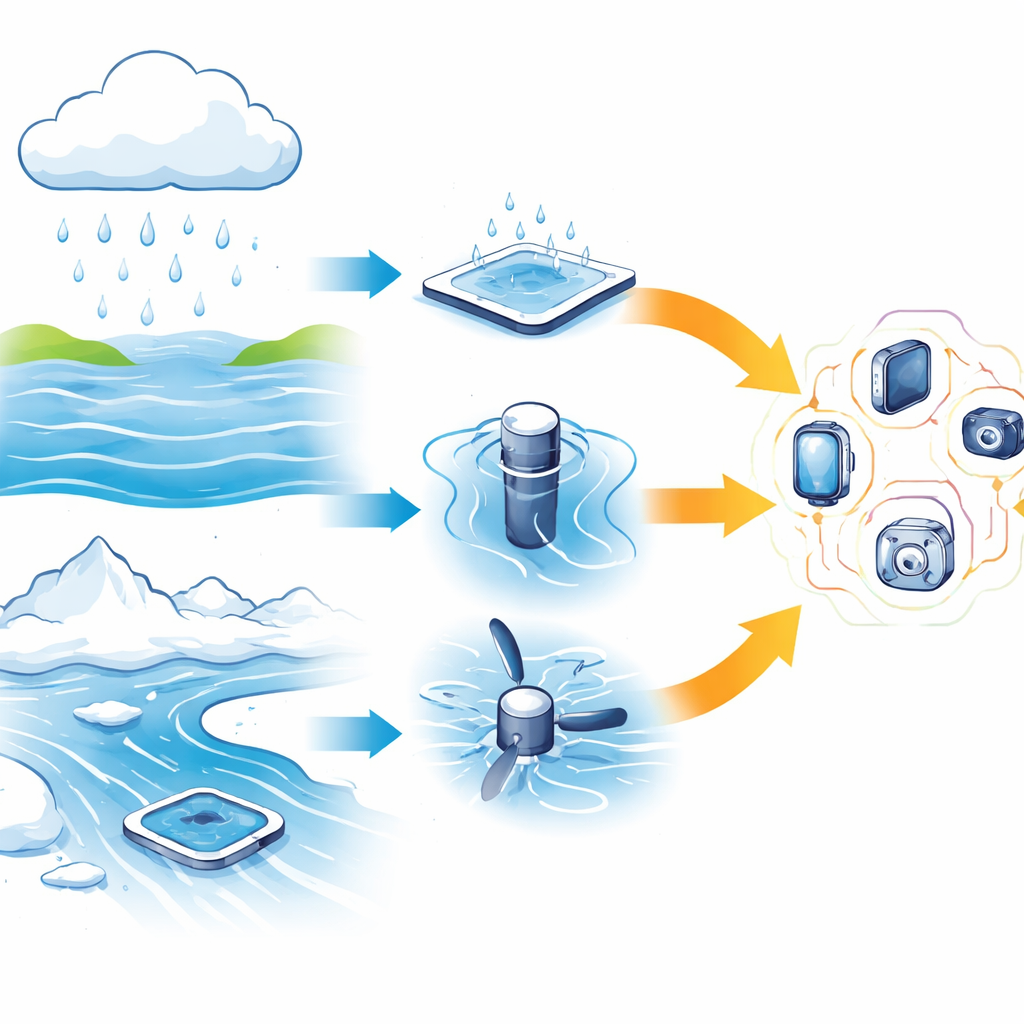
Modern life is quietly filling up with electronics: environmental monitors in rivers and fields, medical patches on the skin, and networked sensors scattered through buildings and cities. Supplying all of them with wired electricity or replaceable batteries is costly and often impractical. The article explains how small-scale water energy harvesting offers an attractive alternative. Instead of giant dams, it focuses on hand-sized components that tap into local water in many forms—humid air, fog, rain, tap water, waves, and even snow. These harvesters sit close to where devices are used, cutting transmission losses and enabling power in remote or hard-to-reach places.
Many Faces of Water, Many Ways to Harvest
The authors organize the field by the form of water and the physical effect used to get electricity out of it. Gaseous water—humidity and steam—can drive devices that rely on moisture absorption, capillary flow in tiny channels, and temperature differences. Liquid water in pipes, rivers, or raindrops can push small turbines for electromagnetic generators, bend piezoelectric films that turn strain into charge, or repeatedly touch and release special surfaces to build up static electricity. Ice and snow can serve as the cold side in temperature-gradient systems or as moving solid particles that strike and rub against tailored materials. Across these approaches, a key theme is taking advantage of interfaces—where water meets a solid surface—to separate charge and guide it in a useful direction.
How the Conversions Work Inside
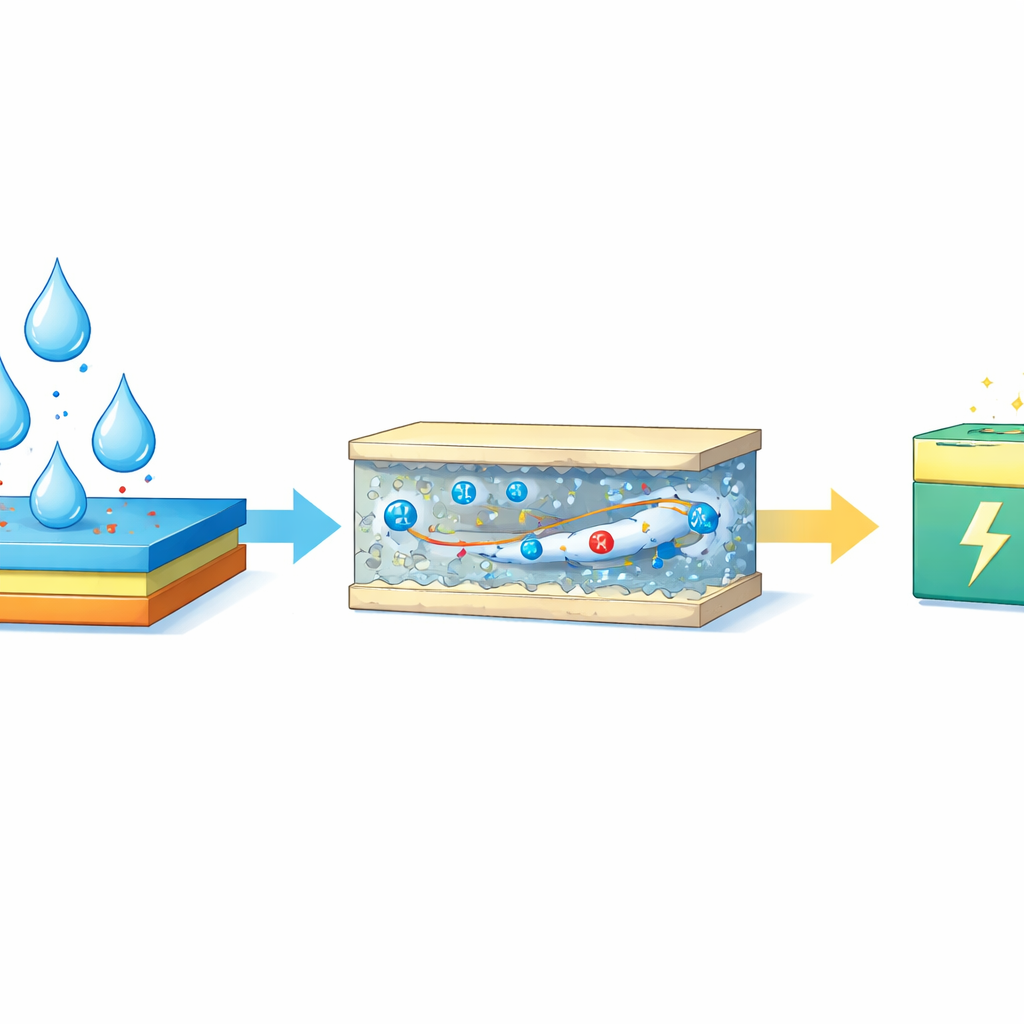
Several main conversion tricks appear again and again. Moisture-enabled generators use absorbent films or hydrogels that soak up water from the air; this activates ions that drift along built-in gradients, producing a steady direct current. Steam and other hot–cold differences feed thermoelectric and thermo-osmotic devices, where ions or electrons move from warm regions to cool ones, creating a voltage. In liquid flows, rotating magnets and coils follow the same rules as big power plants but at centimeter scale. A particularly active line of work uses triboelectric nanogenerators: when water drops or waves contact and then leave a treated surface, electrons jump across the interface and an electric double layer forms in the fluid. Clever layering, shaping, and motion control can turn these fleeting events into sizable pulses of power.
From Lab Demos to Real Uses
Beyond explaining mechanisms, the review surveys many recent prototypes that show what these ideas can do. Moisture-based films and hydrogels have powered arrays that light street lamps, drive smart windows, and even charge phones using ambient humidity alone. Flow and wave devices have been built into pipes, rivers, and near-shore buoys to turn tap water, irrigation streams, or waves into electricity for wireless sensors. Droplet harvesters built into roofs, umbrellas, and panels capture energy from rainstorms while also enabling monitoring of rainfall and flow. Other designs act as self-powered sensors: the same signals that indicate harvested power also reveal humidity level, water level in a ship, liquid speed in a pipe, or even the chemical makeup of a fluid. Some systems are already being tailored for wearable and biomedical contexts, such as face masks that power and record breathing, or smart toilets that read health information from urine without external power.
Challenges on the Road Ahead
While performance has improved quickly, the authors point out that most devices are still at the prototype stage. Many moisture and water-contact materials degrade under cycles of wetting, drying, salt buildup, or abrasion. Outputs are often low-frequency, pulsed, and highly dependent on weather or use patterns, which does not match well with electronics that prefer steady power. Scaling up production from carefully crafted lab samples to robust, low-cost products is another hurdle. The authors call for better materials that are durable, self-healing, and biocompatible; smarter circuits that can smooth and store irregular energy; and standardized testing so that different designs can be fairly compared.
What It All Adds Up To
In simple terms, this article concludes that drops, mist, waves, and snow can become practical fuel for the small electronics around us. No single method will dominate: instead, combinations of moisture, motion, and heat harvesting—paired with tiny storage and efficient power management—are likely to support networks of sensors and wearables that run themselves. If the remaining challenges in materials stability, system integration, and large-scale manufacturing can be solved, small-scale water energy harvesters could quietly provide long-lived, low-maintenance power wherever water and air naturally move.
Citation: Zhou, J., Kim, E., Liu, Y. et al. Small-scale water energy harvesting for sustainably-powered distributed electronics. Commun Mater 7, 98 (2026). https://doi.org/10.1038/s43246-026-01137-6
Keywords: small-scale water energy harvesting, triboelectric nanogenerators, moisture electricity, self-powered sensors, wearable energy harvesting