Clear Sky Science · en
Self-assembled flower like superstructures of highly emitting InP/ZnSe/ZnS quantum dots
Glowing building blocks for future light tech
Imagine tiny specks so small that thousands could fit across a human hair, yet bright enough to paint devices with pure color. This study shows how such specks, called quantum dots, can organize themselves into intricate flower like clusters that shine strongly in yellow. Because these particles avoid toxic heavy metals, they could help make safer screens, sensors and light based technologies in the near future.
Tiny dots that behave like molecules and materials
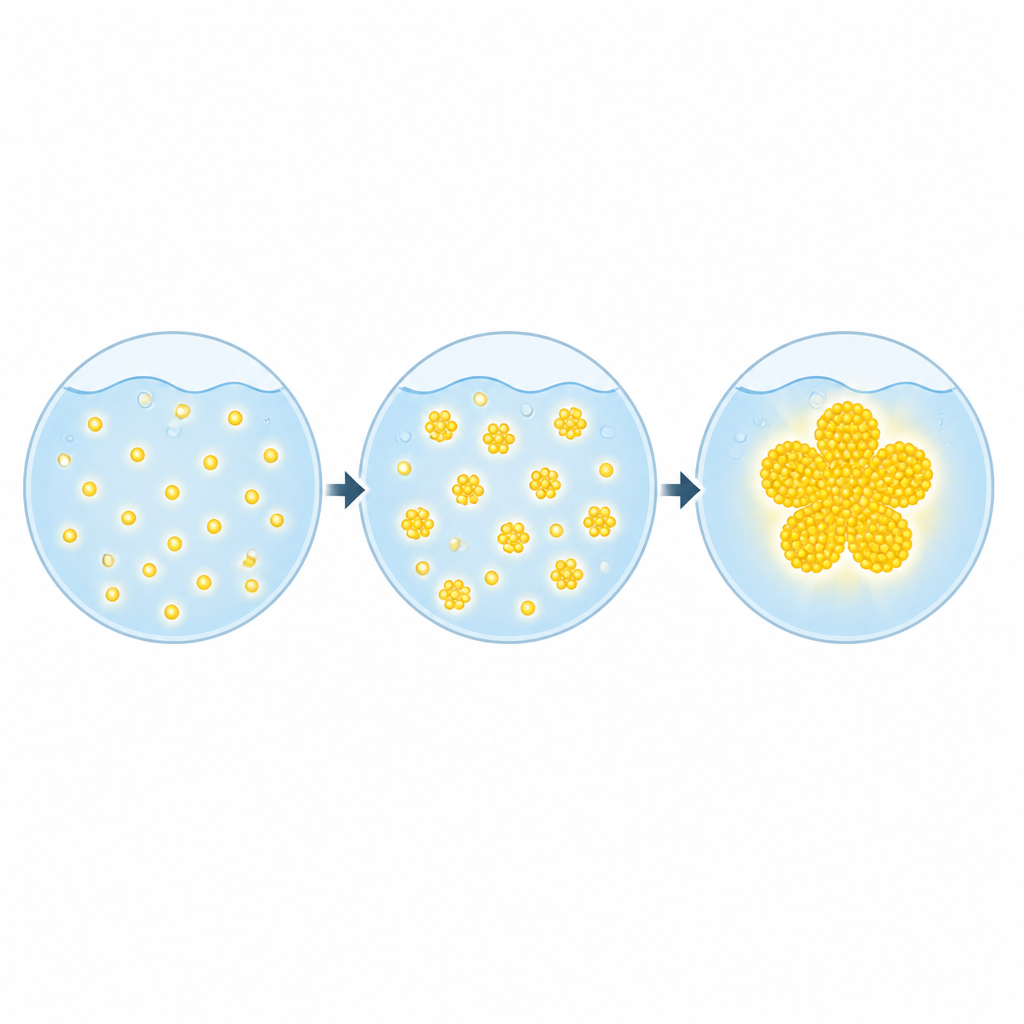
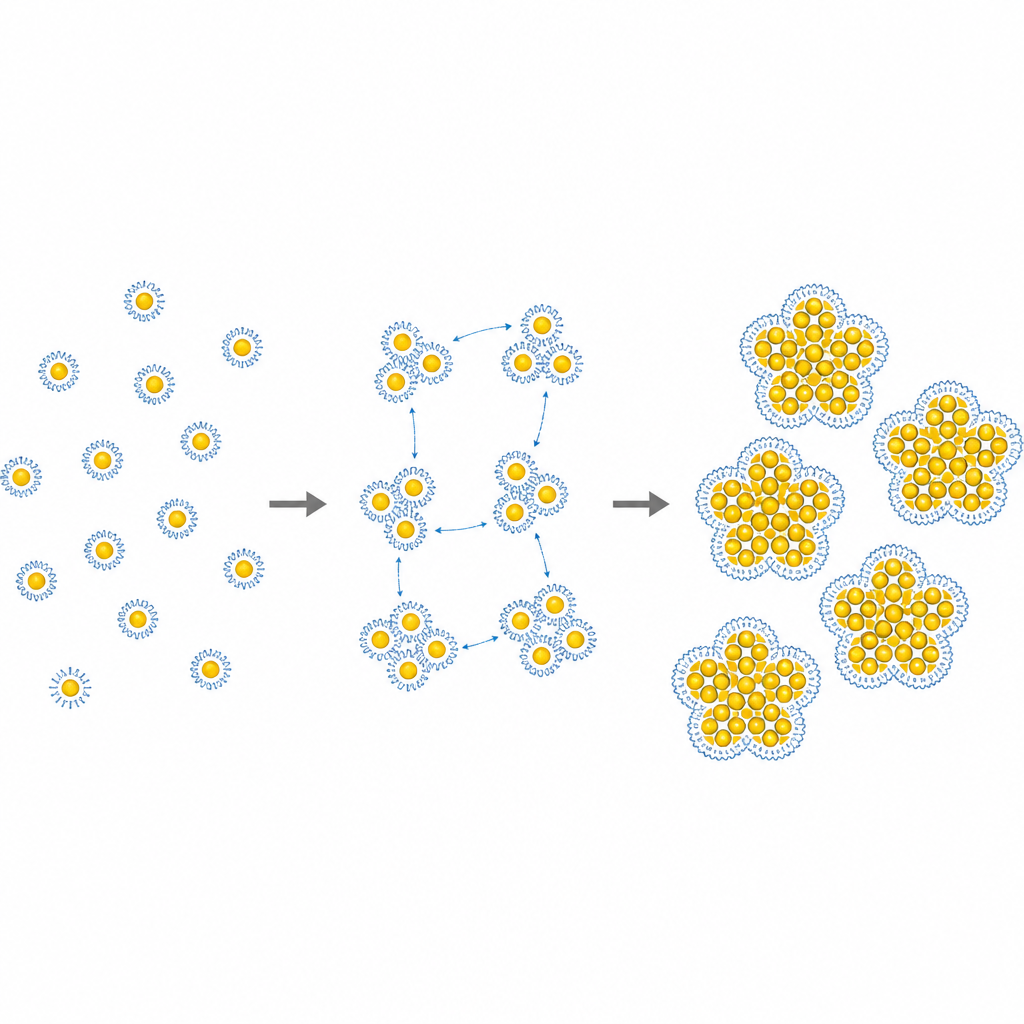
Quantum dots are nanometer sized crystals whose color is set by their size and composition. Here, the team works with indium phosphide based dots wrapped in shells of zinc selenide and zinc sulfide. Unlike many earlier assemblies of nanoparticles, which often lost brightness when packed together, these new structures keep and even enhance their light emission. The dots do not just sit side by side; they come together into three dimensional, flower like superstructures where each petal is made of dozens of individual particles arranged in an orderly fashion.
Guiding self assembly with surface chemistry
A key challenge in designing such superstructures is controlling how strongly dots attract or repel each other while preserving their glow. The researchers achieved this balance using a one pot recipe in a single reaction flask. They combined an indium source, a phosphorus source, zinc salts and organic molecules that cling to the surface of the dots. One ligand, tri octyl phosphine, turned out to be crucial. By binding more strongly than the usual oily amine molecules, it set the spacing between dots and encouraged them to link together into stable, flower like clusters without fusing into a dull lump. Measurements in liquid and dried samples confirmed that these assemblies form in solution, not as an artifact of imaging.
From dim seeds to ultra bright yellow emitters
The scientists then grew protective shells around the indium phosphide cores without breaking the superstructures. First a zinc selenide layer, then a thicker zinc sulfide layer were added, step by step, in the same pot. Each shell thickening changed the color slightly and sharpened the emission, while steadily increasing the fraction of absorbed light that reappeared as yellow glow. The quantum yield climbed from just over one percent for bare cores to an impressive 87 percent after three hours of outer shell growth. Light decay measurements showed that unwanted non radiative pathways, where energy is lost as heat, were strongly suppressed as the shells thickened.
Peering into the rules behind the glow
To understand why the combination of ligands and shells worked so well, the team used high resolution electron microscopy together with computer simulations based on quantum mechanics. Images revealed that the dots inside each flower share a common crystal orientation, forming a so called mesocrystal with narrow gaps that still separate neighboring dots. Theoretical calculations showed that when tri octyl phosphine sits on the dot surface, it removes electronic trap states in the energy gap that would otherwise quench light. For the full core shell structure, the calculations confirmed that both shell growth and ligand coverage reduce mid gap states and improve the chances that excited electrons recombine by emitting light rather than disappearing into defects.
Stable, non toxic clusters for many uses
Beyond their brightness, these yellow emitting superstructures proved remarkably robust. After a year stored at low temperature, their color barely shifted and their cluster shape remained intact, with only a modest drop in efficiency. Because the dots are free of heavy metals such as cadmium and can be tuned in size and composition, they form a flexible platform for building new light based materials. For a layperson, the takeaway is that researchers have learned how to persuade safer quantum dots to self arrange into stable, flower like clusters that emit strong, clean yellow light, paving the way for future displays, sensors and catalytic systems built from these nano sized building blocks.
Citation: Mahato, B., Das, P.K., Mishra, S. et al. Self-assembled flower like superstructures of highly emitting InP/ZnSe/ZnS quantum dots. Commun Mater 7, 126 (2026). https://doi.org/10.1038/s43246-026-01136-7
Keywords: quantum dots, indium phosphide, nanostructures, photoluminescence, self assembly