Clear Sky Science · en
Origin of pressure-induced anomalies in the nodal-line ferrimagnet Mn3Si2Te6
Why squeezing a crystal matters
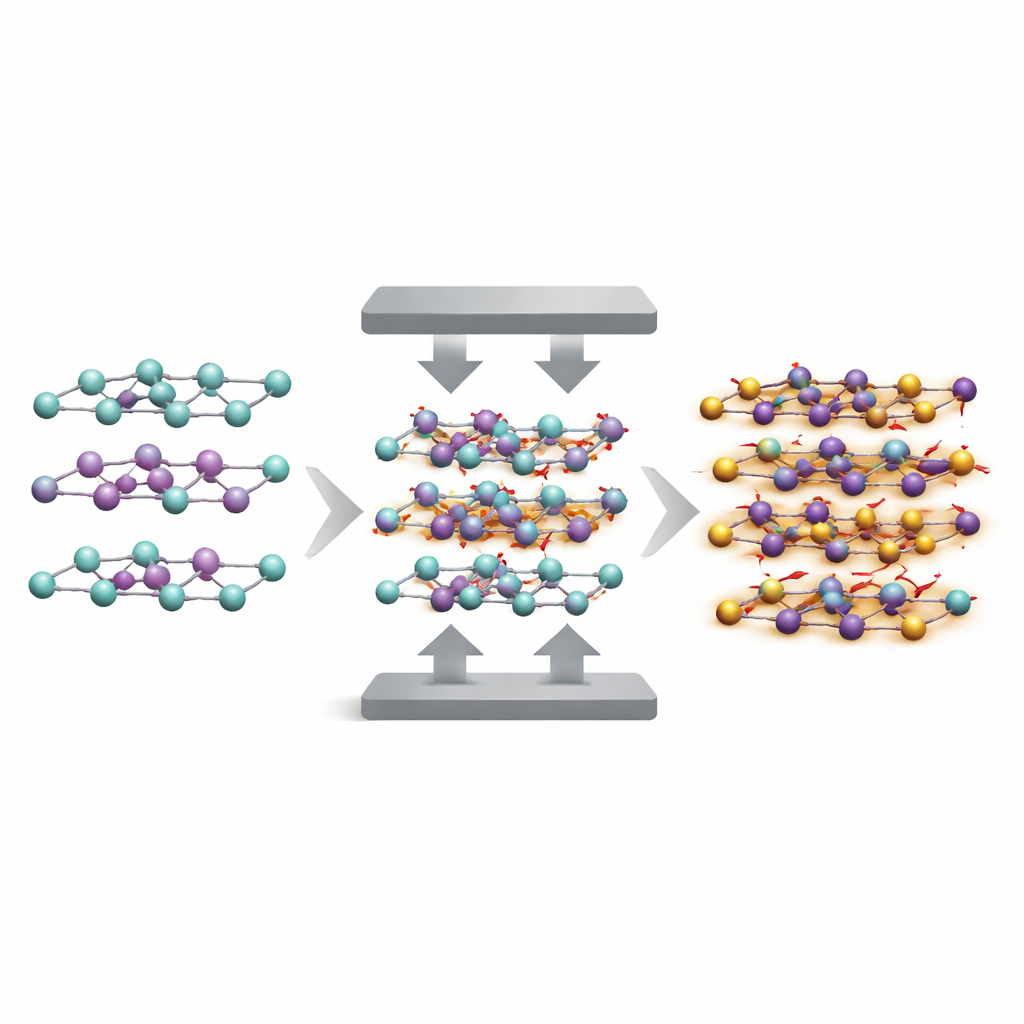
When we think about electronics, we usually picture silicon chips, not magnets that change their behavior when squeezed. Yet a material called Mn3Si2Te6 does exactly that: under high pressure it flips from being an electrical insulator to a metal, and its magnetic behavior and exotic electrical responses change dramatically. Understanding why this happens could help engineers design future low-power memory, sensors, and spin-based devices that use an electron’s magnetic moment, not just its charge.
A magnet with a hidden twist
Mn3Si2Te6 is a layered crystal in which manganese atoms carry magnetic moments that partly cancel each other, making the material “ferrimagnetic.” At normal pressure it behaves as a semiconductor with special band-structure features called nodal lines, which are known to enhance unusual transport effects such as the anomalous Hall effect, where an electric current flowing straight through a crystal creates a sideways voltage without any external magnetic field. Experiments had already shown that this material displays colossal changes in resistance and strong sensitivity to magnetic fields, suggesting that its electronic and magnetic properties are tightly linked.
What happens when you press down
Experiments found that above roughly 15 billion pascals of pressure—more than 150,000 times atmospheric pressure—Mn3Si2Te6 abruptly changes its crystal structure and turns metallic. At the same time, its magnetic ordering temperature rises toward room temperature and then falls again, forming a broad “dome” as a function of pressure. The anomalous Hall conductivity also shows a pronounced peak. To uncover the microscopic origin of this behavior, the authors used computer simulations based on density functional theory to compute how electrons and magnetic interactions evolve with pressure, and then fed those results into large-scale classical Monte Carlo simulations to predict how the spins order.
How spins talk to each other
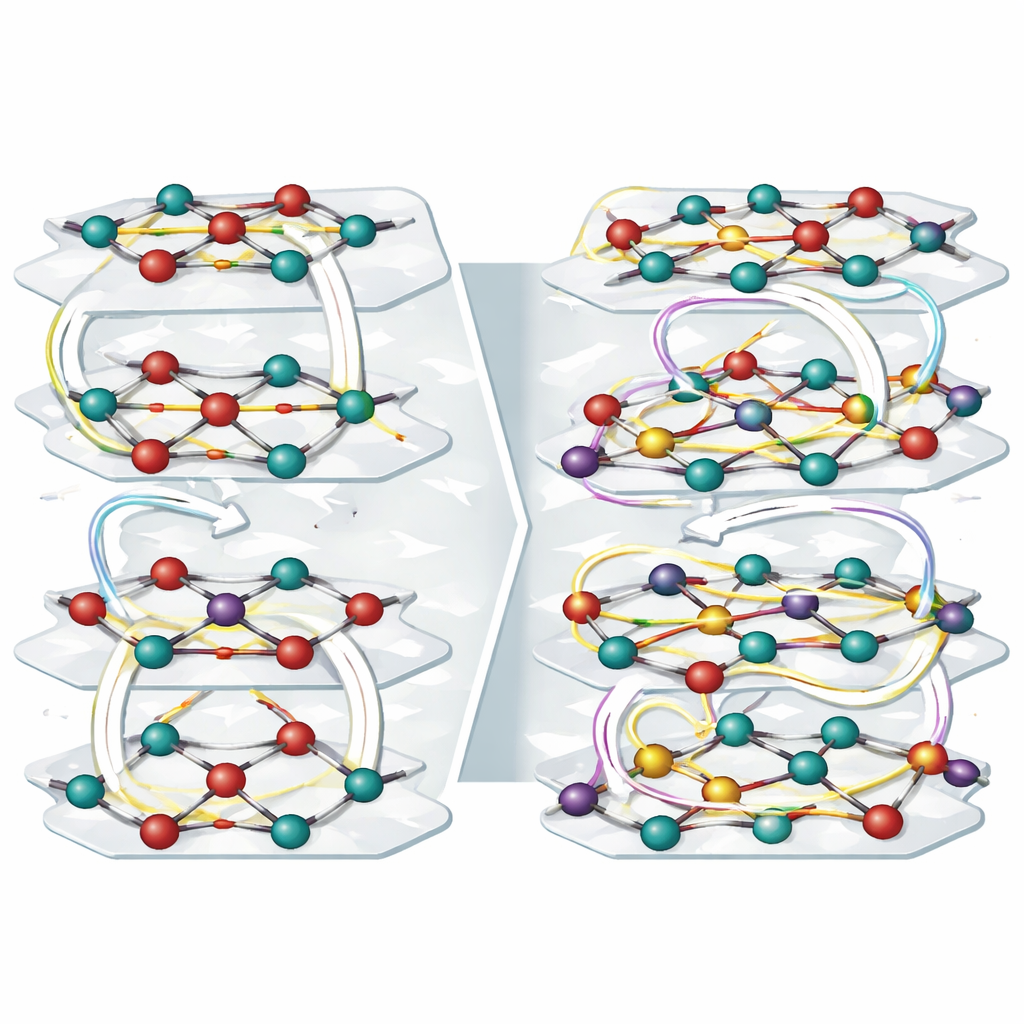
The team distilled the complex material into a network of interacting magnetic sites described by a Heisenberg Hamiltonian, which specifies how strongly neighboring spins prefer to align or oppose each other. At low pressure, two main antiferromagnetic couplings dominate. They lock three manganese spins into tightly bound “trimers” and then link these trimers into a three-dimensional network, naturally producing the observed ferrimagnetic state. As pressure increases in the original trigonal crystal structure, one key coupling grows almost linearly, which the Monte Carlo simulations show leads to a nearly linear rise in the ordering temperature—precisely what experiments see on the low-pressure side of the dome.
When the lattice shifts and frustration grows
At the critical pressure the lattice distorts into a monoclinic structure, splitting several formerly equivalent atomic bonds into multiple types. Many exchange pathways then change sign or strength, so that some favor parallel alignment while others favor antiparallel alignment. This competition, or frustration, weakens the stability of the ferrimagnetic arrangement and causes the ordering temperature to fall again with further pressure. The simulations also show how magnetic anisotropy—the preference for spins to lie in a particular direction—evolves: in the low-pressure phase spins favor lying in the atomic layers, while in the high-pressure phase they prefer one in-plane axis, with the out-of-plane axis remaining energetically costly. These trends match measured “spin-flop” fields, the magnetic fields required to reorient the spins.
A puzzle in the sideways current
One key experimental observation remains unexplained by the material’s intrinsic electronic structure alone. When the authors calculated the anomalous Hall conductivity from the quantum geometry of the electronic bands, they obtained a large signal with the opposite sign to that measured. They showed that two additional ingredients could reconcile theory and experiment: extrinsic effects such as impurity scattering, which add their own Hall contribution, or modest electron doping—plausibly from tiny deviations in chemical composition—that shifts the Fermi level. In the latter case, the computed Hall response naturally forms a dome with pressure, mirroring the experiments.
What this means for future devices
Taken together, the study offers a coherent picture of how pushing on Mn3Si2Te6 simultaneously reshapes its crystal lattice, tunes the way spins interact, and drives an insulator-to-metal transition. The authors show that the pressure-driven rise and fall of the magnetic ordering temperature and the evolution of magnetic anisotropy can be traced back to specific changes in exchange pathways between manganese atoms. At the same time, the work highlights that real materials’ Hall responses may be strongly influenced by imperfections and charge doping. Mn3Si2Te6 thus emerges as a model system for learning how mechanical pressure can be used as a clean control knob to couple structure, magnetism, and band topology in layered quantum materials.
Citation: Venkatasubramanian, V., Shimizu, M., Guterding, D. et al. Origin of pressure-induced anomalies in the nodal-line ferrimagnet Mn3Si2Te6. Commun Mater 7, 94 (2026). https://doi.org/10.1038/s43246-026-01132-x
Keywords: pressure-tuned magnetism, insulator–metal transition, anomalous Hall effect, van der Waals magnets, Mn3Si2Te6