Clear Sky Science · en
Room-temperature perpendicular-anisotropic ferrimagnet Co3Mo mediated by cobalt-kagome flat band
Why this new magnetic film matters
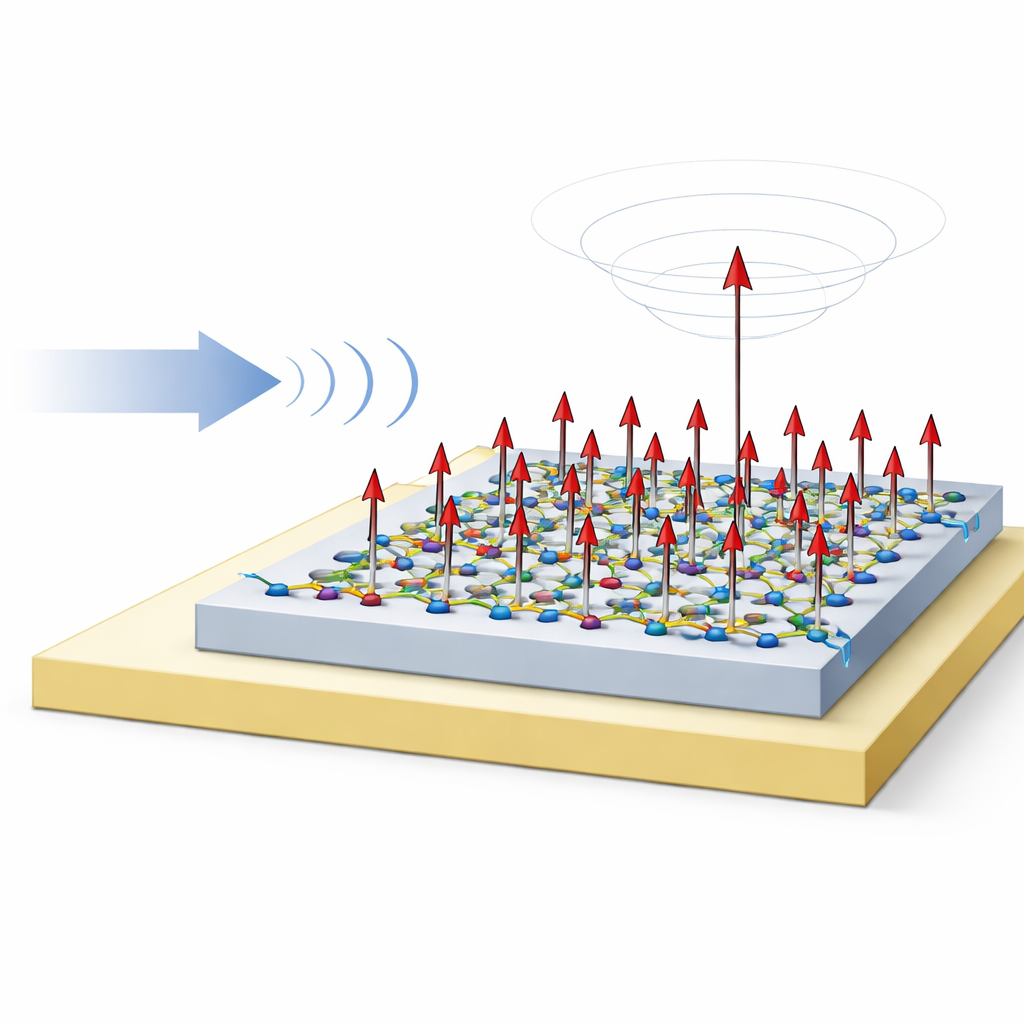
Modern gadgets from smartphones to data centers rely on tiny magnetic bits to store information. Making these bits smaller, faster, and more energy efficient requires materials whose magnetization points cleanly out of the film, stays stable at room temperature, and can be controlled with very low power. This study introduces a cobalt–molybdenum compound, Co3Mo, that naturally forms a special triangular pattern of atoms and shows unusual magnetic behavior that could help build next-generation memory and logic devices.
A flat landscape for electrons
At the heart of this work is a geometric pattern called a kagome lattice, a two-dimensional network of corner-sharing triangles. In Co3Mo, cobalt atoms form stacked kagome layers with molybdenum atoms sitting at the centers of the hexagons between them. Theory predicts that this layout creates “flat bands,” energy ranges where electrons barely move, piling up in place. The researchers used advanced computer calculations to map out the electronic structure and found that these flat bands sit very close to the material’s Fermi energy, where the most active electrons live. This high crowding of electrons favors the development of magnetism and also supports unusual transport effects tied to the geometry of electron motion.
Building and probing the thin films
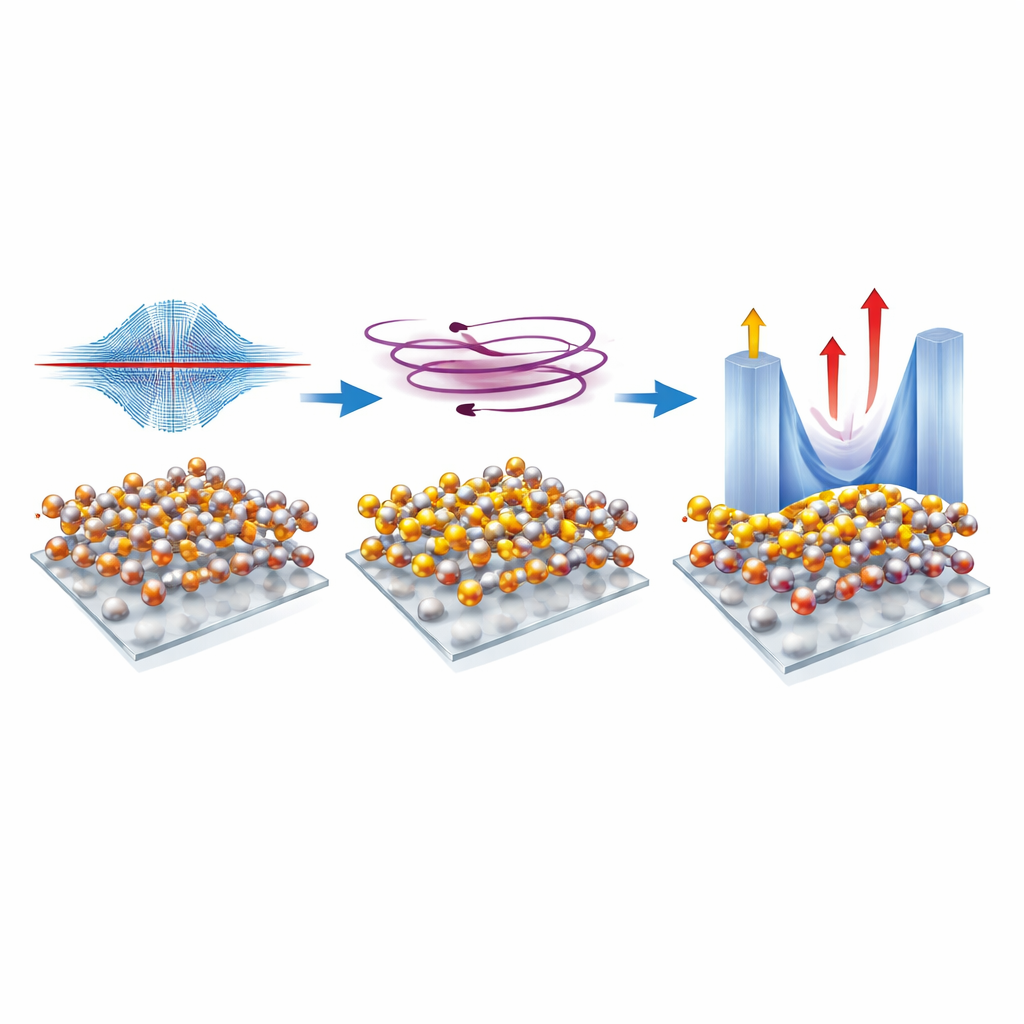
To see whether these theoretical features survive in real devices, the team grew thin films of Co3Mo on sapphire wafers using sputtering and high-temperature annealing. X-ray diffraction and electron microscopy confirmed that the films are single crystals with the expected hexagonal structure and clean stacking of kagome layers. The researchers then turned to angle-resolved photoemission spectroscopy, a technique that ejects electrons with soft x-rays and measures their energy and direction. These measurements directly revealed hallmarks of the kagome pattern: Dirac-like cone bands, saddle points that lead to strong responses, and crucially, a nearly dispersionless flat band just below the Fermi energy, matching the calculations and confirming the special electronic landscape in the films.
Unusual magnetism that points straight up
Magnetic measurements showed that Co3Mo behaves as a ferrimagnet, where cobalt and molybdenum spins line up in opposite directions so that the overall magnetization is small but not zero. Remarkably, this material prefers its magnetization to point perpendicular to the film plane at room temperature, a property called perpendicular magnetic anisotropy. Hysteresis loops measured with the field applied in and out of the plane reveal a large anisotropy field and a sizable coercive field, meaning the magnetization is strongly locked in the out-of-plane direction and resists flipping. X-ray magnetic circular dichroism confirmed that cobalt carries most of the magnetic moment, while the small total magnetization and weak signal reflect the influence of the flat electronic bands typical of kagome magnets.
Tuning magnetism with heavy atoms
To tailor the material for devices, the authors replaced part of the molybdenum with platinum, a heavier element that enhances spin–orbit interaction. In Co3Mo1−xPtx films, modest platinum contents dramatically increased the coercive field and reinforced the perpendicular anisotropy while keeping the overall magnetization low. Structural studies showed that beyond a certain platinum level the crystal structure changes and the favorable magnetic behavior disappears, highlighting a sweet spot near 17 percent platinum where the kagome-based structure and strong anisotropy coexist. Compared with established perpendicular magnetic materials used in spintronics, the Co3Mo–Pt films occupy a distinct regime of low magnetization but large coercive field, attractive for reducing the currents needed to switch bits while maintaining stability.
What this means for future devices
In simple terms, this study identifies a room-temperature magnetic film whose tiny overall magnetization points straight out of the surface yet is hard to disturb. The combination of a kagome geometry, flat electronic bands, and enhanced spin–orbit effects allows Co3Mo and its platinum-doped variants to host stable, tunable magnetism tied to the underlying band structure. That makes these materials promising platforms for exploring flat-band and topological physics and for engineering more efficient, compact spin-based devices for information storage and processing.
Citation: Ishida, K., Fujiwara, K., Nakazawa, K. et al. Room-temperature perpendicular-anisotropic ferrimagnet Co3Mo mediated by cobalt-kagome flat band. Commun Mater 7, 116 (2026). https://doi.org/10.1038/s43246-026-01131-y
Keywords: kagome magnet, perpendicular magnetic anisotropy, flat band, spintronics, Co3Mo thin films