Clear Sky Science · en
A space-forged super-thermal insulating material—lunar agglutinates
Moon Dust as a Natural Super-Insulator
When we picture future Moon bases or lunar factories, one of the most basic questions is also one of the hardest: how do you keep equipment and habitats from freezing at night and baking in the day? This study shows that some grains of lunar soil are astonishingly good at blocking heat—so good, in fact, that they rival the most advanced man‑made insulating materials, and they do it with a very different internal design. Understanding how this "space-forged" insulation works could reshape how we protect spacecraft, instruments, and even buildings on Earth.
Why Heat Hates to Travel
Engineers have spent decades trying to slow the flow of heat through solids. On Earth, one of the best solutions is the aerogel: a feather‑light material that is mostly empty space, with a thermal conductivity as low as 1–10 milliwatts per meter per kelvin under vacuum. By comparison, ordinary rocks conduct heat thousands of times better. Lunar soil, or regolith, has long been known to behave strangely—it insulates so well that it complicates temperature measurements from past Apollo missions. But no one had directly measured how individual grains behave. The key question was whether nature, under the harsh conditions of space, can produce particles as insulating as painstakingly engineered aerogels, and if so, how.
Space-Weathered Grains with Hidden Complexity
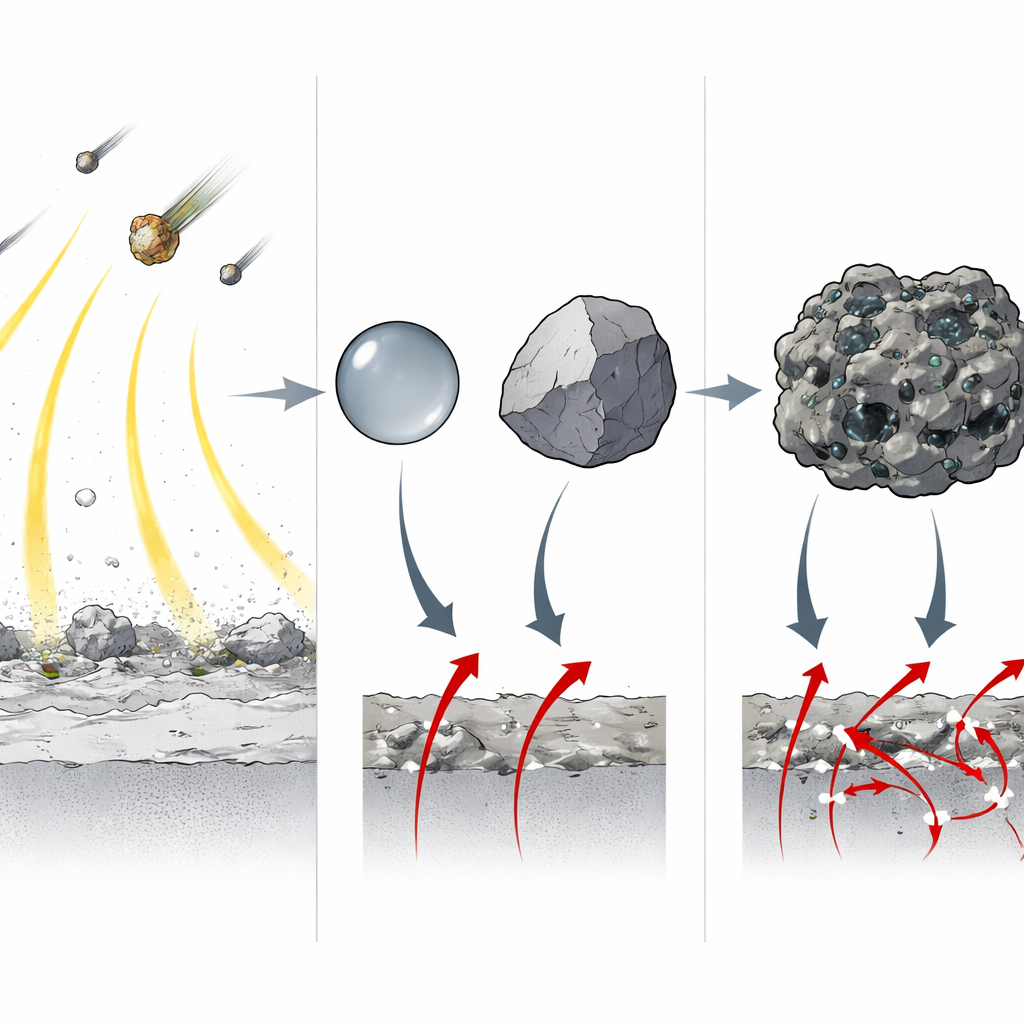
The samples examined in this study come from China’s Chang’E‑5 mission, which returned soil from a young lava plain on the Moon. Under microscopes and 3D X‑ray scans, the researchers sorted the grains into three families: smooth glass beads, sharp‑edged rock fragments, and oddly shaped clumps called agglutinates. These agglutinates are unique to airless worlds. They form when tiny meteorites smash into the surface, melting and mixing bits of many minerals into a glassy glue. As the molten splash cools rapidly, gases become trapped as bubbles, and fragments of different minerals freeze in place. The result is a single grain with a tangled interior: patches of different materials, a foamy network of pores from nanometers to micrometers, and countless internal boundaries.
Measuring Heat Flow Through a Single Grain
To probe how well each kind of grain blocks heat, the team used a custom "suspended bridge" device about the width of a human hair. A single grain is gently placed so that it connects two tiny gold strips that can both heat and measure temperature. In a high‑vacuum chamber that removes air‑borne heat transfer, the researchers warm one side and watch how much heat reaches the other. Glass beads turned out to be relatively poor insulators, and rock fragments did better—especially when crisscrossed by cracks. But the real surprise came from the agglutinates: some blocked heat so effectively that their thermal conductivity dropped to about 8 milliwatts per meter per kelvin, comparable to top‑tier aerogels, even though they are far less porous overall.
How a Jumbled Interior Stops Heat Cold
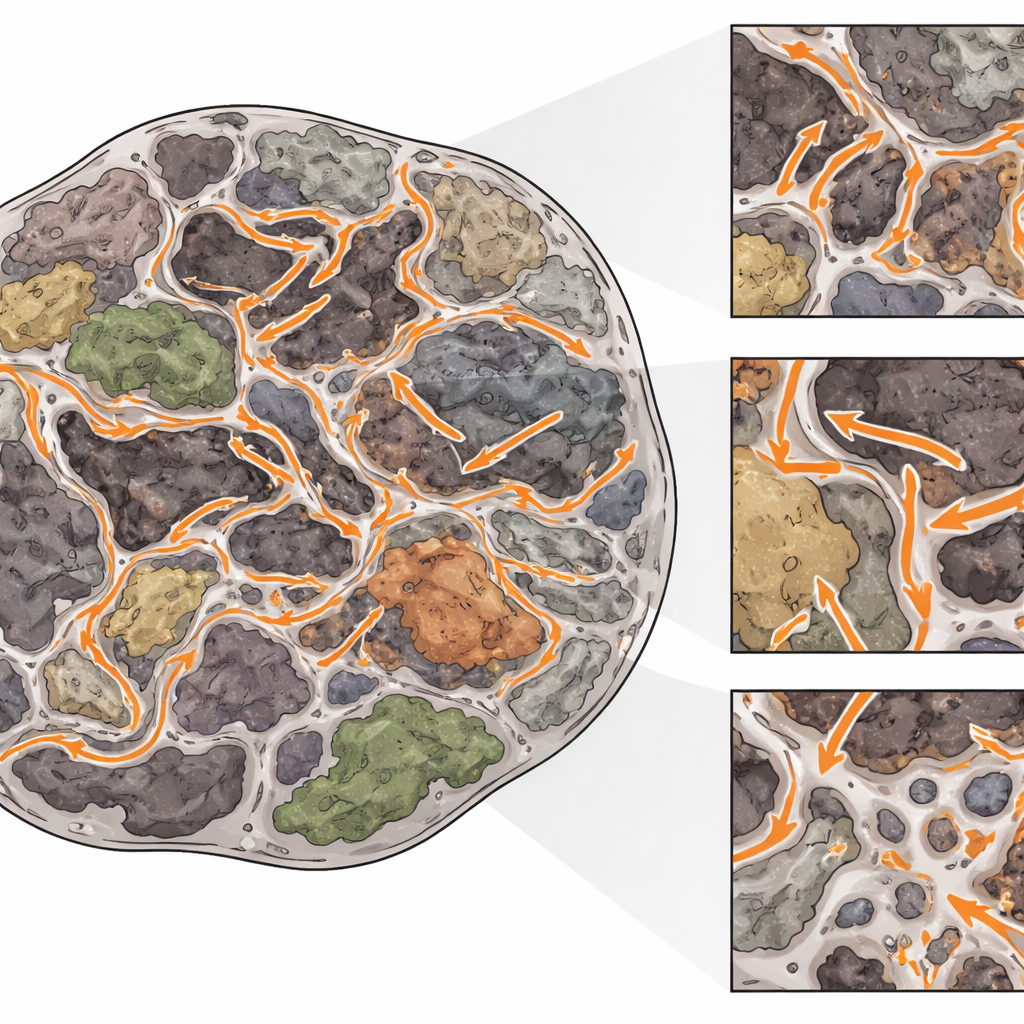
To understand why agglutinates are so effective, the team combined their imaging with computer simulations that track how vibrations move through solids. In most non‑metallic materials, heat travels as tiny vibrations of the atomic lattice, called phonons. At each internal boundary—where one mineral meets another, or where crystal meets glass—those vibrations partly reflect, scatter, or change character. In agglutinates, these boundaries are everywhere, and they are surrounded by pores that force heat to take long, twisted paths. Molecular‑scale simulations show that this web of defects and mismatched interfaces can slash the effective thermal conductivity of the minerals to a small fraction of their bulk values. Crucially, grains with more connected, irregular pores and more mixed phases were better insulators than grains that simply had more empty space.
Rethinking How We Design Insulation
The study concludes that the Moon’s remarkable insulation does not come just from fluffy, loosely packed soil. Instead, it arises from the complex architecture of individual agglutinate grains, sculpted by billions of years of space weathering. These grains achieve super‑insulating performance without the extreme porosity of aerogels, by using a maze of voids and internal interfaces to frustrate the passage of heat. For engineers, this points to a new strategy: rather than merely making materials emptier, we can design dense solids with deliberately tangled microstructures that mimic lunar agglutinates. Such "space‑inspired" insulators could help future Moon explorers manage temperatures more efficiently, while also suggesting fresh approaches to thermal protection back on Earth.
Citation: Tian, Z., Zheng, J., Wang, H. et al. A space-forged super-thermal insulating material—lunar agglutinates. Commun Mater 7, 109 (2026). https://doi.org/10.1038/s43246-026-01126-9
Keywords: lunar regolith, thermal insulation, space weathering, agglutinates, aerogel-like materials