Clear Sky Science · en
Multifunctional metallic nanomushrooms on nanowires for detecting and killing tumor cells
New tools in the fight against cancer
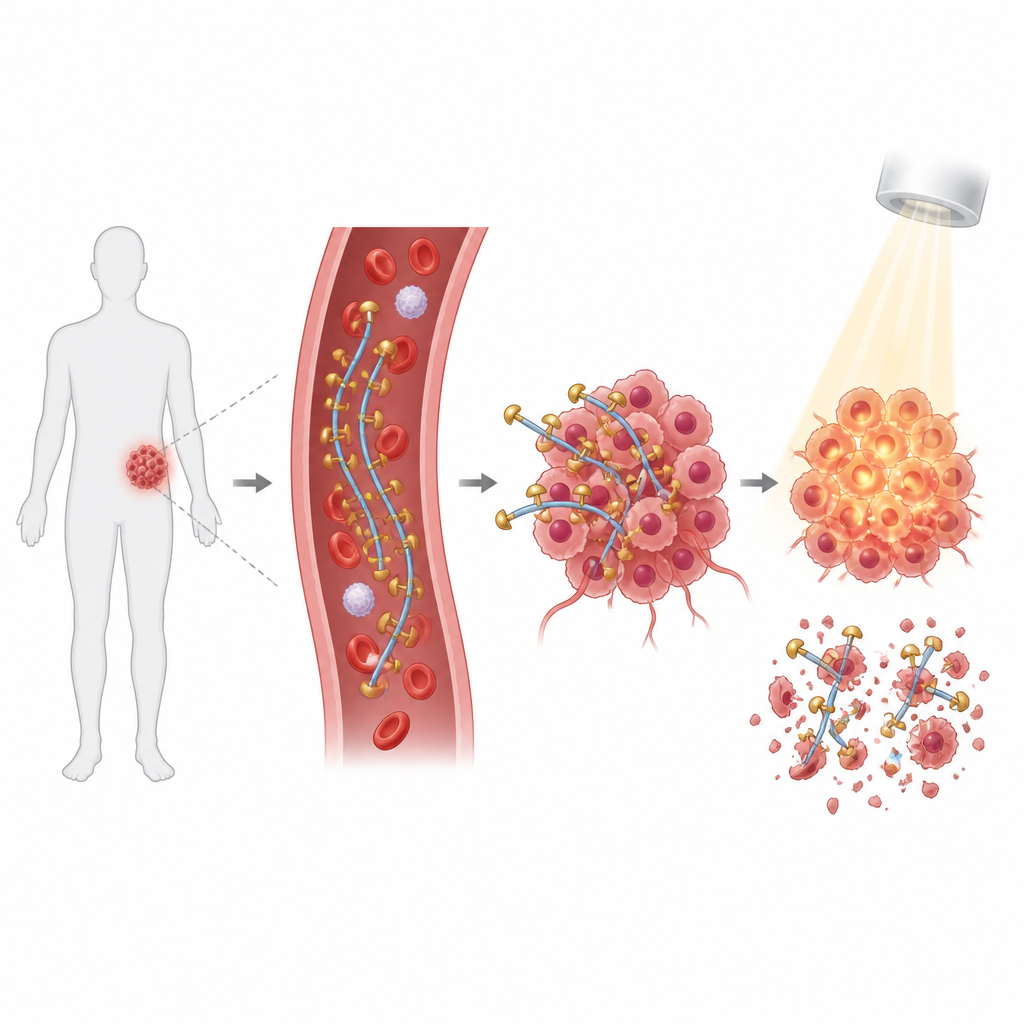
Researchers have created tiny metal structures that look like mushrooms sitting on thin wires, and these "nanomushrooms" can both light up and kill tumor cells. This dual ability means they can help doctors see cancer cells more clearly and then destroy them using gentle light, offering a more precise way to attack tumors while sparing healthy tissue.
Tiny mushrooms made of metal
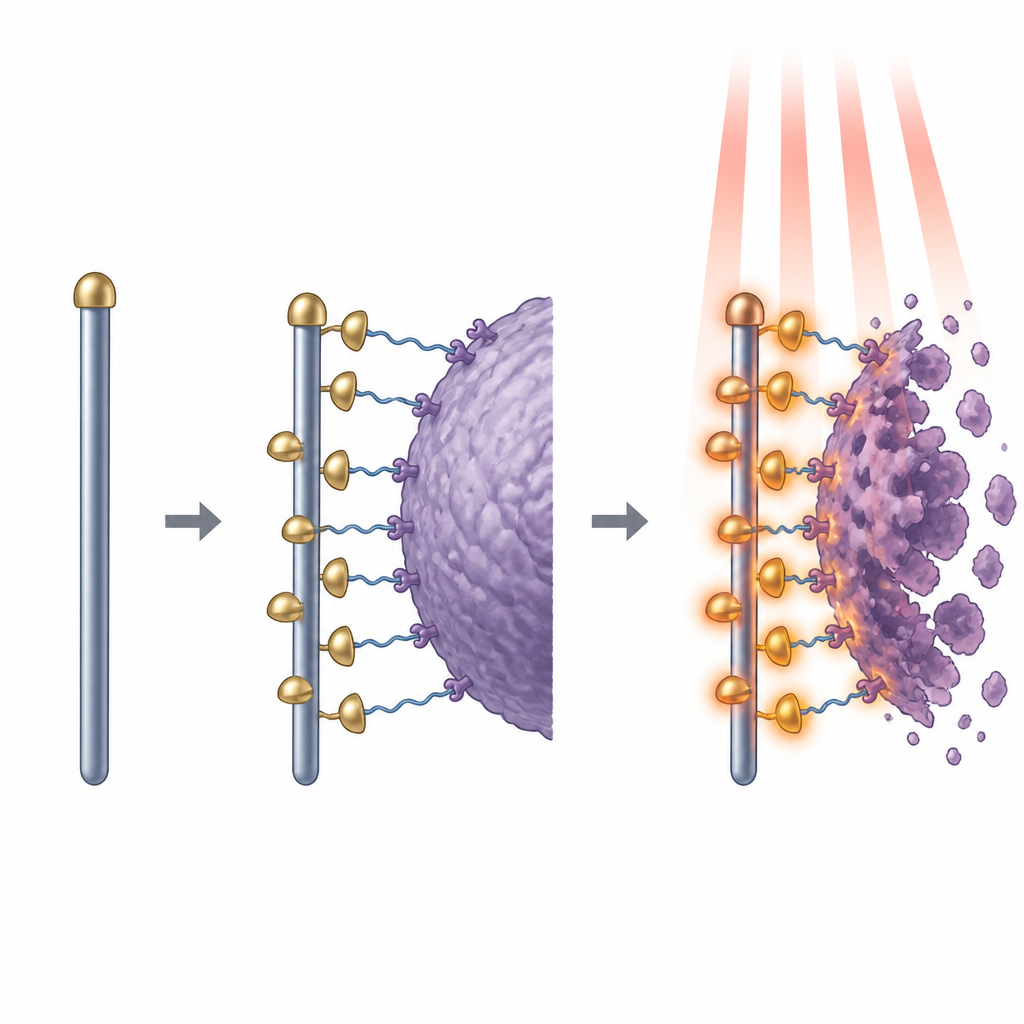
At the heart of this work are nanomaterials made from gold and silver, metals already used in medical imaging and therapy. The team grew mushroom-shaped gold–silver alloy caps on silver–gold nanowires using a focused electron beam. Under this beam, silver atoms become mobile and flow from the wire into growing caps, much like nutrients feeding the top of a real mushroom. The result is a wire decorated with many umbrella-like metal caps, each only tens of billionths of a meter across, with a large surface area for attaching targeting molecules and interacting with light.
Bright beacons under gentle light
These nanomushroom wires naturally glow when excited by light, a property known as photoluminescence. The researchers found that wires covered with dense nanomushrooms showed strong greenish fluorescence, while bare wires without the mushroom caps barely glowed at all. Careful measurements revealed that adding more nanomushrooms increased light absorption, brightness, and the efficiency with which absorbed light was turned into glow. This behavior comes from the way electrons in the gold–silver alloy respond to light, creating localized surface plasmons that trap energy near the metal surface, boosting both brightness and electrical conductivity.
Finding tumor cells by their favorite vitamin
To make the nanomushrooms home in on cancer cells, the team coated them with folic acid, a form of vitamin B that some tumor cells avidly consume. Many cancer cells carry extra folate receptors on their surfaces, while normal cells have fewer. When the folic acid-coated nanomushroom wires were mixed with ovarian cancer cells, they clustered tightly around and onto the tumor cell surfaces, as seen by cryo-electron microscopy and fluorescent imaging. In contrast, they barely attached to normal cells, and adding free folic acid blocked this binding, confirming that the targeting relies on the folate receptor system.
Turning light into local heat to kill cancer
Because the nanomushroom wires conduct electricity so well and concentrate light at their surfaces, they can efficiently convert light into heat. Simulations and measurements showed that decorating nanowires with many nanomushrooms greatly increased light absorption and photothermal conversion compared with plain wires, across a wide range of wavelengths similar to those used in common light sources. In cell tests, ovarian cancer cells loaded with folic acid-coated nanomushroom wires were exposed to a modest LED light. Even though the overall liquid warmed only to about body temperature, the local heating right where the nanomushrooms sat on the cell membrane was intense enough to rupture the cells, producing clear signs of cell death, while normal cells were largely spared.
Understanding how fast heat beats cell defenses
Typically, cancer cells respond to heat by making protective molecules called heat shock proteins, which help them survive mild thermal stress and can weaken standard photothermal therapy. Here, gene tests showed that these protective proteins still rose, but the damage to cells happened so quickly and locally that their repair systems could not keep up. By comparing cells treated with drugs that boost or inhibit heat shock responses, the researchers concluded that this ultrafast, highly focused heating shifts the balance toward cell death even when the usual defenses are active.
A two-in-one flashlight and scalpel
Overall, the study shows that metallic nanomushrooms on nanowires can act as both bright markers and tiny heaters that seek out folate-hungry tumor cells, highlight them with fluorescence, and then destroy them under relatively mild light. To a layperson, these structures behave like microscopic flashlights and scalpels combined into one, offering a way to see and treat cancer cells at the same time while limiting harm to healthy tissue.
Citation: Qi, Y., Qiu, H., Dai, H. et al. Multifunctional metallic nanomushrooms on nanowires for detecting and killing tumor cells. Commun Mater 7, 125 (2026). https://doi.org/10.1038/s43246-026-01125-w
Keywords: nanomaterials, photothermal therapy, cancer targeting, nanoparticles, bioimaging