Clear Sky Science · en
Electrochemical deactivation of high-strength, catechol-based adhesives incorporated with anhydrous proton and electron conducting elements
Glue That Lets Go When You Flip a Switch
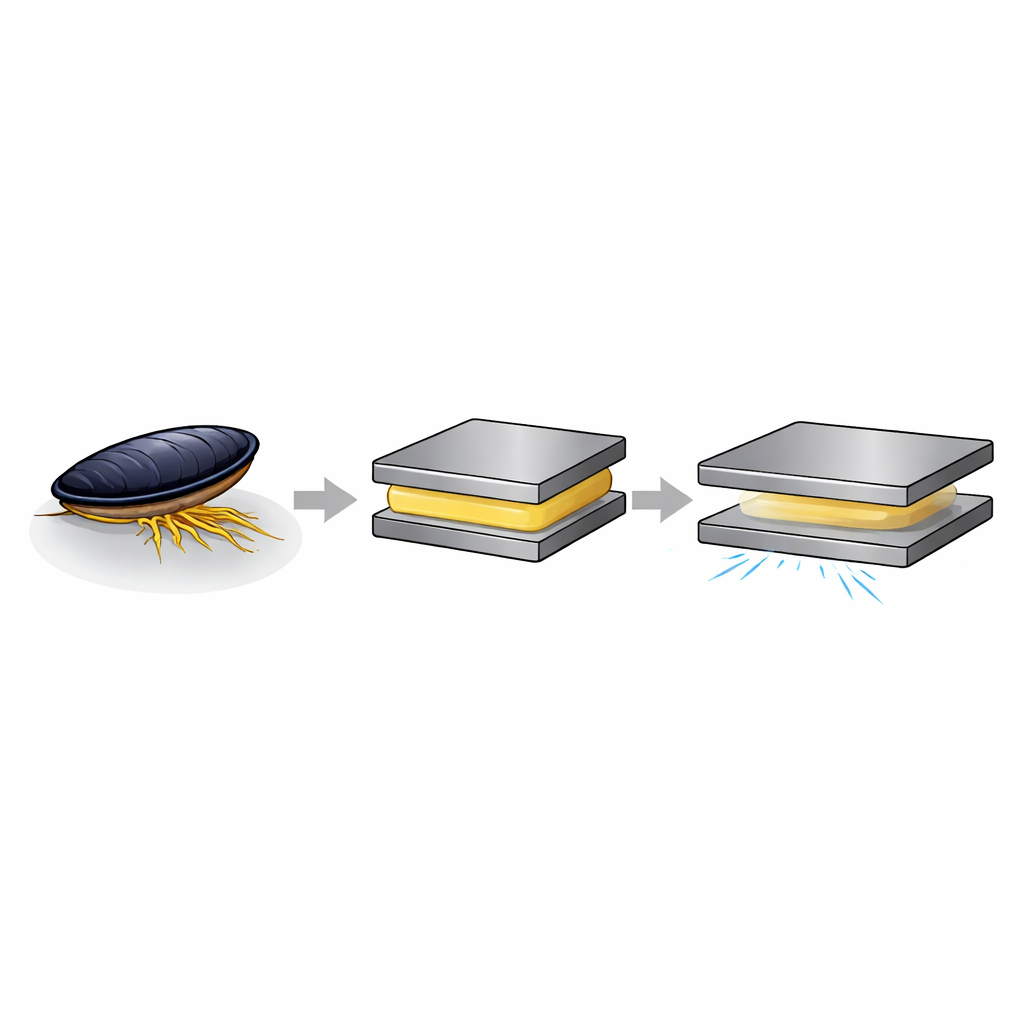
Imagine a super-strong glue that can hold a metal weight with a tiny contact area—yet lets go on command when you apply a small battery. This study introduces just such a "smart" adhesive. It borrows tricks from mussels, which cling to rocks in pounding surf, and combines them with simple electrical control so that bonds can be switched off without heat, harsh chemicals, or forceful prying.
Why Switchable Glue Matters
Modern products—from medical patches to robots and modular electronics—often need parts that can be attached securely but also removed cleanly. Today, that usually means choosing between weak, removable tapes or permanent glues that must be cut or pried apart, risking damage and waste. Other smart adhesives exist, but many respond to light, heat, or changes in acidity, which can be slow, hard to target, or incompatible with delicate components. Electricity, by contrast, is easy to deliver precisely where and when it is needed, but previous electrically responsive glues have typically required high voltages, constant power to stay stuck, or have only worked well when swollen with water, which weakens their mechanical strength.
Borrowing a Trick from Mussels
Mussels stick to wet rocks using specialized proteins rich in a small, ring-shaped molecule called catechol. Catechol can form many kinds of attractive interactions with surfaces, giving rise to strong adhesion to metals, plastics, and even biological tissue. Crucially, catechol changes its bonding behavior when it is oxidized—its “on” state is strongly sticky, while its oxidized “off” state, called a quinone, adheres poorly. The research team set out to harness this natural chemical switch inside a tough, water-free polymer, so that a modest electric signal could flip catechol from its sticky to its non-sticky form and thus release the bond on demand.
Designing a Dry, Electrically Responsive Glue
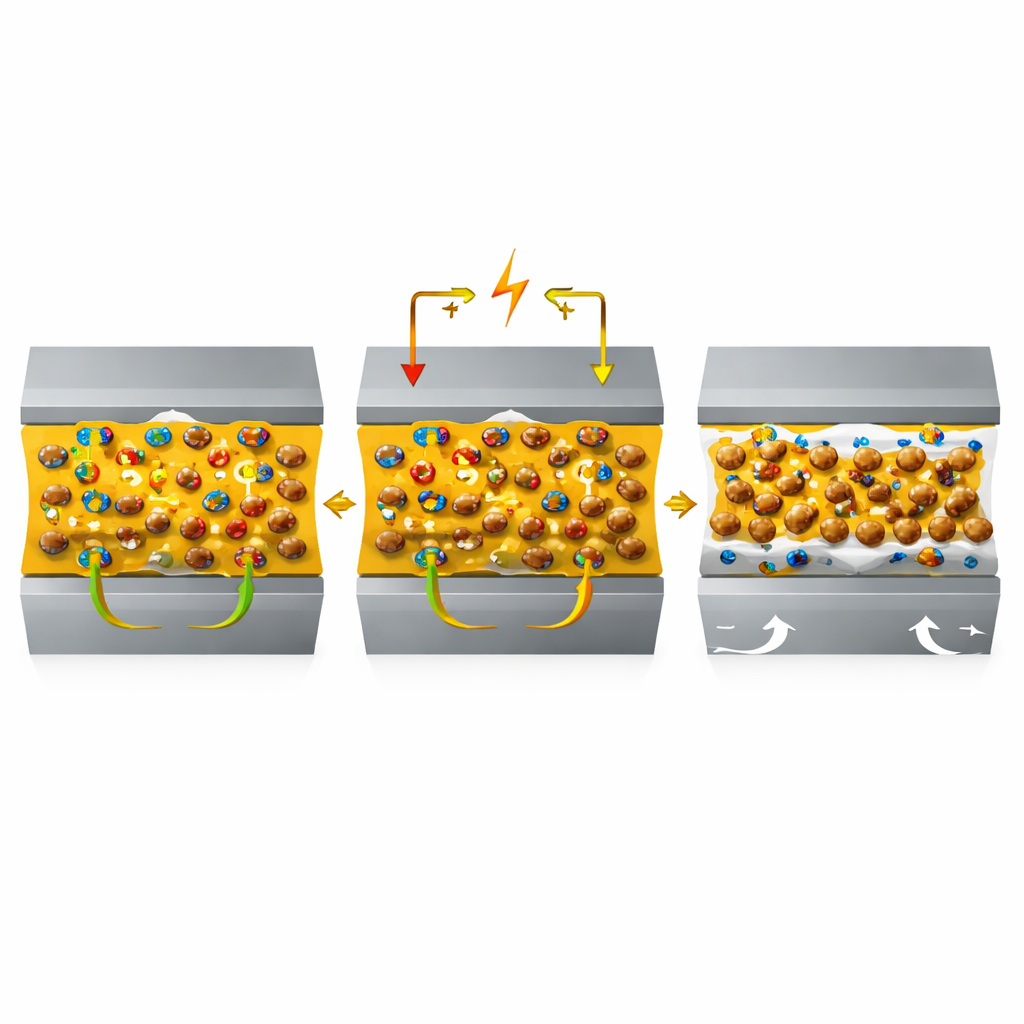
The big challenge was that electrochemical reactions usually rely on water to move charged particles, especially protons, through the material. Removing water is necessary to make a strong, rigid glue, but it usually shuts down the electrochemical switch. To solve this, the authors engineered a new adhesive by combining three building blocks in one polymer: a catechol-bearing unit for strong surface bonding, a sulfonic-acid-containing unit to shuttle protons even without water, and a hydroxyl-bearing backbone that forms hydrogen bonds and stiffens the material. They then mixed in a network of multiwalled carbon nanotubes, which act like tiny wires to carry electrons. Together, these ingredients create a dry adhesive that conducts both electrons and protons well enough to support the catechol oxidation reaction throughout the bonded area.
Strong Hold, Gentle Release
When this adhesive was placed between metal sheets such as titanium, steel, or aluminum, it formed lap joints with shear strengths between about 2 and 7 megapascals—comparable to, and in one case better than, a commercial epoxy. A joint only a few millimeters across could hold a 2.3-kilogram weight. Yet, when the metal pieces were briefly connected to a 9-volt power supply, the bond weakened dramatically: adhesion dropped by more than 90 percent within minutes, allowing the joint to fail under load with little extra force. By tuning the recipe—changing the amount of catechol, the proton-carrying groups, and the nanotubes—the team balanced three key features: high initial strength, good proton and electron transport, and deep loss of adhesion under mild electrical stimulus.
Seeing the Switch at the Molecular Level
To confirm that the glue really turns off by changing catechol’s chemical state, the researchers probed the adhesive surface with X-ray photoelectron spectroscopy. After applying a small voltage, signals associated with catechol’s hydroxyl groups decreased sharply, while signals from carbon–oxygen double bonds, characteristic of quinones, increased. Electrical measurements also showed that adding sulfonic acid groups and nanotubes boosted proton and electron conductivities by more than two orders of magnitude, exactly what is needed to drive catechol oxidation efficiently in the dry polymer. Microscopy images revealed an intertwined network of nanotubes within a continuous polymer matrix, providing long-range pathways for charge transport without sacrificing mechanical integrity.
Smart Bonds for Future Devices
Because the glued metal parts themselves serve as electrodes, the adhesive can even be switched off selectively in one joint while leaving a neighboring joint intact—an important feature for complex assemblies. Overall, this work demonstrates a glue that is both as strong as a robust structural adhesive and as controllable as an electronic component. For non-specialists, the key takeaway is simple: by combining mussel-inspired chemistry with clever charge-transport design, the authors have created a powerful dry adhesive that can be turned "off" with a low-voltage signal. Such materials could one day make electronic gadgets easier to repair, medical devices more comfortable to remove, and robotic systems more adaptable, all while cutting down on wasteful, one-time-use bonds.
Citation: Peng, H., Zhang, Z., Khare, V. et al. Electrochemical deactivation of high-strength, catechol-based adhesives incorporated with anhydrous proton and electron conducting elements. Commun Mater 7, 114 (2026). https://doi.org/10.1038/s43246-026-01124-x
Keywords: switchable adhesive, mussel-inspired glue, electrochemical control, dry structural adhesive, carbon nanotube composite