Clear Sky Science · en
Cr-LiF as a high energy density conversion-type cathode for Li-ion solid-state batteries
Why This New Battery Material Matters
Rechargeable batteries power our phones, laptops, and increasingly our cars, but today’s lithium-ion batteries are starting to bump up against their performance limits. This study explores a new kind of material for the positive side of a battery—using a compound based on the metal chromium and lithium fluoride—to pack more energy into the same mass, while working in a solid-state design that promises better safety and longevity.
Looking Beyond Today’s Battery Ingredients
Most commercial lithium-ion batteries rely on so-called intercalation cathodes, where lithium ions slip in and out of crystal structures without changing them very much. These materials, such as NMC and LFP, are reaching their practical ceiling in both energy and power. An alternative approach uses “conversion” cathodes, which undergo a more dramatic chemical change during charging and discharging. Transition-metal fluorides fall into this category and can, on paper, store up to three times more charge per gram than common cathodes. Until now, research has focused mainly on iron- and copper-based fluorides, which showed high initial capacities but suffered from poor reversibility and slow reaction speeds.
Introducing Chromium to the Mix
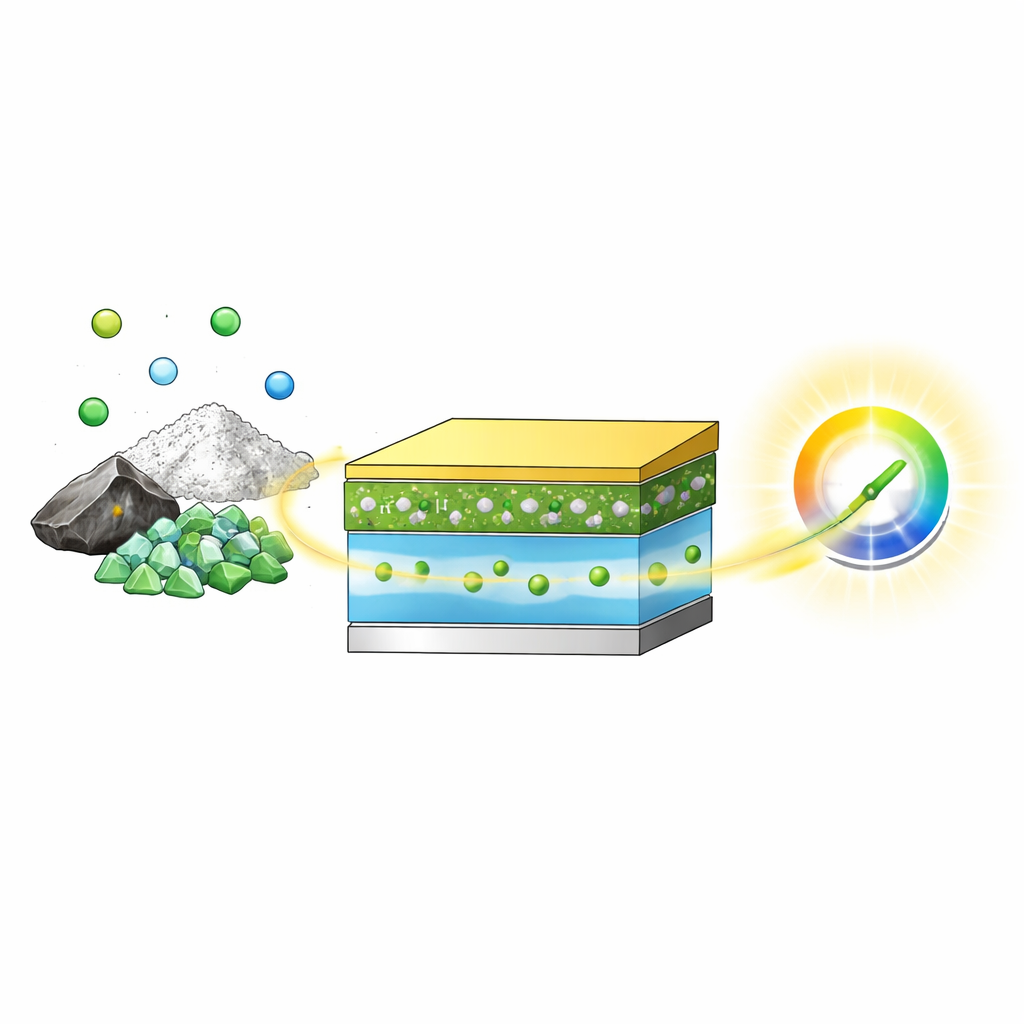
The authors propose chromium—a relatively light and abundant metal—as a fresh candidate for these fluoride cathodes. Safety concerns around one highly oxidized form of chromium have discouraged its use, but the material explored here involves metallic chromium and lithium fluoride, avoiding the harmful species. Based on basic electrochemical calculations, chromium fluorides should deliver capacities well above standard cathodes and competitive energy densities. To test this, the team co-evaporated chromium and lithium fluoride onto a conductive base, forming an ultra-thin, well-mixed layer with a carefully chosen composition. This layer acts as the battery’s positive electrode when paired with a solid lithium phosphorus oxynitride (LiPON) electrolyte and a lithium metal negative electrode.
Peering Inside a Solid-State Thin-Film Cell
Using electron microscopy and ion-beam analysis, the researchers confirmed that the chromium–lithium fluoride film is finely intermixed and has the intended atomic ratios throughout its thickness. In operation, the cathode follows a conversion reaction in which lithium leaves and re-enters the structure as the battery charges and discharges. Experiments and advanced computer simulations agree that a compound called chromium difluoride (CrF₂) is the main phase formed when the cathode is charged. When cycled slowly, the cathode delivers an impressive first discharge capacity of 435 milliamp-hours per gram and an energy density of about 0.71 watt-hours per gram—substantially higher than common commercial cathode materials.
Balancing Speed, Lifetime, and Structure
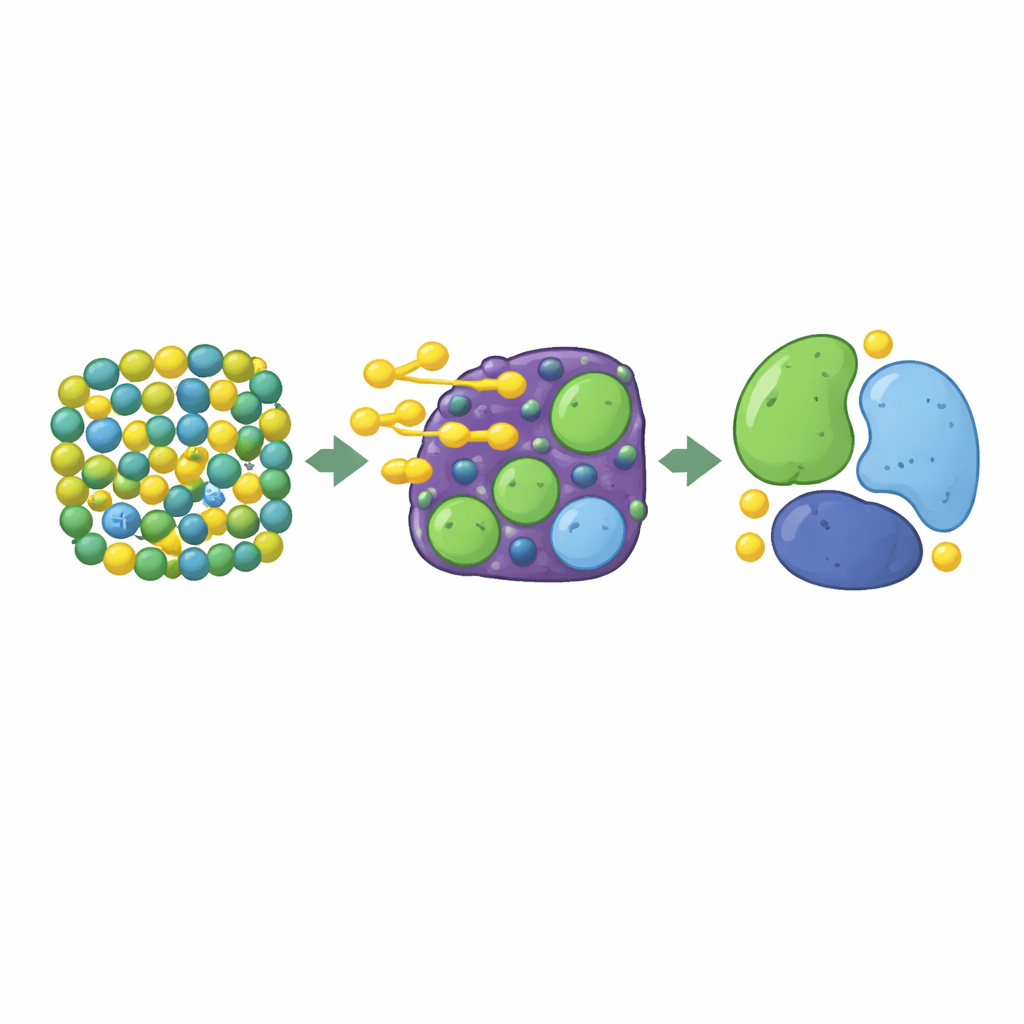
The study also examines how this new cathode behaves under faster charging and long-term use. Even at demanding rates, the material retains nearly half of its theoretical capacity, and at very high power output it still performs better than many other fluoride-based cathodes reported in the literature. Over thousands of rapid cycles, the capacity gradually falls to around 200 milliamp-hours per gram and then levels off, while the electrical resistance inside the cell actually improves. Imaging of cross-sections taken after many cycles suggests that the nanoscale mixture of chromium and lithium fluoride slowly reorganizes: small, well-mixed domains coarsen into larger, chromium-rich and fluoride-rich regions, and some chromium migrates toward the electrolyte interface. This restructuring appears to trade some capacity for faster and more stable ion and electron transport.
What This Means for Future Batteries
In plain terms, this work shows that chromium-based fluorides can act as powerful, long-lived cathodes in solid-state lithium-ion batteries. The material starts with very high energy storage per gram, and although it settles into a lower-capacity state over time, it continues to cycle stably at high rates. By revealing that chromium difluoride is the key charged product and that the cathode’s internal nanostructure evolves into a more robust configuration, the study opens a new family of materials for next-generation batteries. With further tuning of composition, structure, and device design, chromium fluoride cathodes could help future solid-state batteries store more energy in a safer, more compact form.
Citation: Casella, J., Morzy, J., Montanelli, V. et al. Cr-LiF as a high energy density conversion-type cathode for Li-ion solid-state batteries. Commun Mater 7, 113 (2026). https://doi.org/10.1038/s43246-026-01121-0
Keywords: solid-state batteries, lithium-ion cathodes, chromium fluoride, conversion electrodes, energy storage materials