Clear Sky Science · en
Unlocking ultra-stable blue emission from Ytterbium- and erbium-doped metal halides
Why bright, tough blue glow matters
Blue light sources are workhorses of modern technology, from phone screens to medical scanners. Yet many blue-emitting materials are fragile, especially when they meet water or harsh solvents, and most rare-earth-based light-emitters shine in the invisible infrared rather than in vivid blue. This study reports an unusual class of crystals that buck both trends: they glow strongly in blue, stay stable in water for months, and can even be dissolved into a clear liquid that still shines brightly under X-rays, pointing toward new, flexible ways to detect radiation and create robust lighting components.
Crystals that glow the “wrong” color
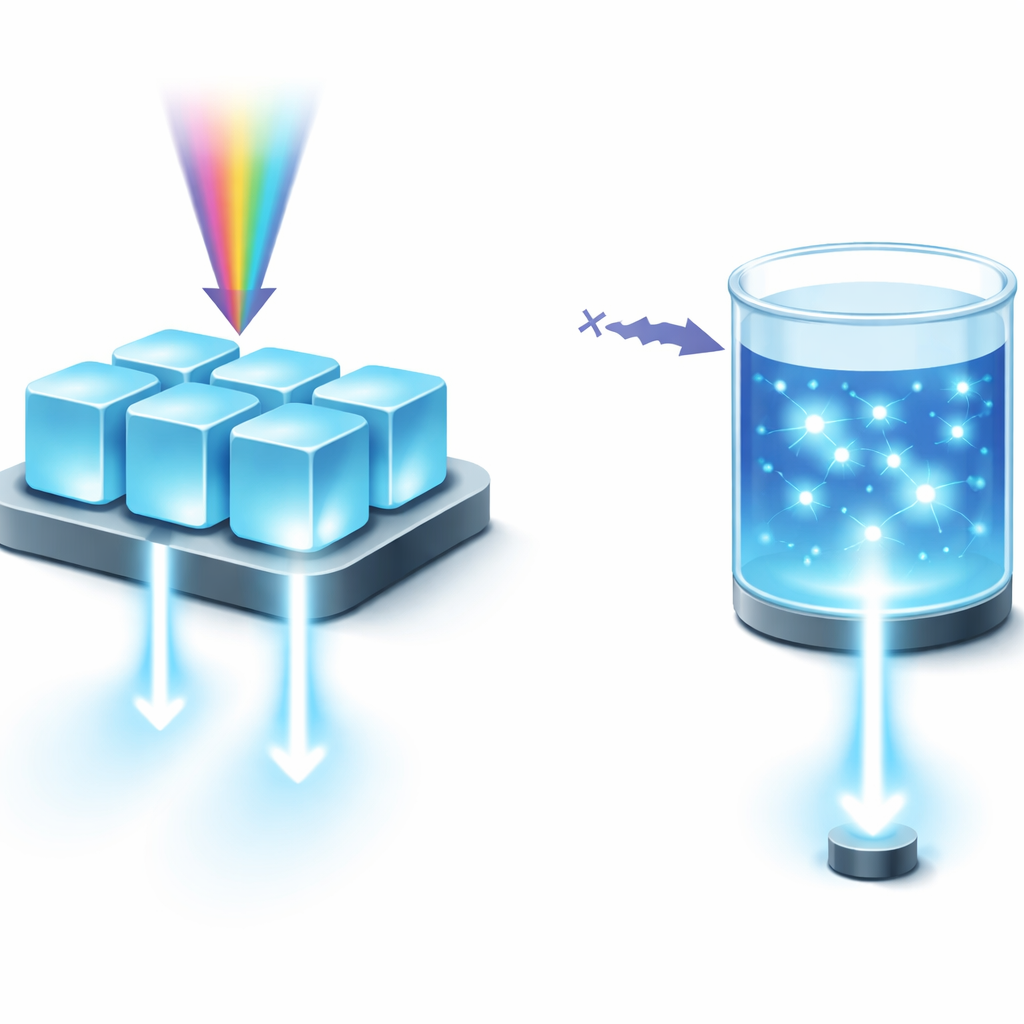
The researchers started with hybrid metal halide crystals built from metal–chloride units separated by organic molecules, forming a zero‑dimensional, molecule-like solid. Into these hosts, they introduced tiny amounts of two familiar rare-earth elements, ytterbium and erbium, which almost always emit near-infrared light when excited. Surprisingly, in these particular crystals the doped materials emit brilliant blue light between 400 and 500 nanometers and essentially no infrared at all. Measurements of how much light is produced show that the solid crystals convert ultraviolet light to blue with a high efficiency of around two-thirds, already competitive with many commercial phosphors.
How the blue pathway is switched on
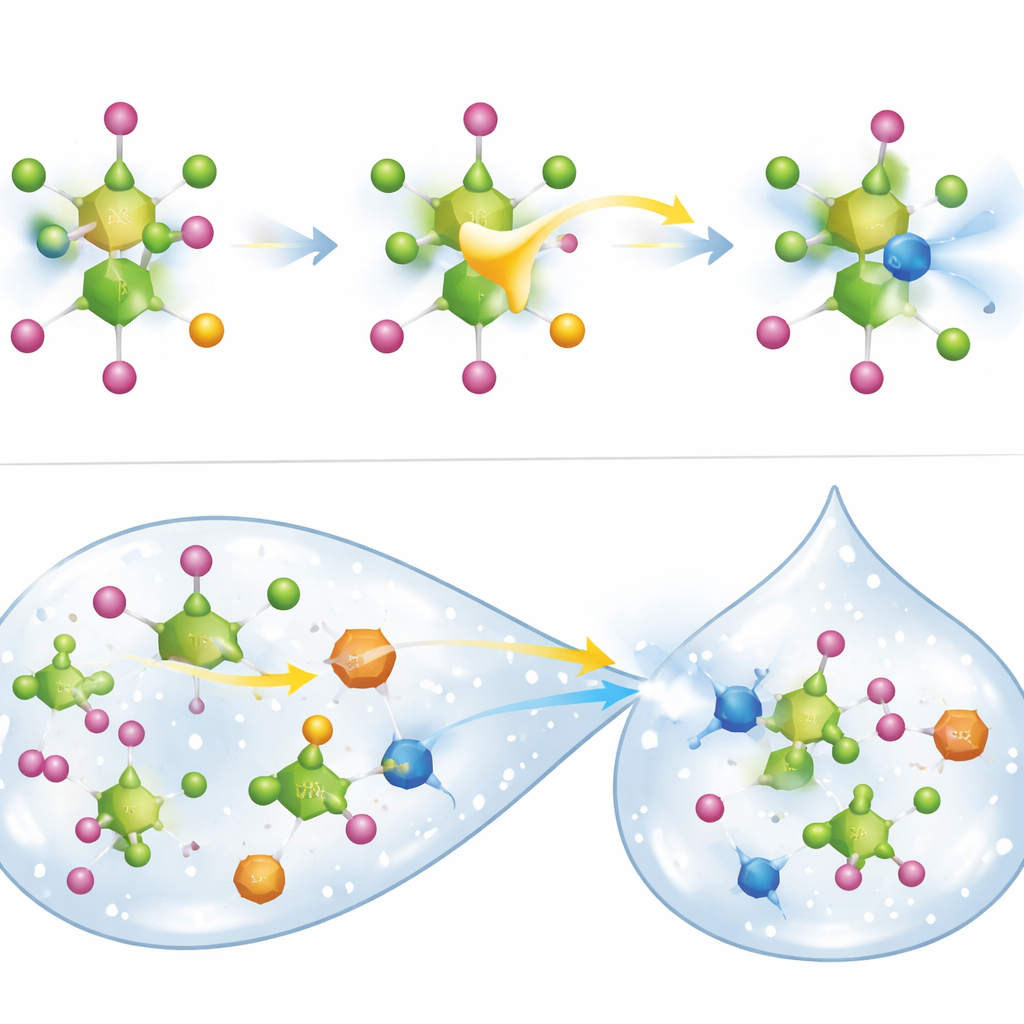
To understand this unexpected color, the team combined detailed computer simulations with optical experiments. In most rare-earth-doped phosphors, energy flows from the host material into the rare-earth ions, which then emit their characteristic colors. Here, calculations revealed that adding ytterbium or erbium subtly reshapes the energy landscape of the crystal. Instead of funnelling energy into the rare-earth centers, the dopants create a new high-lying energy level shared between the chloride ions and the surrounding organic molecule. When ultraviolet light excites electrons on the chloride, those electrons preferentially hop to this new organic–chloride level, where they recombine and emit blue light, while the usual infrared-emitting pathways of the rare-earth ions are effectively bypassed.
Bright, fast, and stable in harsh conditions
Further tests probed how the blue emission behaves under different conditions. The intensity of the glow increased smoothly with stronger excitation, which rules out emission from a limited number of permanent defects. Temperature-dependent measurements and lifetime studies pointed to a “free exciton” process: electrons and holes pair up only loosely and recombine quickly, producing light in just a few billionths of a second. The crystals also showed a relatively high binding energy for these excitons, meaning they remain intact even at room temperature, helping to sustain the strong emission. Crucially, the materials proved exceptionally tough. Unlike most metal-halide compounds, which fall apart in water within minutes, these crystals maintained their structure and still kept about 40 percent of their brightness after two months submerged, thanks to a tightly packed organic shell that keeps water out.
Turning glowing crystals into shining liquids
The same protective organic design that shields the solid also allows a surprising trick: when placed in strong polar solvents such as dimethyl sulfoxide, the crystals fully dissolve into clear solutions rather than forming cloudy suspensions. Instead of losing their light, these solutions glow even more efficiently, with blue-light output reaching roughly 90 percent of the absorbed ultraviolet energy. Tests showed that simply mixing the raw ingredients in solution does not produce this effect—the special charge-transfer pathway between organic molecule and chloride, imprinted during crystal growth, appears to survive in the dissolved complexes. In other words, the key light-making units remain intact and active even after the solid lattice has disappeared.
From glowing liquids to X-ray vision
Because these blue-emitting solutions are clear, stable, and very efficient, the team explored them as liquid scintillators—materials that convert penetrating X-rays into visible light for imaging. When exposed to X-rays, the solutions produced blue flashes with a light yield close to that of a standard commercial solid scintillator. The emission intensity scaled linearly with X-ray dose across medically relevant ranges, and the detection limit was well below typical diagnostic levels, meaning the material can sense very weak radiation. In demonstration images, fine details in test patterns and metal objects remained visible even at low X-ray doses, underscoring the promise of these liquids for adaptable, high-resolution medical and industrial imaging.
What this discovery means
This work shows that by carefully engineering how energy moves inside hybrid crystals, scientists can coax familiar rare-earth ions to support entirely new colors of light, here an ultra-stable blue glow instead of their usual infrared. It also reveals that these tailored light-emitting units can survive beyond the solid state, functioning just as well when dispersed in a solvent. Together, these insights broaden the design space for durable, bright emitters and point toward a new generation of customizable solid and liquid scintillators that could improve imaging devices and other technologies that rely on converting invisible radiation into visible light.
Citation: Li, C., Meng, Q., Bai, Y. et al. Unlocking ultra-stable blue emission from Ytterbium- and erbium-doped metal halides. Commun Mater 7, 107 (2026). https://doi.org/10.1038/s43246-026-01119-8
Keywords: blue photoluminescence, rare-earth doped halides, liquid scintillators, X-ray imaging, water-stable luminescent materials