Clear Sky Science · en
Plasmonic polaron in self-intercalated 1T-TiS2
Why this strange electron duet matters
Modern electronics rely on how easily electrons move through solids, but in real materials electrons rarely travel alone. They team up with vibrations, spins, and other collective motions, creating new “quasiparticles” that can dramatically change conductivity, magnetism, and even superconductivity. This article reports the first clear view of an especially elusive partnership, the plasmonic polaron, inside a layered crystal called 1T‑TiS2. Understanding and controlling this electron–plasmon duet could open new ways to design faster, more tunable quantum materials and devices.
Electrons that carry a crowd
In many crystals, electrons dress themselves in a cloud of atomic vibrations, forming polarons that become heavier and move more sluggishly. These familiar companions have been linked to high‑temperature superconductors and exotic magnetic materials. The new work focuses instead on electrons that interact with plasmons—ripples in the sea of mobile charge inside a solid. When an electron strongly couples to these charge waves, it can form a plasmonic polaron, a composite object with properties quite different from vibration‑based polarons. Plasmonic polarons are expected to be more energetic and easier to tune, but have been hard to spot cleanly in real three‑dimensional materials.
A layered crystal with built‑in extra electrons
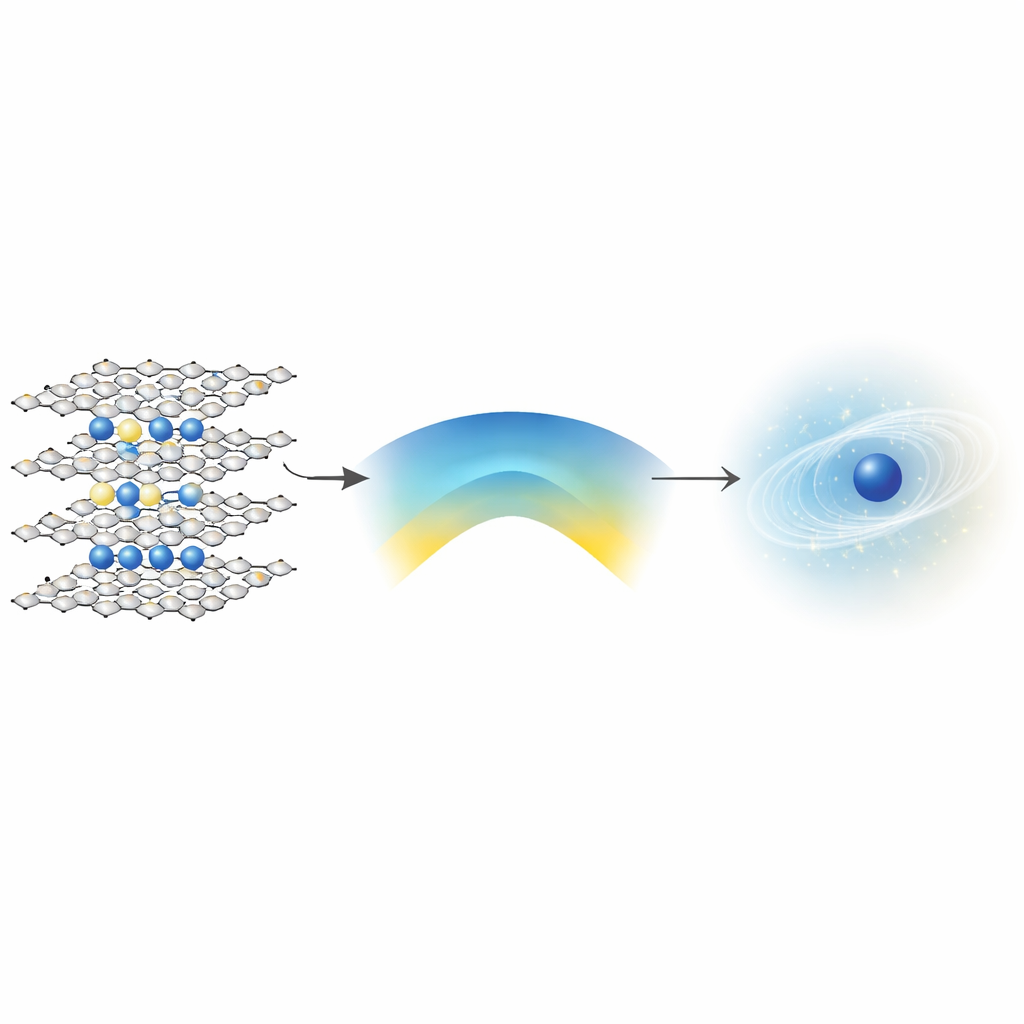
The researchers turned to 1T‑TiS2, a van der Waals layered compound where flat sheets of titanium and sulfur stack like pages in a book. In their samples, some extra titanium atoms naturally slip into the gaps between layers—a process called self‑intercalation. These interlayer atoms act as an internal electron reservoir, heavily doping the material without the disorder and surface treatments usually required. Using detailed calculations, the team shows that this self‑intercalated crystal is a highly electron‑rich semiconductor with a modest band gap, and that its electronic bands match angle‑resolved photoemission measurements. Crucially, however, the data also reveal an additional faint band sitting about 0.2 electronvolts below the main conduction band, a hallmark “shadow” often associated with polaronic behavior.
Following the energy trail of hidden waves
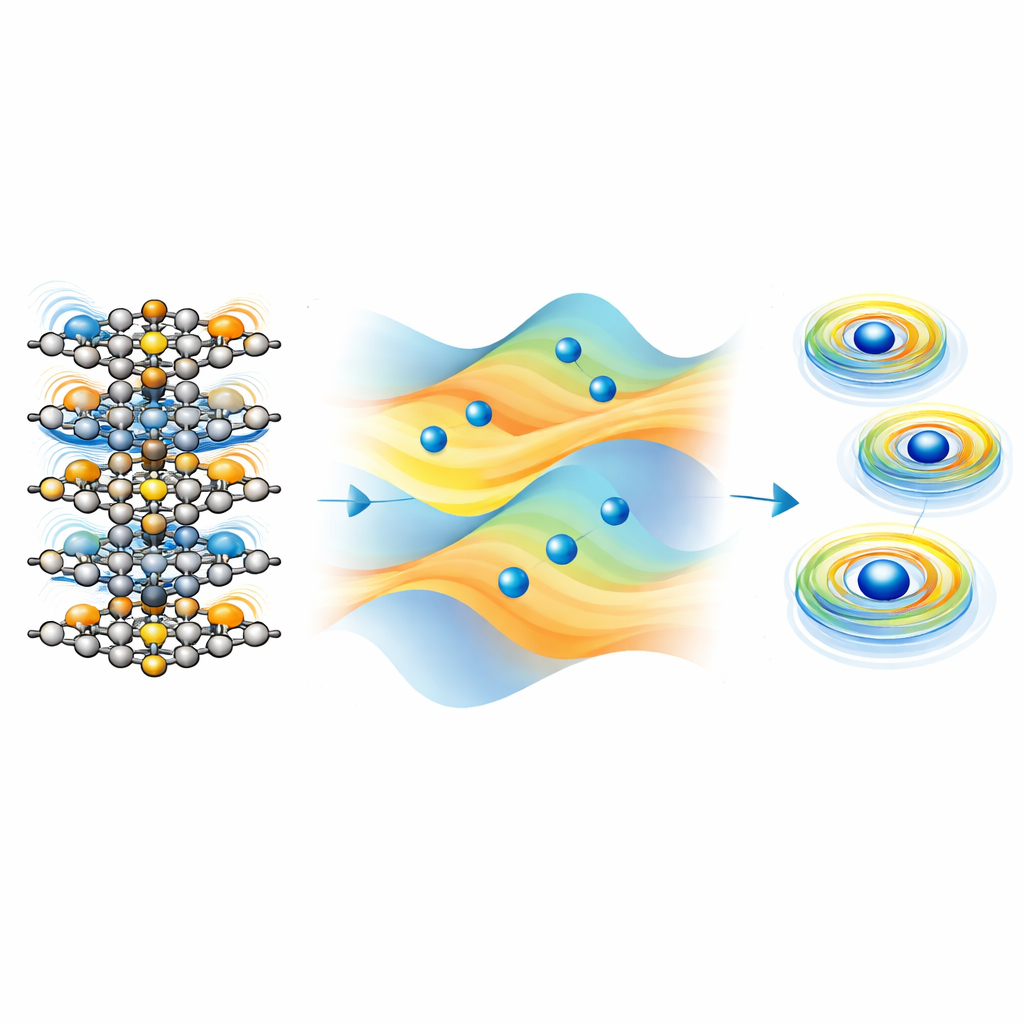
To identify what kind of bosonic partner created this shadow band, the team combined two powerful probes. Photoemission maps how electrons occupy energy and momentum states, while high‑resolution electron energy‑loss spectroscopy measures the energies of collective excitations. The loss spectra show two distinct modes: a low‑energy one matching lattice vibrations, and a much higher‑energy mode near 0.2 electronvolts whose behavior fits that of a bulk plasmon, including its rapid fading at higher momenta. The separation between the main conduction band and the satellite in the photoemission data matches this plasmon energy, strongly indicating that electrons are coupling to plasmons rather than to ordinary vibrations.
Turning a quantum knob: density and temperature
A key signature of plasmonic, rather than vibrational, polarons is that their characteristic energy should change when the density of mobile electrons changes. The researchers tested this by gently depositing rubidium atoms on the crystal surface, adding even more electrons. As the carrier density rose, the energy gap between the main band and the satellite band increased by nearly 10%, just as expected for a plasmon whose frequency grows with electron density. They then explored temperature effects. As the crystal warmed, the plasmon peak in the loss spectra shifted to lower energy, broadened, and weakened, and the satellite band in photoemission became fuzzier and moved closer to the main band. By tracking both the number of carriers and their effective mass, the team showed that these changes require an increase in the material’s dielectric screening—the ability of its electrons and lattice to smooth out electric fields—which damps and softens the plasmon with heat.
A new playground for tunable electron waves
Altogether, the matching energy scales, tunable satellite spacing, and detailed calculations confirm that 1T‑TiS2 with self‑intercalated titanium hosts intrinsic plasmonic polarons in its bulk. To a non‑specialist, this means the material naturally supports electrons that move while dragging along ripples of collective charge, and that the strength and energy of this partnership can be adjusted by changing how many electrons are present and how warm the crystal is. Because similar layered compounds can readily accept extra metal atoms between their sheets, this work points to a broad class of materials where such tunable electron–plasmon couplings might be engineered—potentially enabling new kinds of plasmon‑assisted electronics or even alternative routes to high‑temperature superconductivity.
Citation: Choi, B.K., Choi, W., Tao, Z. et al. Plasmonic polaron in self-intercalated 1T-TiS2. Commun Mater 7, 105 (2026). https://doi.org/10.1038/s43246-026-01118-9
Keywords: plasmonic polaron, electron plasmon coupling, layered quantum materials, tunable charge carriers, 1T-TiS2