Clear Sky Science · en
Ultra-fast time modulated Willis vectors in nonreciprocal active acoustic metamaterials
Why fast control of sound matters
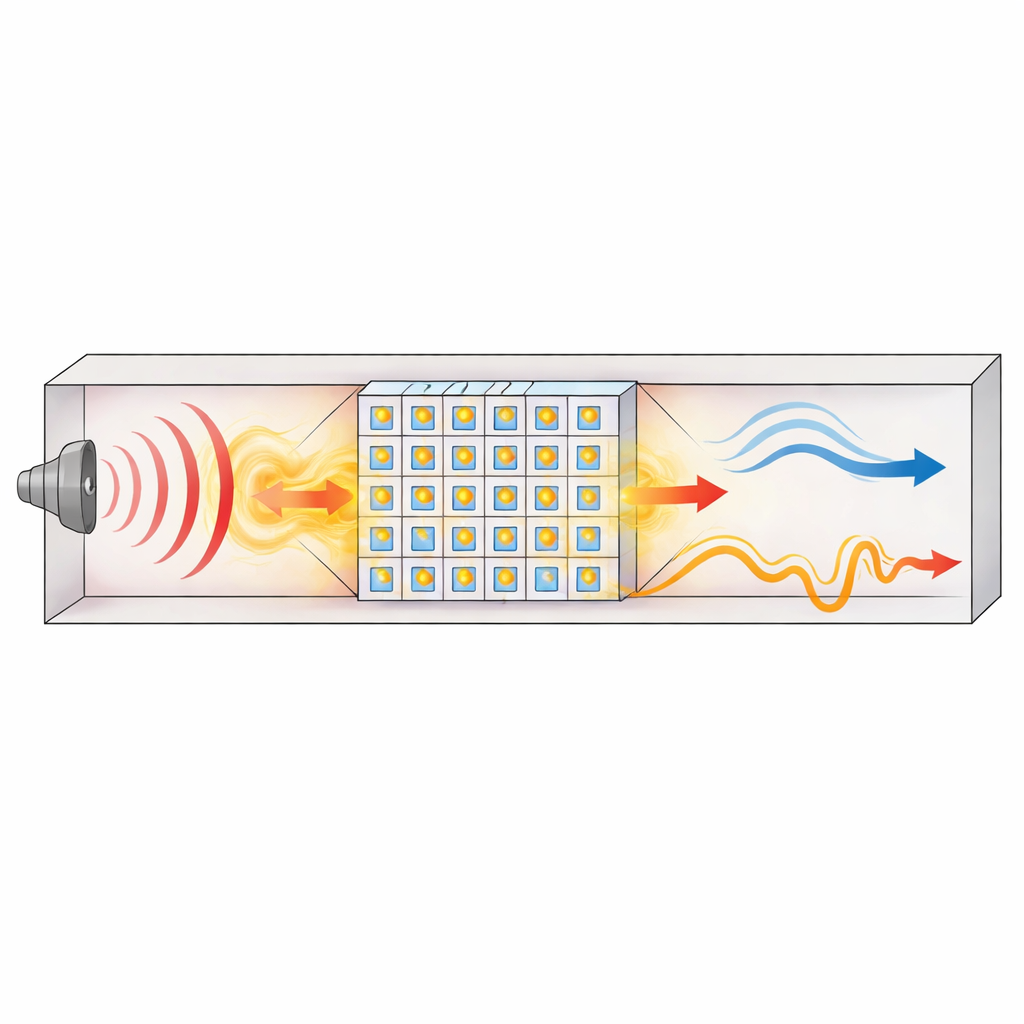
From noise‑canceling headphones to medical ultrasound, our ability to control sound usually depends on fixed materials that behave the same way every moment. This paper explores a radically different idea: a man‑made "fluid" for sound whose properties can be electronically reprogrammed and even rapidly changed in time. Such a medium can let sound pass freely in one direction while blocking it in the other, or steer a beam of sound around corners at will—all at speeds comparable to the sound waves themselves. These capabilities hint at future acoustic devices that are as flexible and smart as modern electronics.
Building a programmable sound medium
The authors start from a theoretical concept called Willis media, which describes exotic materials where sound pressure and motion are linked in unusual ways. In ordinary air or water, these links are limited by symmetry and energy‑conservation rules. Here, the team sidesteps those limits by constructing an active metamaterial: a grid of small electronic unit cells inside a thin two‑dimensional waveguide. Each cell contains microphones to sense the local sound field, a microcontroller that computes a response, and speakers that feed sound back into the medium. By choosing how the microphone signals are multiplied and delayed before driving the speakers, the researchers can effectively dial in a desired stiffness, mass, and a vector quantity (the "Willis vector") that gives the medium a built‑in sense of direction.
Making sound pass one way but not the other
To showcase what this programmable medium can do, the team first configures their grid of 16 unit cells as a slab that is almost invisible to sound coming from one side but strongly blocking from the other. They adjust two key parameters—an effective stiffness and a directional Willis vector—so that, when a sound wave travels along the Willis vector, the slab’s own response cancels the usual scattering, and the wave passes through as if nothing were there. When the same wave comes from the opposite side, the cancellation becomes reinforcement, and the slab behaves more like a solid barrier. Crucially, because the behavior is generated by software‑controlled gains inside each cell, the orientation and strength of this directional vector can be changed on the fly.
Spinning the material properties in time
The authors then push the concept further by letting the Willis vector rotate in time, like the hand of a clock. While the sound at a chosen pitch passes through the metamaterial, the internal programming causes its preferred direction to sweep around at a selectable cycle frequency. Experiments show that when this rotation is slow compared with the sound frequency, the medium behaves as if it were static at each instant, simply redirecting scattering in step with the rotation. As the rotation rate increases to become comparable to or faster than the sound frequency, the system no longer looks static: the scattered sound forms short pulses and frequency sidebands, effectively mimicking a different, "time‑averaged" material. This demonstrates that rapidly changing internal settings can create acoustic responses that do not exist in any ordinary fixed substance.

Guiding sound around a circular shell
In a second demonstration, the researchers reshape the active cells into a ring around a central source, turning the medium into a kind of acoustic traffic circle. By programming the Willis vector to point tangentially around the ring, they bias sound to circulate preferentially in one rotational direction. Simulations reveal that waves entering the shell from one side are guided smoothly through and out the other side, while waves coming from the opposite side are mostly reflected away—behavior similar to a three‑port "circulator" used in radio‑frequency technology. When a source is placed at the center, the ring redirects its emission so that the outgoing beam appears rotated relative to the actual orientation of the source. Time‑modulating the strength and direction of the Willis vector causes this apparent beam direction to swing rapidly, enabling fast electronic steering without moving any hardware.
What this means for future sound control
Overall, the paper shows that a grid of sensor‑and‑speaker units can act like a bulk acoustic medium whose directional properties can be programmed and even spun in time at will. This medium can make sound flow more easily one way than the other, filter it by direction, or steer it around a shell, all while operating at audio frequencies with reconfiguration speeds set by fast digital electronics. To a lay reader, the key message is that sound can now be controlled almost as flexibly as light or radio waves in modern communication systems, pointing toward compact, tunable devices for sound isolation, beam steering, and perhaps even acoustic computing based on time‑varying materials.
Citation: Kovacevich, D.A., Popa, BI. Ultra-fast time modulated Willis vectors in nonreciprocal active acoustic metamaterials. Commun Mater 7, 96 (2026). https://doi.org/10.1038/s43246-026-01112-1
Keywords: acoustic metamaterials, nonreciprocal sound, time-modulated media, beam steering, wave control