Clear Sky Science · en
High-performance zinc tin oxide thin-film transistors via hydrogen assisted metal capping structures
Faster Screens for Everyday Devices
Modern gadgets like smartphones, tablets, and augmented‑reality headsets rely on tiny electronic switches called thin‑film transistors to control each pixel on a screen. To make brighter, sharper, and more power‑efficient displays—especially on flexible or heat‑sensitive surfaces—engineers need these switches to move electrical charge very quickly without using expensive or scarce materials. This study shows how a clever combination of a common metal, aluminum, and a treatment with hydrogen gas can dramatically speed up a promising, indium‑free transistor material called zinc tin oxide, without resorting to high‑temperature or costly manufacturing steps.
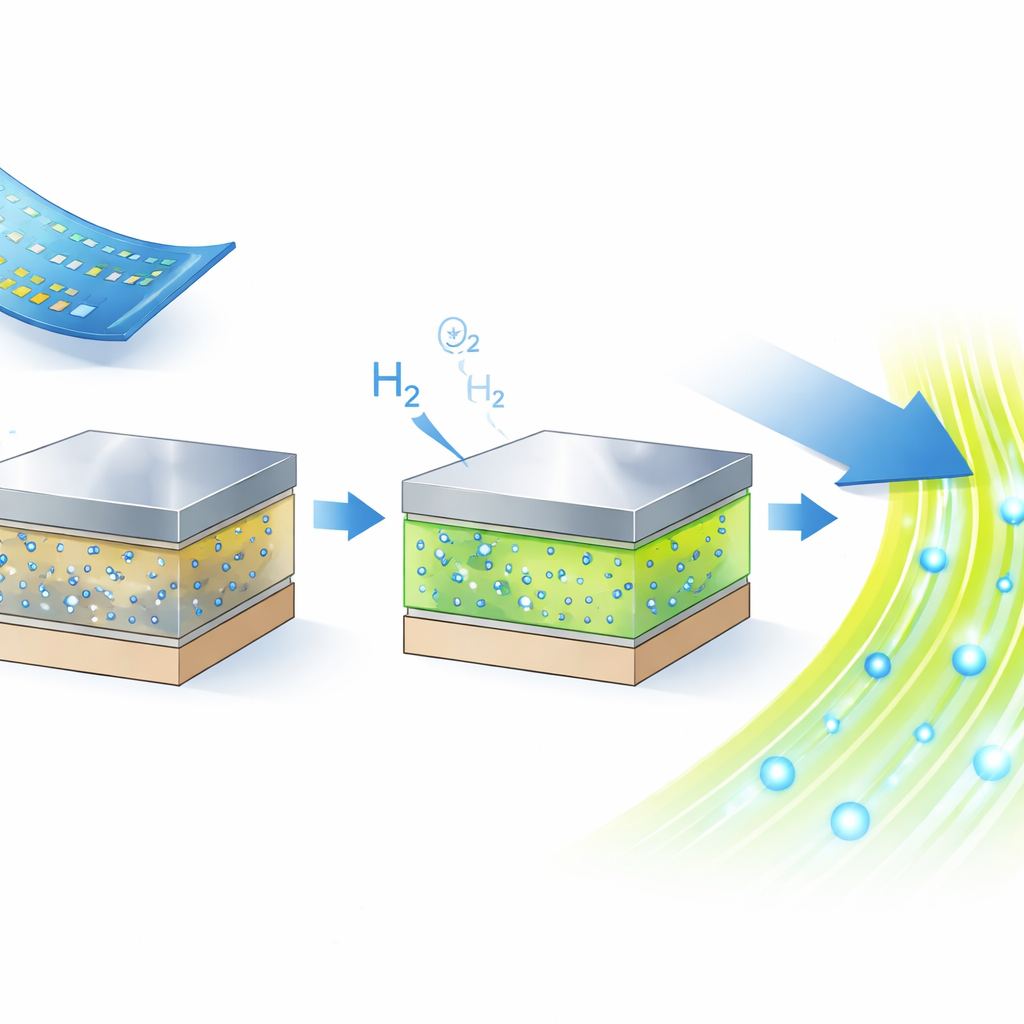
Why New Switch Materials Matter
Today’s high‑end displays often use silicon‑based transistors or oxide materials that contain indium, a relatively rare and expensive element. While these technologies deliver good performance, they either require very high processing temperatures or complex, power‑hungry circuits. Zinc tin oxide stands out as an attractive alternative because it avoids indium yet can still be transparent and compatible with large, low‑cost glass or plastic panels. The challenge is that in its usual glass‑like (amorphous) form, charge moves through zinc tin oxide more slowly than desired for ultra‑high‑resolution or high‑refresh‑rate displays. The researchers set out to coax this material into a more ordered form at gentle temperatures, so electrons can travel faster while still keeping the process simple and scalable.
Using a Metal Cap to Tidy the Material
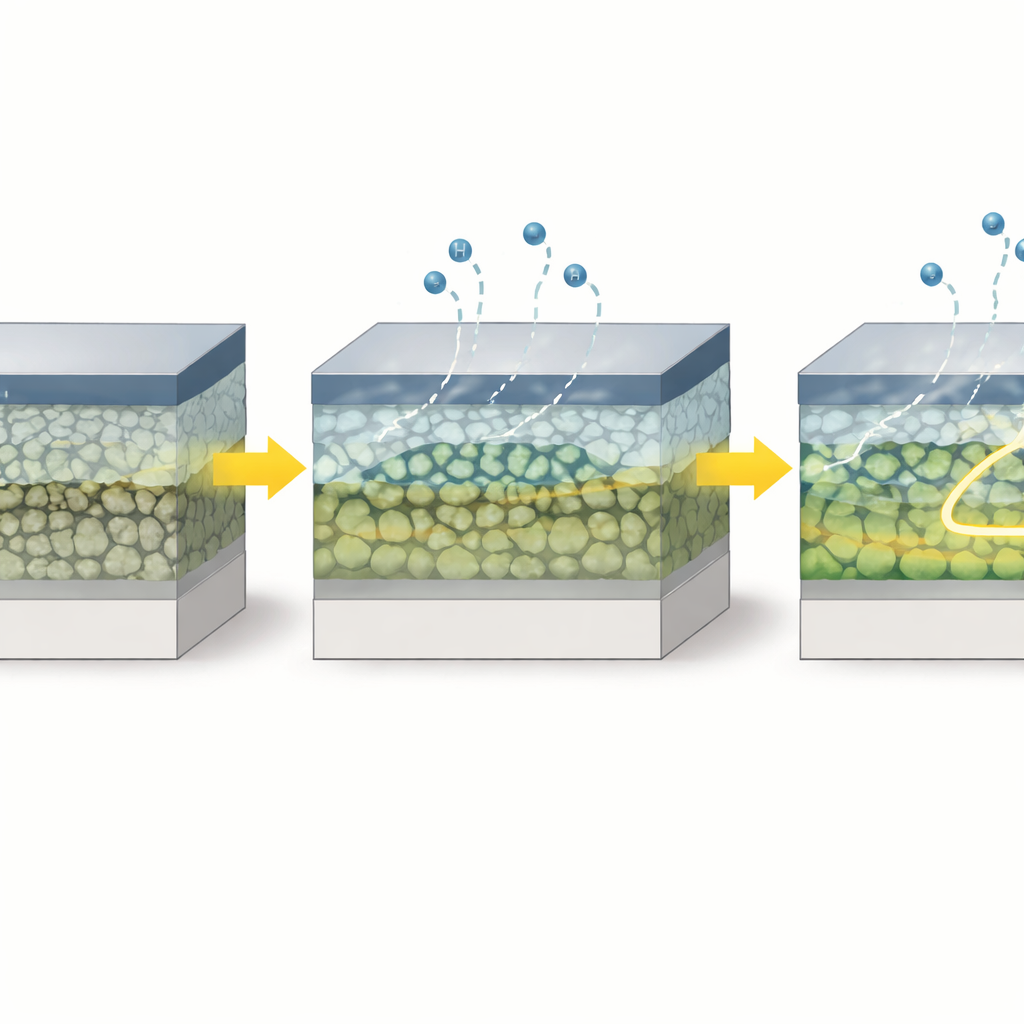
The team began with thin layers of amorphous zinc tin oxide deposited on an insulating surface, then added a very thin aluminum “cap” on top. When this stack is heated in air, the aluminum strongly prefers to grab oxygen, forming aluminum oxide at the interface. In doing so, it pulls weakly bound oxygen out of the zinc tin oxide layer beneath. This oxygen reshuffling destabilizes the disordered network and allows atoms to rearrange into a more regular, crystalline pattern at temperatures around 350 °C—far lower than the roughly 700 °C normally needed. Microscopy and X‑ray measurements confirmed that a crystalline region forms just under the aluminum, and that this region becomes thicker wherever the aluminum strip is longer, directly tying the metal cap to how much of the channel turns into a better‑ordered phase.
Hydrogen as a Subtle Helper
To push the improvement further, the researchers introduced an extra heating step in a hydrogen‑containing atmosphere before the final air anneal. Hydrogen atoms slip into the oxide network as small defects or temporary bonds, making it easier for metal–oxygen connections to break and re‑form in a more organized way. This treatment produces a larger crystalline zone with fewer disruptive flaws at the same overall temperature. Chemical analysis showed fewer oxygen‑related defects in the hydrogen‑treated films, and slightly larger crystalline grains. Importantly for device use, this cleaner structure not only helps electrons move more freely but also reduces the trap sites that usually cause transistors to drift or degrade under long‑term electrical stress.
Two Parallel Paths for Electric Current
When built into working thin‑film transistors, these structural changes translate into striking performance gains. Devices processed only in air but capped with aluminum reached an electron mobility of about five times that of uncapped zinc tin oxide. Adding the hydrogen step more than doubled mobility again, exceeding 100 square centimeters per volt‑second—rivaling or surpassing many commercial oxide and even some silicon‑based backplane technologies. Computer simulations helped explain why: the aluminum‑induced crystalline layer forms a high‑speed “back channel” for electrons beneath the cap, while the remaining amorphous region near the source and drain contacts continues to control the transistor’s turn‑on voltage. As the aluminum strip gets longer, this fast lane extends, boosting current without shifting the voltage at which the device switches on, and preserving stability under repeated biasing.
What This Means for Future Displays
In plain terms, the study shows a way to turn an inexpensive, indium‑free oxide into a high‑speed transistor channel using modest heating and a thin aluminum overlayer, with hydrogen acting as a quiet assistant that improves ordering and reduces defects. The result is a tiny switch that can carry charge more than ten times faster than the untreated material, while keeping its operating voltage stable and its processing compatible with large‑area and potentially flexible display manufacturing. This metal‑assisted, hydrogen‑enhanced approach offers a practical route toward faster, more efficient pixels for next‑generation screens in everything from virtual‑reality headsets to energy‑saving smartphones.
Citation: Nam, D., Jeon, SP., Kim, D.H. et al. High-performance zinc tin oxide thin-film transistors via hydrogen assisted metal capping structures. Commun Mater 7, 95 (2026). https://doi.org/10.1038/s43246-026-01111-2
Keywords: zinc tin oxide transistors, oxide semiconductor displays, metal-induced crystallization, hydrogen annealing, high-mobility TFTs