Clear Sky Science · en
Multidimensional and reconfigurable optical neuromorphic computing using perovskite-based all-photonic synapses
Light That Learns
Computers that power modern artificial intelligence still move bits of data back and forth between separate chips for memory and processing, wasting time and energy. This study explores a radically different approach: using light itself to both carry information and perform brain-like learning. The researchers built an "all-photonic synapse"—a tiny light-controlled element that remembers past flashes of light—and then showed how large collections of these elements could recognize patterns and adapt to changing surroundings without rewiring the hardware.
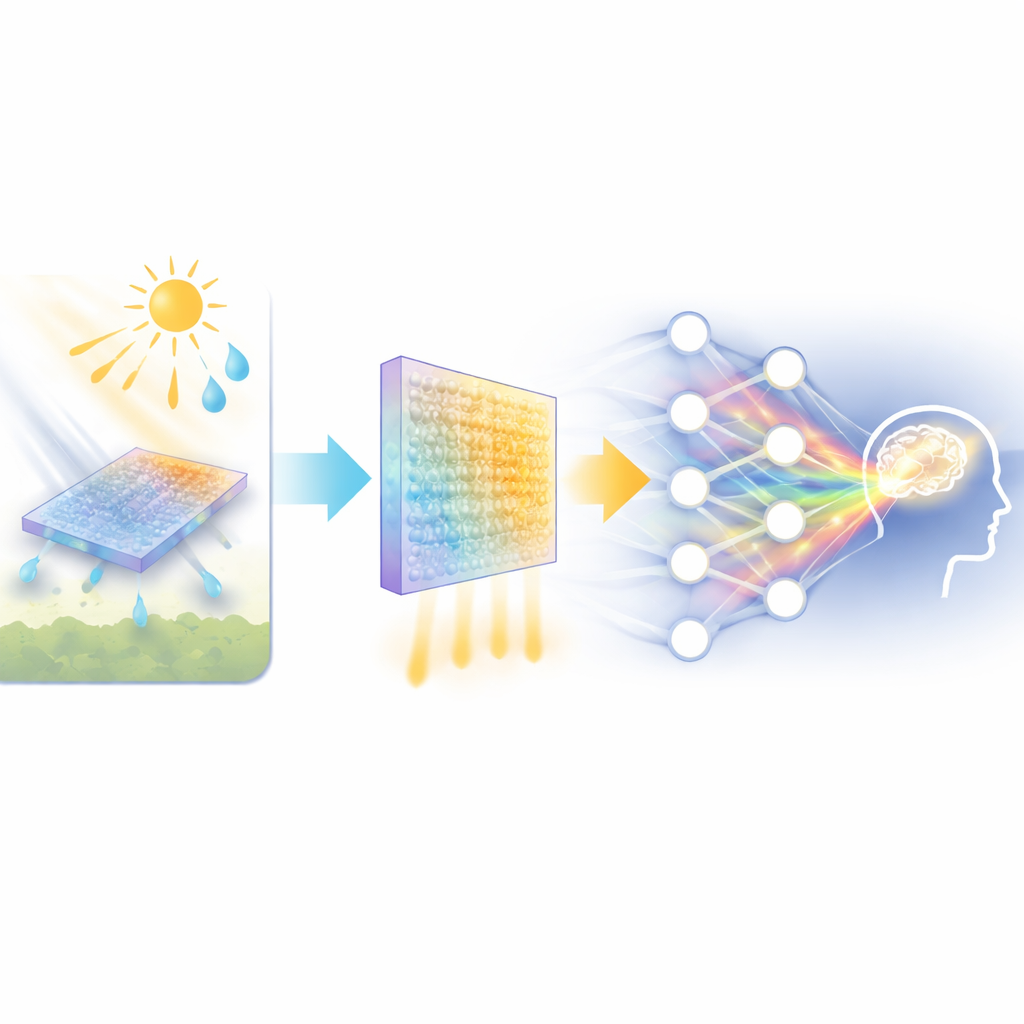
A Film That Changes With Light and Air
At the heart of the work is a thin film made from a perovskite material that is unusually sensitive to both light and water in the air. When ultraviolet light shines on the film, its crystal structure rearranges and it darkens, blocking more visible light; when the light is removed and the material absorbs moisture from the environment, it slowly returns to a more transparent state. This back-and-forth shift is fully reversible and very stable over many cycles and months of storage. Because the amount of light that passes through the film can swing from nearly clear to strongly tinted, it provides a wide window for encoding different “weights” or strengths—much like the variable connection strengths between neurons in the brain.
Optical Synapses That Remember
The researchers treat changes in the film’s transparency as an optical memory. Successive light pulses can temporarily boost the film’s response, mimicking how real synapses briefly strengthen when signals arrive in quick succession. By varying how many light pulses strike the film, how often they are repeated, and how strong they are, the team can push the device from short-lived memories that quickly fade to long-lived ones that persist, echoing the brain’s distinction between short-term and long-term memory. The surrounding humidity also acts as a control knob: drier air slows the material’s recovery, extending how long the “memory” of a light pulse is preserved, while more humid conditions speed up forgetting.
Reading Many Clues From One Device
Because the film’s response depends on several factors at once—light power, exposure time, and humidity—the same type of synapse naturally carries multidimensional information about its environment. The team recorded how the film’s transparency evolved over time under different conditions and fed these traces into a recurrent neural network, a form of artificial intelligence that excels at recognizing patterns that unfold in time. Even though all the information came from a single kind of optical signal, the network learned to tell apart different light intensities, pulse durations, and moisture levels with perfect accuracy, showing that these photonic synapses can serve as rich, time-sensitive sensors as well as memory elements.
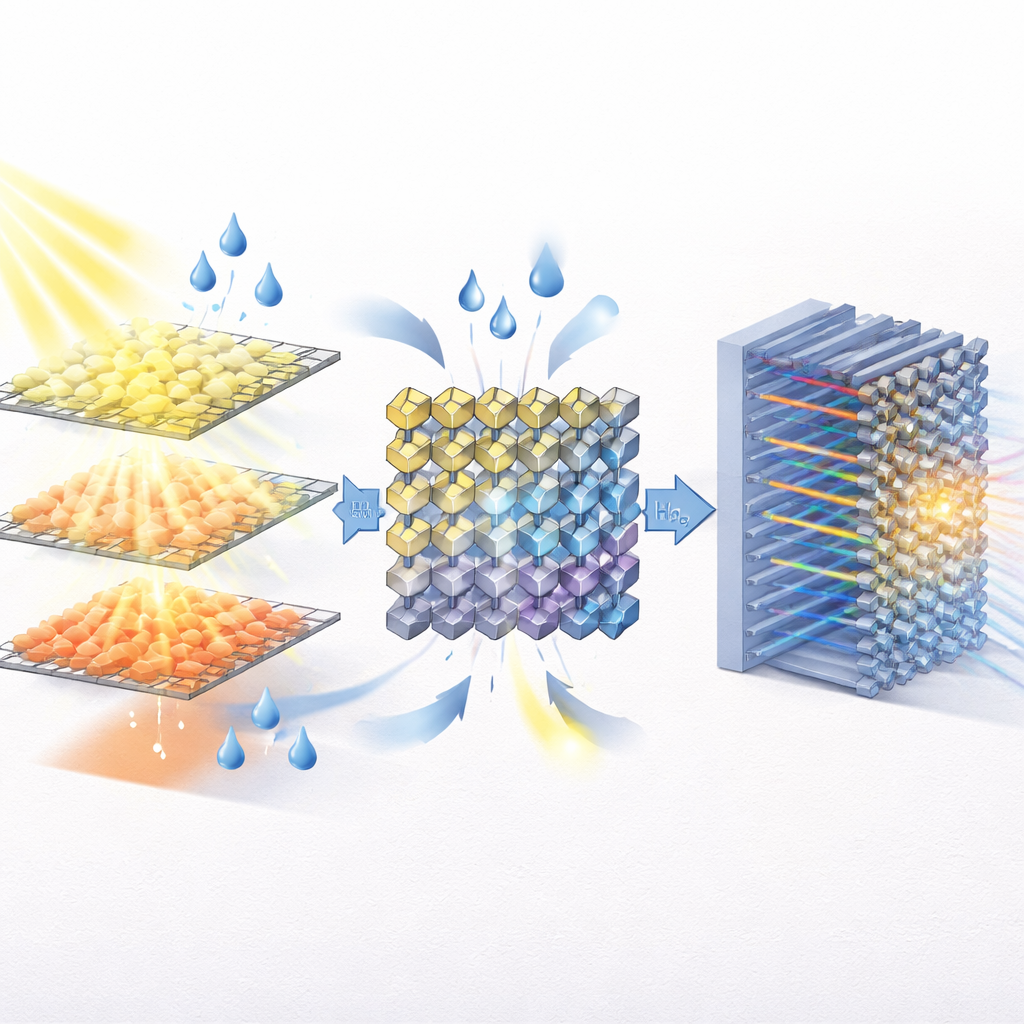
Rewiring Tasks With Only Light
To demonstrate practical computing, the authors then used arrays of these films as the adjustable elements in a diffractive optical neural network—a setup where images are processed as they pass through thin patterned layers rather than through electronic circuits. By shining different programming light sequences on the perovskite synapses, they could dial in up to 80 distinct transparency levels at each location, effectively setting the network’s internal parameters without any physical changes. With one set of optical "weights" the system classified handwritten digits; with another, it recognized clothing items from a separate database. Both tasks were handled by the same hardware, simply reconfigured by light-driven updates of the synapses.
What This Means for Future Machines
This work shows that a simple light-sensitive film can behave like a smart, adjustable connection in a neural network, storing information in its transparency and responding differently depending on both recent signals and the surrounding environment. By combining many such elements, the researchers create optical systems that can sense, remember, and adapt to new tasks at high speed and with low energy use, all without conventional electronic circuits. In everyday terms, it is a step toward cameras and sensors whose "eyes" and "brains" are made of the same light-based material, learning directly from the light they see and reshaping their behavior with nothing more than new patterns of illumination.
Citation: Zi, J., Sun, J., Yang, B. et al. Multidimensional and reconfigurable optical neuromorphic computing using perovskite-based all-photonic synapses. Commun Mater 7, 92 (2026). https://doi.org/10.1038/s43246-026-01097-x
Keywords: optical neuromorphic computing, perovskite synapse, all-photonic memory, reconfigurable photonics, diffractive neural network