Clear Sky Science · en
Shapiro steps in ballistic Josephson junction based on a single Bi2Te2.3Se0.7 nanocrystal
Why this matters for future quantum tech
Engineers around the world are racing to build quantum devices that store and manipulate information in especially robust quantum states, sometimes linked to elusive particles called Majorana modes. One popular way to hunt for these states is to look for a peculiar electrical fingerprint—missing steps in the voltage response of a tiny superconducting circuit. This paper shows that even perfectly ordinary effects like heating can mimic that fingerprint, reminding us to be cautious when declaring the discovery of new quantum phases of matter.
A tiny bridge for superconducting currents
The study focuses on a nanoscale “bridge” called a Josephson junction, where a thin flake of a special crystalline material sits between two superconducting metal leads. The crystal, made from bismuth, tellurium, and selenium, belongs to a family known as topological insulators, whose surfaces can host unusually robust electronic states. In this device, electrons travel across the crystal in a very clean, nearly collision-free way—a regime known as ballistic transport. When the niobium electrodes on either side become superconducting at low temperature, they induce superconductivity into the crystal as well, allowing a supercurrent to flow with no voltage drop under the right conditions.
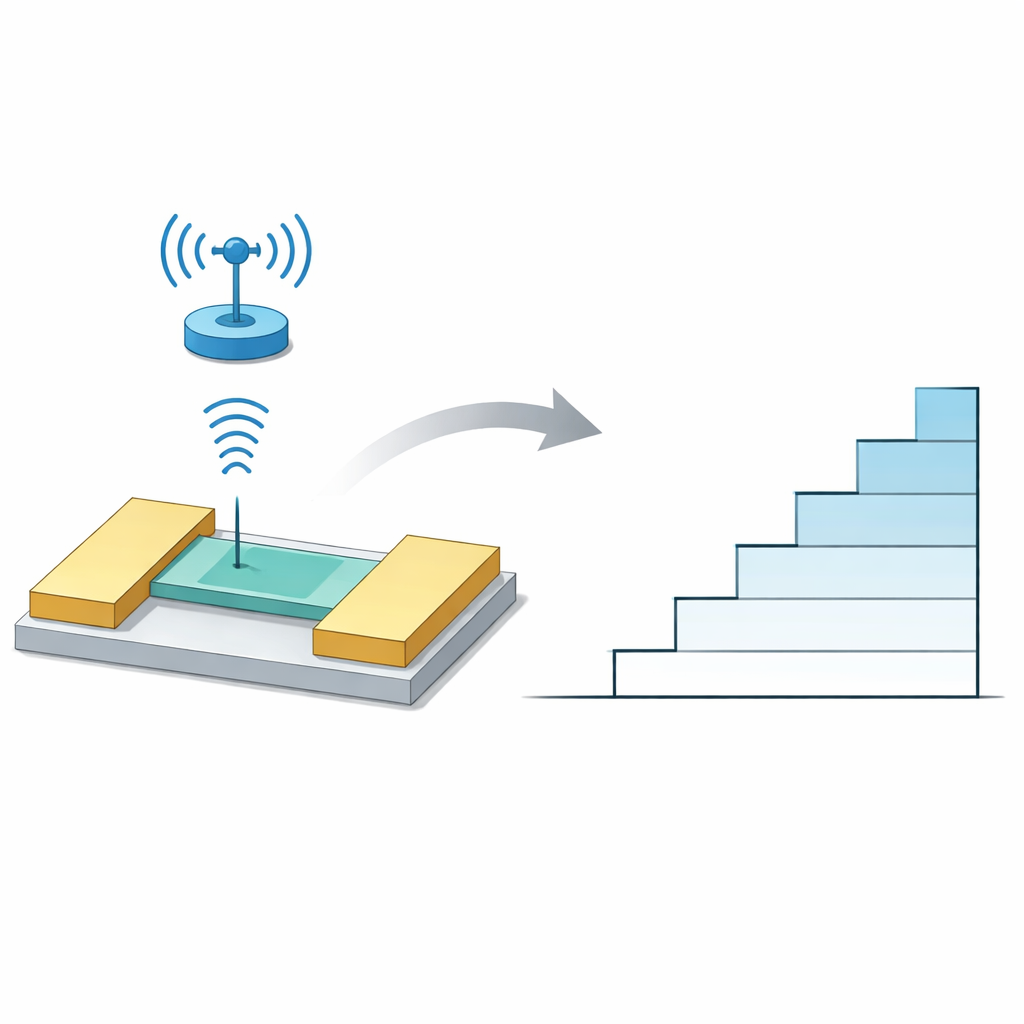
Stepped voltages under microwave drive
When this junction is exposed to microwave radiation, its voltage–current behavior develops a series of plateaus known as Shapiro steps. Each step corresponds to the supercurrent’s internal rhythm locking onto the external microwave rhythm, producing discrete voltage values instead of a smooth ramp. In many materials these steps form a regular sequence: first, second, third, and so on. However, certain exotic superconducting states are predicted to alter this pattern by removing the odd-numbered steps, particularly the very first one. Because of this, experimentalists have treated the absence of the first step as a promising sign of topological superconductivity and of Majorana-like bound states in the junction.
A surprising vanishing act at low frequencies
The authors carefully measured how the Shapiro steps evolve when they change the microwave frequency and power in their ballistic junction. At relatively high frequencies, above about 1.3 gigahertz, the full set of lower steps—including the first—appeared as expected when the drive was strong enough. But as they tuned the microwaves to lower frequencies below 2 gigahertz, the first step gradually weakened and, at still lower frequencies, disappeared from view, while higher steps remained visible. At first glance this pattern looks very much like the sought-after topological signature: a missing first step in an otherwise regular staircase of voltages.
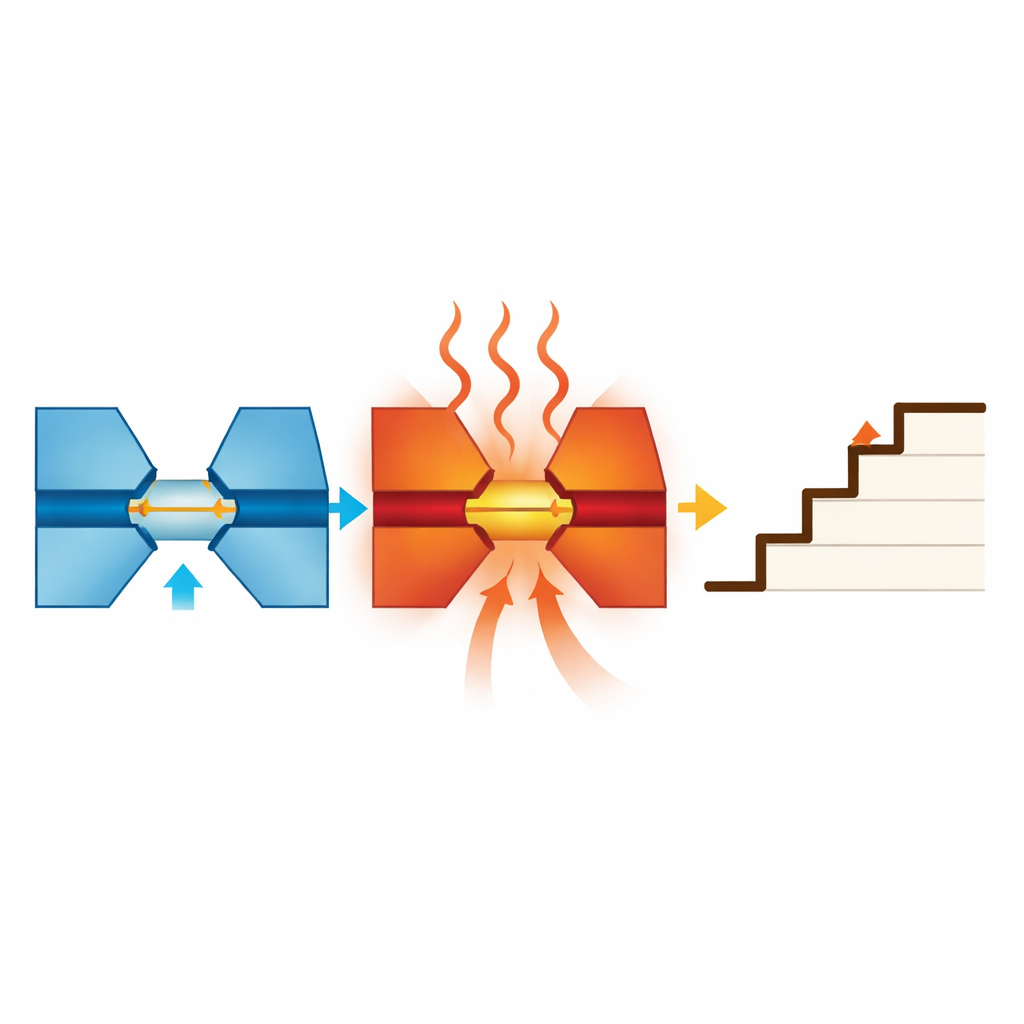
Heating masquerades as exotic physics
To understand whether a truly exotic state was required to explain these observations, the team turned to a detailed model that includes two very down-to-earth ingredients: ordinary superconducting currents and simple heating. In this picture, the junction behaves like a standard Josephson element shunted by a resistor, but the local electron temperature is allowed to rise as electrical power is dissipated and to cool through interaction with the crystal lattice. By solving the coupled equations for the current, voltage, and temperature, the researchers reproduced the key experimental feature—the selective loss of the first step at low frequency—without needing to assume a dominant exotic current channel. They also explored more subtle effects, such as how the junction’s tendency to jump between superconducting and resistive states near a “retrapping” current can hide the lowest step when heating is strong.
Rethinking a popular quantum clue
While the device studied had previously shown hints of unconventional superconductivity in other measurements, the present work shows that the missing first Shapiro step in this setup can be fully, or almost fully, explained by conventional thermal effects. In plain terms, the junction simply gets warm in the wrong places at the wrong times, scrambling the lowest step in the voltage staircase. The authors conclude that this widely used diagnostic—looking for a vanished first step under microwave drive—cannot by itself serve as proof of topological superconductivity or Majorana modes. Future experiments will need to combine multiple, carefully controlled signatures and pay close attention to mundane processes like heating before claiming the discovery of new quantum states.
Citation: Stolyarov, V.S., Kozlov, S.N., Yakovlev, D.S. et al. Shapiro steps in ballistic Josephson junction based on a single Bi2Te2.3Se0.7 nanocrystal. Commun Mater 7, 91 (2026). https://doi.org/10.1038/s43246-026-01095-z
Keywords: Josephson junctions, topological superconductivity, Shapiro steps, Majorana modes, quantum materials