Clear Sky Science · en
Defect landscape engineering suppresses helium damage in ceramics
Why hidden flaws can make materials safer
In nuclear reactors, fusion devices, and even some spacecraft, materials must withstand constant bombardment by energetic particles without cracking or falling apart. One of the most troublesome culprits is helium, a harmless gas in daily life that can quietly rip ceramics apart from the inside. This study shows that, counterintuitively, adding the right kind of tiny “pre-damage” to a ceramic can make it far more resistant to helium, offering a new way to design safer, longer‑lasting materials for extreme environments.
Helium: a quiet destroyer inside hard materials
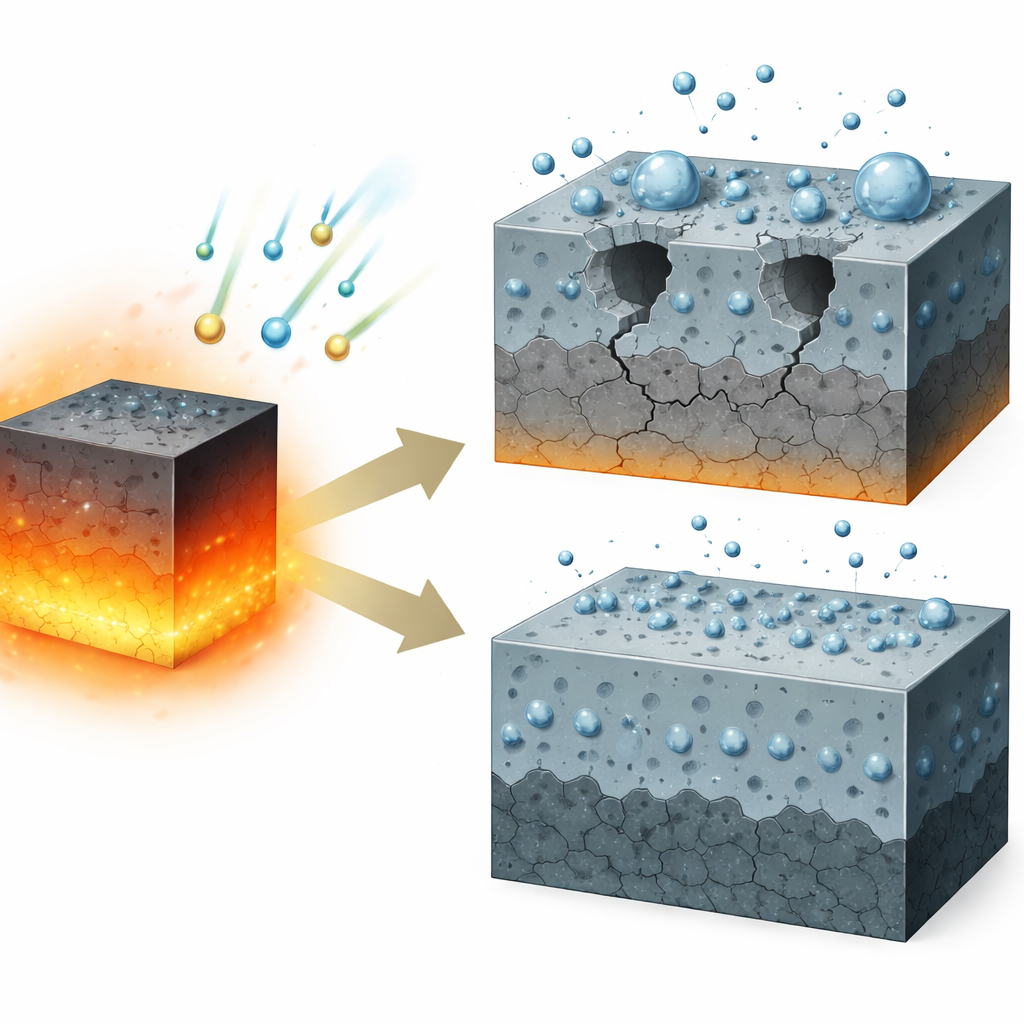
Helium atoms are created inside reactor materials by nuclear reactions or arrive from hot plasmas. Because helium does not dissolve easily in solids, the atoms tend to clump together. In structural ceramics such as silicon carbide, these clumps grow into bubbles, flat gas pockets called platelets, and eventually networks of cracks. Near the surface, the pressurized gas can cause blistering and pieces of material to spall off. Traditional approaches try to change composition or microstructure to cope with this damage, but there has been no simple, general way to control how helium defects form and grow.
Turning flaws into a protective landscape
The authors introduce a design idea they call defect landscape engineering. Instead of treating defects as an unavoidable weakness, they deliberately create specific types of vacancies—empty atomic sites—before helium ever arrives. Using silicon carbide as a model ceramic, they bombard the material with carbon ions to generate controlled levels of pre‑damage at chosen depths, mimicking the empty pockets that would exist under real reactor conditions. The key question is whether this tailored background of tiny defects can redirect where helium goes and what kinds of structures it forms.
Seeing bubbles, cracks, and strain at the nanoscale
To test this, the team compares three cases: silicon carbide exposed only to helium, silicon carbide first given a low level of pre‑damage, and silicon carbide given a higher level of pre‑damage. With advanced electron microscopy, they find that helium alone at high temperature produces long gas‑filled platelets and nanocracks, tightly concentrated near the peak helium depth, along with strong local stretching of the crystal lattice. When a modest amount of pre‑damage is introduced, these large platelets disappear and are replaced by discrete bubbles and bubble arrays, still somewhat localized. At the highest pre‑damage level, helium no longer forms platelets or cracks at all—instead, it resides as uniformly dispersed nanometer‑scale bubbles spread over a much broader region, and the overall strain is reduced.
How engineered vacancies tame helium
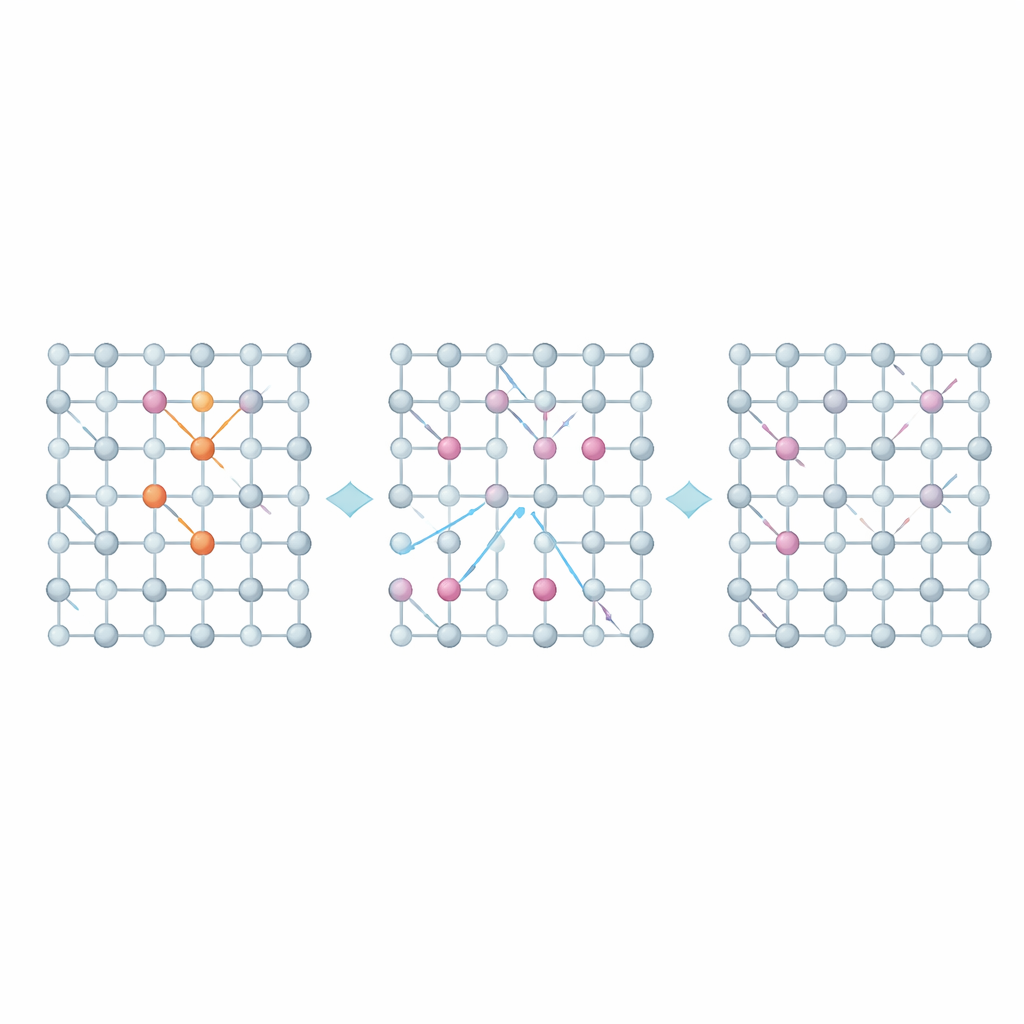
Other measurements, including positron annihilation spectroscopy, confirm that pre‑damaged samples contain many small vacancy clusters rather than a few large voids. Computer simulations then reveal why this matters. In virtual collision cascades, pre‑existing voids act as sinks for interstitial atoms—the displaced atoms that normally help build big defect clusters—causing the voids to shrink and leaving behind numerous small vacancy groups. Calculations at the atomic level show that helium atoms are especially strongly attracted to these small clusters and prefer to bind there rather than in pure helium clumps. As a result, helium is trapped early in many tiny pockets, forming stable nanobubbles whose local gas content never becomes high enough to inflate into damaging platelets.
A new dial for designing tougher ceramics
By carefully shaping the “defect landscape” ahead of time, this work turns what would usually be a weakness—damage—into a powerful design tool. In silicon carbide, it converts dangerous helium‑induced cracks into harmless, evenly distributed nanobubbles and spreads strain over a larger volume. Because the underlying mechanism depends mainly on how vacancies and helium interact, not on the exact chemistry of the ceramic, the authors argue that this strategy should extend to many carbides, nitrides, and oxides used in nuclear, fusion, and aerospace systems. In practical terms, it suggests that engineers can tune pre‑damage, via ion implantation or irradiation during processing, as a new knob to boost the radiation tolerance and lifetime of hard, brittle materials exposed to some of the harshest conditions humans can create.
Citation: Daghbouj, N., Tamer AlMotasem, A., Li, B. et al. Defect landscape engineering suppresses helium damage in ceramics. Commun Mater 7, 97 (2026). https://doi.org/10.1038/s43246-026-01083-3
Keywords: helium damage, radiation tolerant ceramics, silicon carbide, defect engineering, nuclear materials