Clear Sky Science · en
Modular large language model agents for multi-task computational materials science
Smart helpers for designing better materials
From lighter airplanes to longer lasting batteries, new materials quietly power many technologies we rely on every day. But discovering and testing these materials can be slow and complex. This article presents MatSciAgent, a smart digital assistant built on large language models that aims to make materials research faster and easier by turning plain language questions into concrete simulations, database lookups, and structure suggestions.
One digital conductor, many specialist helpers
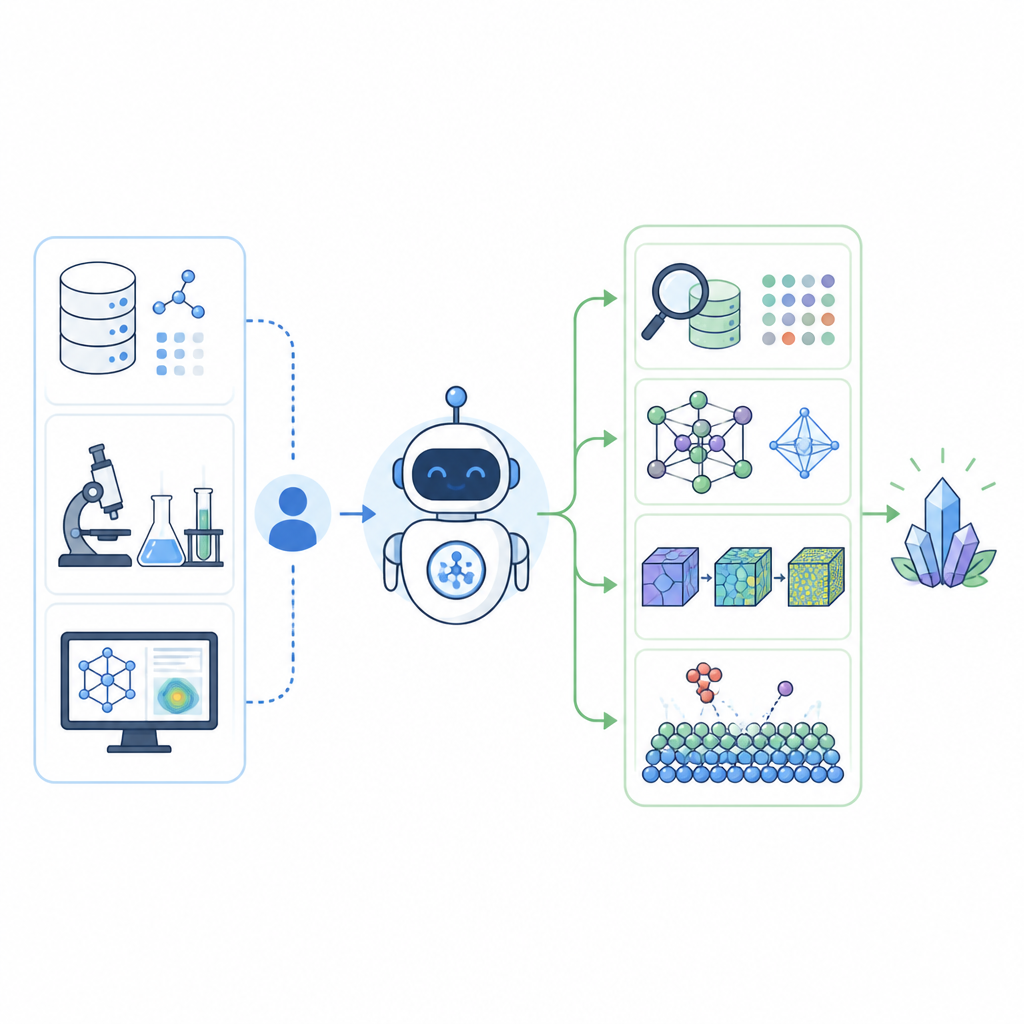
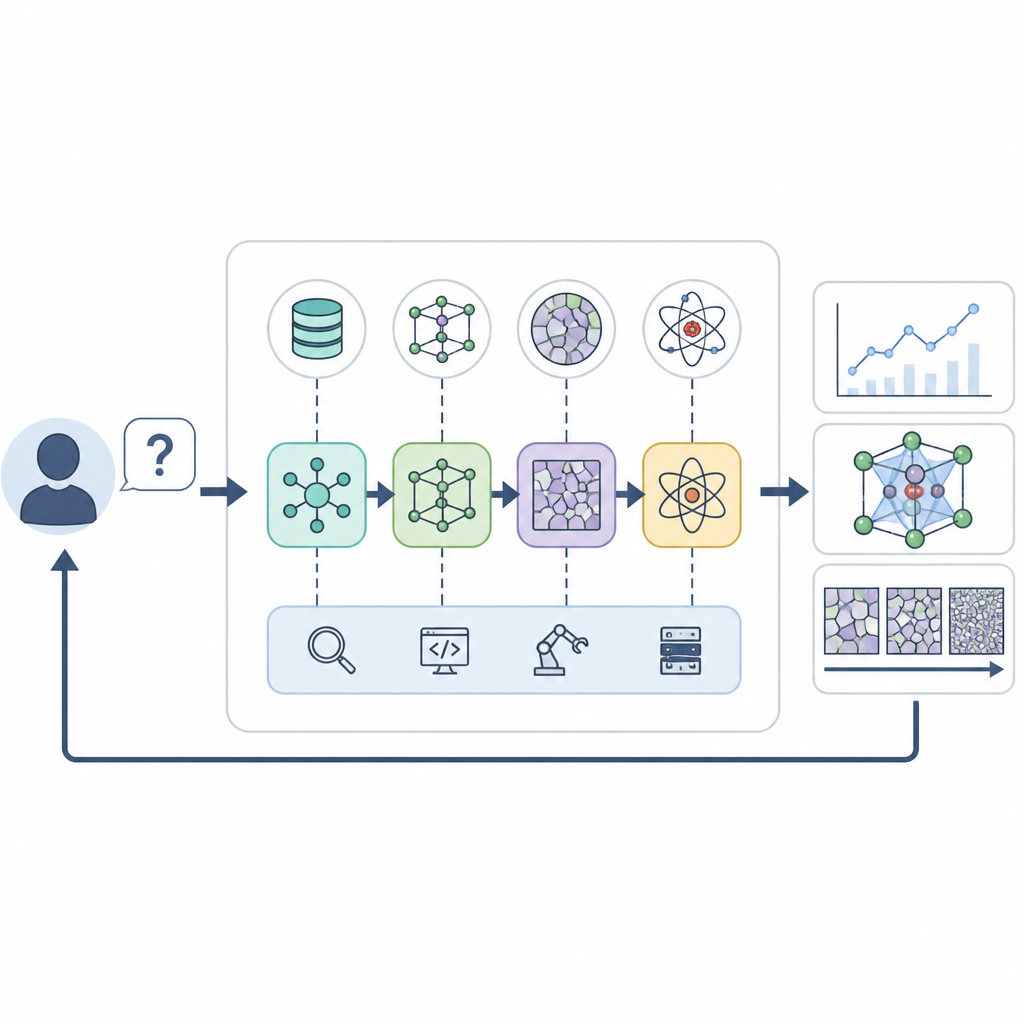
At the heart of MatSciAgent is a master agent that behaves like a conductor of an orchestra. A researcher types a question in everyday language, such as asking for suitable materials or how a metal will behave when cooled. The master agent decides what kind of task this is and passes it to one of several specialist agents. These include agents for looking up materials data, running computer models of how materials change shape or phase, designing crystal structures, and simulating how atoms move. Each specialist has access to its own tools and software, while the language model handles understanding the request and planning the steps.
Grounding answers in real data, not guesswork
A major concern with general purpose language models is that they can sometimes sound confident while being wrong. MatSciAgent tackles this by tying its answers directly to trusted materials databases. When a user asks for synthesis routes for solar cell materials or the bond lengths in a crystal such as titanium dioxide, the materials extraction agent connects to resources like the Materials Project and MatWeb. It then gathers up to date entries, filters them, and writes a summary based on real records instead of memory alone. Tests show that this approach produces richer, more precise answers than an unassisted language model, including specific compositions, process temperatures, and structural details.
From microstructure pictures to atomic motion
The framework also translates natural language instructions into full computer simulations. In continuum simulations, the system models how metal alloys solidify or how grains in a polycrystal grow when heated. By extracting parameters such as grid size, growth probability, and number of nuclei from the user’s words, it can automatically launch tools that create frame by frame images of evolving microstructures. For atomic scale behavior, the molecular dynamics agent sets up simulations of metals like aluminum at chosen temperatures and conditions. It configures crystal structures, selects interaction models, and checks that energy and temperature behave as expected over thousands of time steps.
Inventing plausible crystal building blocks
Sometimes the structure of an interesting material is not yet available in public databases. To handle these cases, MatSciAgent includes a crystal generation agent powered by a specialized language model called CrystaLLM. Given a composition and symmetry description, this agent proposes detailed crystal structures in a standard file format that can be visualized or used directly in later simulations. The system can also link steps together: for example, generating a crystal structure for a nickel aluminum compound and then, in a follow up request, running an atomic simulation of that very structure without the user having to restate all the details.
Checking reliability and room to grow
Because scientific work depends on trust, the authors carefully tested how consistently MatSciAgent behaves. They reran the same queries many times and tracked which agents and tools were selected, what parameters were extracted, and what results came back. For material lookups, continuum simulations, and atomic simulations, the system chose the same workflows and parameters almost every time, with only rare failures and minor differences in how answers were worded. The design is modular, so new databases, more advanced models, or extra simulation methods can be added over time to broaden the range of materials problems the assistant can tackle.
Why this matters for future materials discovery
In simple terms, this work shows how language based AI can move beyond chat into acting as a reliable lab assistant for materials science. By grounding its decisions in trusted data and established simulation tools, MatSciAgent helps researchers move from a question to concrete numbers, structures, and visualizations with far less manual setup. While it does not replace expert judgment or high level physics, its consistent performance and flexible design suggest it could become an everyday companion for scientists searching for the next generation of functional materials.
Citation: Chaudhari, A., Ock, J. & Barati Farimani, A. Modular large language model agents for multi-task computational materials science. Commun Mater 7, 131 (2026). https://doi.org/10.1038/s43246-025-00994-x
Keywords: materials informatics, large language models, scientific agents, molecular dynamics, crystal structure generation