Clear Sky Science · en
Functionally rich crop rotations increase calorie and macronutrient outputs across Europe
Why Crop Variety on Farms Matters to Your Dinner Plate
As the world worries about feeding a growing population, many assume that vast fields of a single cereal—like wheat, maize or barley—are the most efficient way to produce food. This study challenges that belief. By looking at decades of real farm experiments across Europe, the researchers show that mixing different kinds of crops in rotation can actually produce more food energy and a better balance of nutrients for people, without ploughing up extra land.
From Single-Crop Fields to Mixed Farm Landscapes
Modern industrial farming often relies on monocultures: the same cereal grown in the same place year after year, or short rotations that shuffle only different cereals. These systems depend heavily on synthetic fertilizers and pesticides and can degrade soil and increase vulnerability to pests, diseases and climate extremes. The team behind this paper asked a simple but powerful question: if farmers instead rotate cereals with other types of crops—such as oilseeds, root crops, grain legumes and grass–clover leys for forage—does this reduce the total amount of food we can produce, or can it actually increase our ability to nourish people?
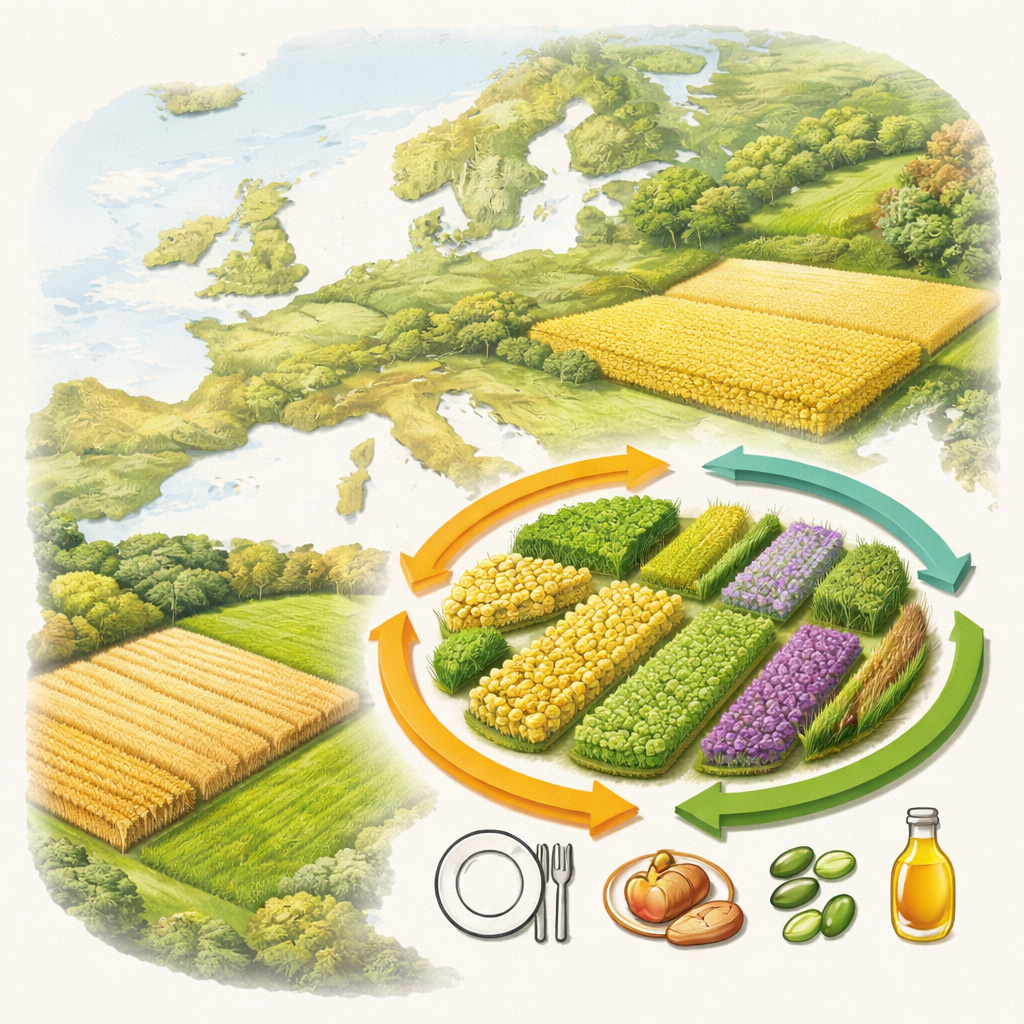
Measuring Food by Calories and Nutrients, Not Just Tonnes
To answer this, the researchers assembled more than 34,500 yield records from 16 long-term experiments scattered across Europe, some running for over half a century. They grouped crops into “functional types” that play different roles: cereals, legumes, broadleaf crops (oil and root crops) and perennial leys for animal feed. For each rotation, they converted crop yields into human-edible calories and the three main macronutrients—carbohydrates, proteins and fats—using data for familiar food products such as flour, beans, vegetable oil, sugar and milk. Importantly, they analyzed the output of the entire rotation on a per-hectare, per-year basis, which reflects how much food a farmed area can really provide to people over time.
More Diverse Rotations Deliver More Food
The results overturn the common idea that diversity on farms must come at the cost of production. Rotations that combined cereals with two additional functional crop types produced 85% more calories, more than twice as much protein and about ten times more fat for human consumption than cereal monocultures, within just five years of adoption—assuming that forage crops were used to produce milk. Even carbohydrates, usually seen as the strong point of cereal monocultures, were maintained or slightly increased overall, depending on local conditions and the exact crops in the mix. These advantages tended to grow over two decades, whereas cereal monocultures often produced less over time as soils degraded and pests and climate stresses accumulated.
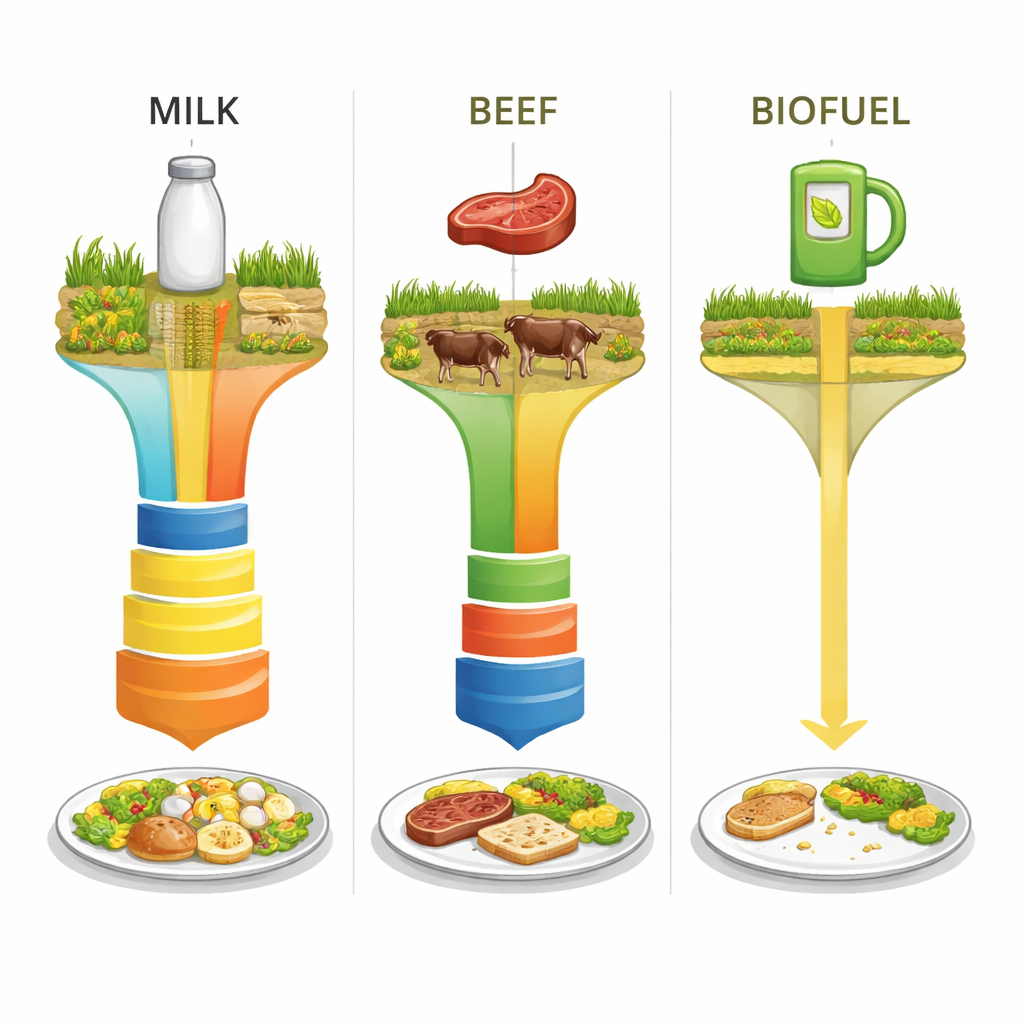
How We Use Crops Can Waste or Multiply Food
A crucial twist in the story is how non-edible crops, such as leys and some forage cereals, are used. When the researchers assumed that forage went into dairy production, diverse rotations clearly outperformed monocultures in calories and all three macronutrients. But when the same forage was modeled as being used for beef or biofuel instead, the apparent benefits vanished: functionally rich rotations then supplied fewer human-available calories and nutrients than simple cereal systems. This is because turning crops into meat or fuel is inefficient; much of the original food energy is lost along the way, and biofuels contribute nothing to human diets.
Healthier Nutrient Balance Without More Land
Beyond sheer quantity, the mix of nutrients produced by different systems matters for public health. After 20 years, diverse rotations with three functional crop types and forage used for milk produced calories distributed roughly as 45% from carbohydrates, 18% from protein and 39% from fat—close to dietary guidelines for adults. In contrast, cereal monocultures delivered about 85% of calories as carbohydrates and very little fat, mirroring the imbalance of grain-heavy food systems. The study concludes that thoughtfully designed, functionally rich crop rotations can increase total food and macronutrient output and bring that output closer to what humans need, all without expanding farmland—provided that forage and crop residues are directed toward efficient food uses rather than meat-heavy diets or fuel.
Citation: Vico, G., Costa, A., Smith, M.E. et al. Functionally rich crop rotations increase calorie and macronutrient outputs across Europe. Nat Food 7, 185–193 (2026). https://doi.org/10.1038/s43016-026-01293-5
Keywords: crop rotation, food security, agroecology, nutrient output, sustainable farming