Clear Sky Science · en
Everyday movement through nature linked to nighttime cardiac regulation
Why a Walk in the Park Matters at Night
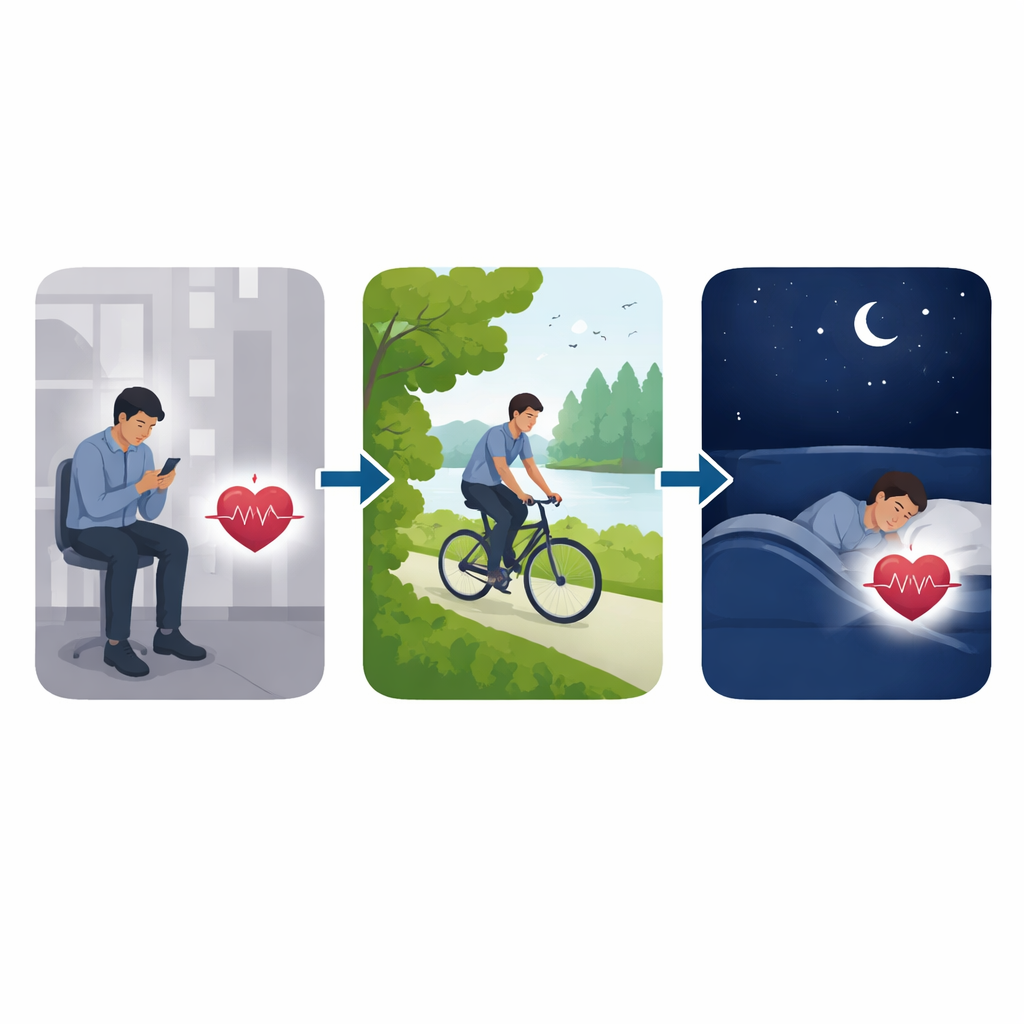
Many of us feel that a stroll through a park helps us unwind, but this study asks a deeper question: can everyday movement through nature actually change how our hearts recover from stress while we sleep? By tracking where people go during the day and how their hearts behave at night, the researchers explored whether weaving green spaces into daily routines might quietly support long-term health.

A City, Its Green Spaces, and Everyday Lives
The study took place in Gävle, a small Swedish city surrounded by forests and other natural areas. Forty-five residents wore Garmin smartwatches and used a smartphone app for up to ten months. The watches recorded heart data during the night, while the phones logged location during the day. By combining these streams of information with detailed maps, the team could tell when people were in nature versus built-up areas, and whether they were walking, cycling, riding in vehicles, or mostly staying in one place.
How the Heart Reveals Stress and Recovery
To understand how well the body regulates stress, the researchers focused on the autonomic nervous system, which automatically controls heart rate and other vital functions. They examined resting heart rate between one and four in the morning, when people were likely asleep, and heart rate variability, a measure of how flexibly the heart responds to changing demands. A lower resting heart rate and higher variability generally signal a more resilient, better regulated system—a heart and nervous system that can gear up for challenges and then settle back down.
Following People Through City Streets and Green Paths
During daytime hours, from eight in the morning to ten at night, the app sorted each GPS point into different categories: stationary time, active movement such as walking or cycling, and passive movement such as being in a car or bus. Each location was also tagged as nature or non-nature using high-resolution land-cover maps smoothed to capture parks and wooded areas rather than just scattered trees. For every person and every day, the team added up how many minutes were spent in each type of setting, then compared days when an individual had more or less nature exposure or movement than usual for them.
What Moving Through Nature Did—and Did Not—Change
Simply spending more time in nature, or being more physically active overall, was not clearly linked to better nighttime heart measures when looking at the full group. What stood out was a specific combination: actively moving through natural environments. When a person spent an extra ten minutes walking or cycling in nature compared with their own average, their resting heart rate that night was slightly lower and their heart rate variability slightly higher. A thirty-minute nature walk, for example, produced a shift in nighttime resting heart rate comparable to changes seen after intense workouts or breathing problems in other studies, though the variability changes were modest.
Differences Between Women and Men and the Role of Stress
When the team looked at women and men separately, the pattern was strongest among women. For them, both total time in nature and active movement in general were linked to healthier nighttime heart patterns, but the benefits seemed to concentrate in active movement in nature rather than sitting in green spaces or being active in more urban settings. Men showed similar trends but with weaker and more uncertain results, partly because there were fewer men and fewer low-income men in the study. Importantly, the findings held up even after accounting for daily physical activity levels, suggesting that the surroundings themselves—perhaps by easing rumination or helping people mentally detach from daily pressures—contributed to the effect.
What This Means for Everyday Health
For lay readers, the conclusion is straightforward: regularly moving through natural spaces may help the body dial down from daily stress by the time you fall asleep. The changes measured in this small study were subtle, and more research in larger and more varied populations is needed to know how much these daily effects add up over months and years, or whether they differ reliably between women and men. Still, the work shows that even ordinary walks or bike rides through trees and parks—rather than nature as a rare getaway—can be part of a low-cost, accessible way to support the heart’s nightly reset in modern, urban lives.
Citation: Samuelsson, K., Giusti, M., Hallman, D.M. et al. Everyday movement through nature linked to nighttime cardiac regulation. npj Urban Sustain 6, 65 (2026). https://doi.org/10.1038/s42949-026-00387-0
Keywords: urban nature, heart rate variability, stress recovery, active travel, wearable sensors