Clear Sky Science · en
Bridging urban theory and artificial intelligence: a multi-agent recommendation system for sustainable city development
Why this matters for city life
As more cities turn to artificial intelligence to tackle traffic, heat waves, crime, and pollution, a hidden risk is emerging: many AI projects ignore decades of hard-won knowledge about how real neighborhoods work. This study shows that most urban AI tools chase the latest algorithms rather than the actual needs of residents, and then offers a new way to put human-focused city thinking back in charge of the machines.
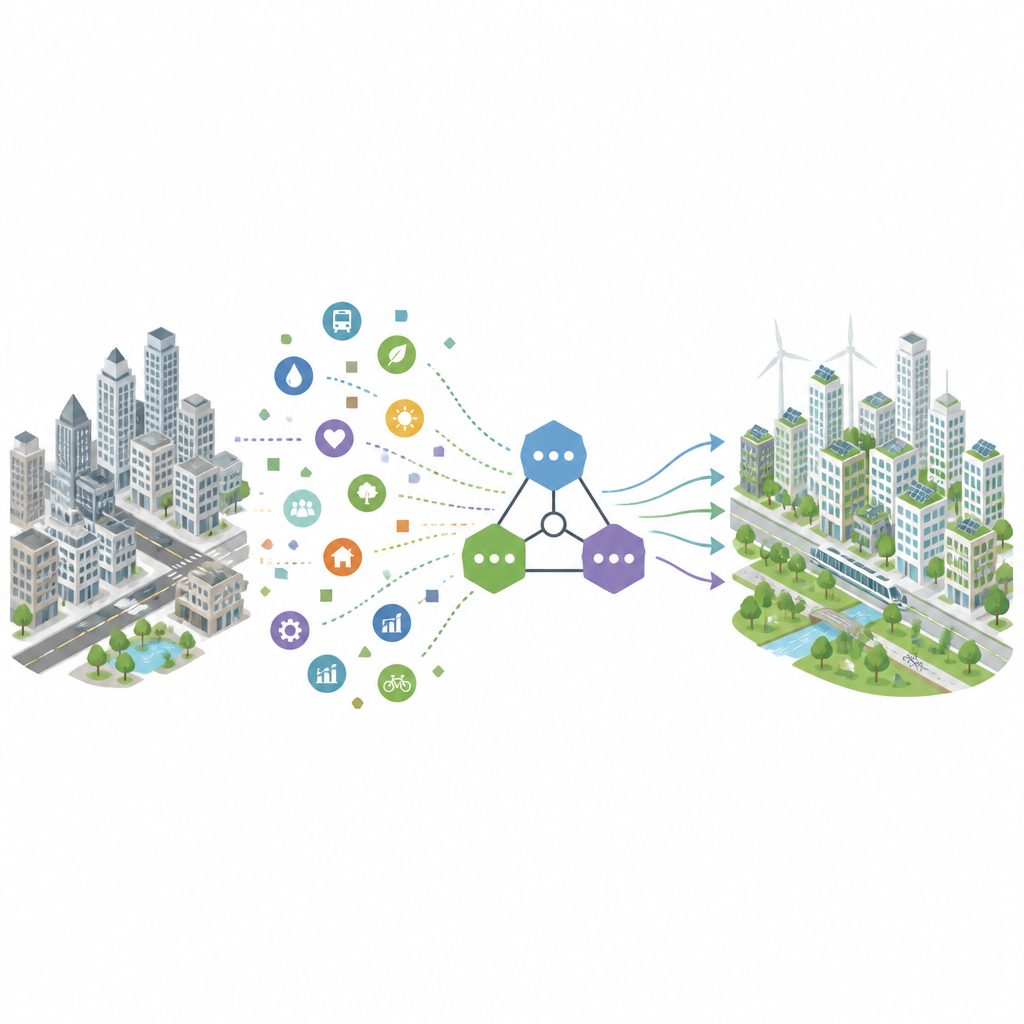
When smart tools forget city wisdom
The authors reviewed 1,123 research papers using AI for urban planning and safety. They found that fewer than 2 in 100 even mentioned classic ideas about cities, such as how street life supports safety or how services should be arranged in a neighborhood. Instead, almost half of the studies were driven mainly by technology: researchers chose algorithms because they were new or powerful, not because they matched a real urban problem. Social fairness, long-term resilience, and daily livability were often treated as afterthoughts.
Data and algorithms steering the wrong way
The team also examined what kinds of algorithms and data these projects used. Modern machine learning and deep learning dominated, and newer AI models such as large language systems and generative tools were adopted almost immediately after release. At the same time, most projects relied on easy-to-grab sensor and environmental data, like air quality monitors or traffic detectors. Harder-to-collect information about people’s experiences, social conditions, or neighborhood layouts was used far less, even though many urban theories say these factors are crucial. The result is what the authors call “data opportunism,” where what is measurable shapes the questions, rather than what truly matters to city life.
How the rush to AI speeds the problem
Looking over time, the researchers saw AI in cities shift from careful, problem-led experiments to a rapid “technology push.” Before 2008, hardly any urban planning papers used AI language. After that, and especially after deep learning took off, the number of AI-labelled studies exploded, with more than 60 percent published after 2020. New tools such as image-language models and large text models appeared in city research within the same year they were invented. That speed may sound exciting, but it encourages using whatever is latest, even if it is a poor fit for the task or blinds planners to social and environmental trade-offs.
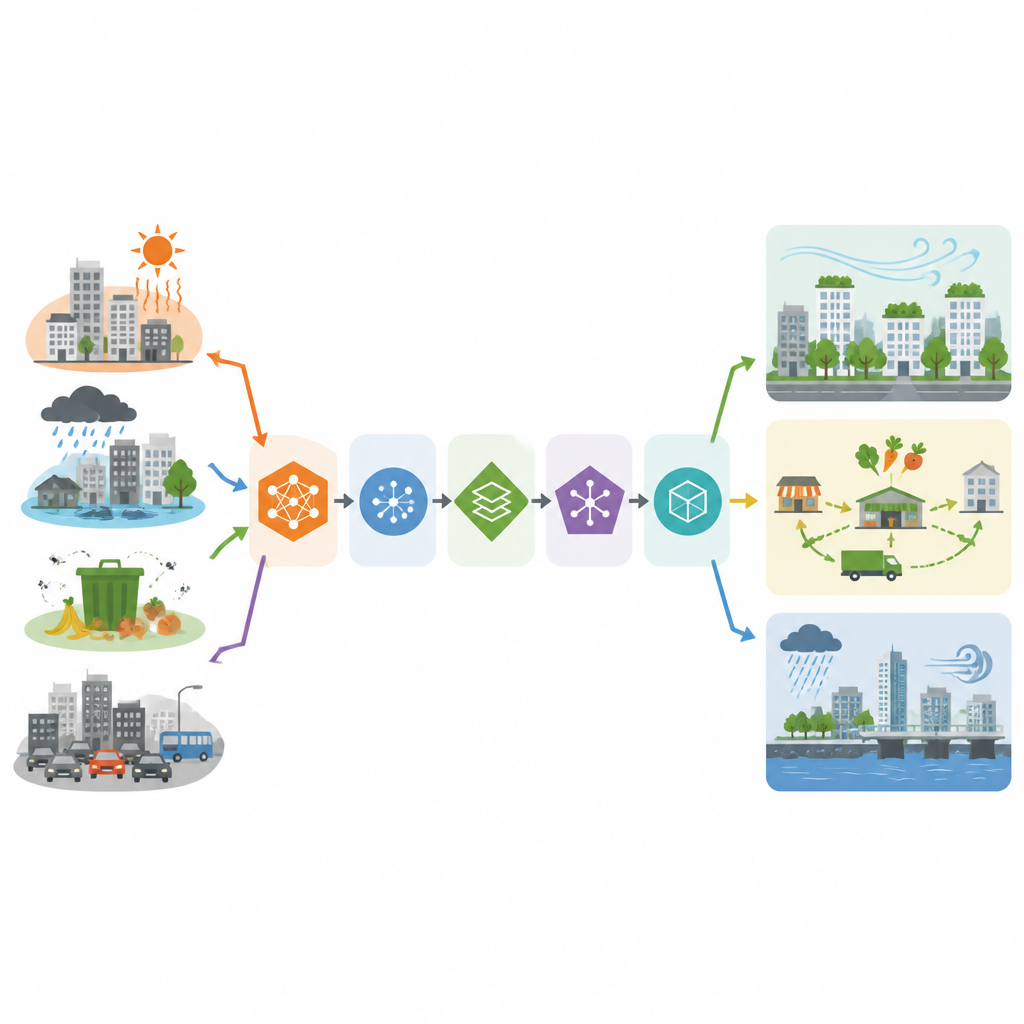
A new guidebook for smarter, fairer AI in cities
To reconnect AI with real urban needs, the authors built a large language model based system that acts like a panel of expert assistants. When given a description of a city challenge, such as food waste, heat exposure, or disaster risk, one agent first structures the problem. Another searches a bank of 46 classic city theories to find those that best describe what is going on. A third matches suitable AI methods, a fourth suggests needed data sources, and a fifth checks whether the whole package is robust and realistic. Tests on case studies show that this process shifts projects away from narrow goals, like cutting delivery costs or improving prediction accuracy, toward richer aims that also account for equity, health, and climate impacts.
What this means for the future of urban AI
In plain terms, the study argues that asking “What can this algorithm do?” is the wrong starting point. Instead, planners, engineers, and communities should first ask “What does this city problem really require to become more sustainable and fair?” and only then choose AI tools that fit those needs and the best available urban theories. By making those theories visible and usable inside an AI recommendation system, the authors show how cities can use advanced computation without losing sight of human experience, shared spaces, and long-term resilience.
Citation: Tong, J., Wang, S., Wang, G. et al. Bridging urban theory and artificial intelligence: a multi-agent recommendation system for sustainable city development. npj Urban Sustain 6, 77 (2026). https://doi.org/10.1038/s42949-026-00377-2
Keywords: urban AI, sustainable cities, urban planning, multi-agent systems, smart city governance