Clear Sky Science · en
Deep neural operator for free boundary problems
Why moving boundaries matter
Many natural and engineered systems evolve on the fly: ice melts and refreezes, metal parts expand when heated, and tumours push into surrounding tissue. In all these cases, the region where the action happens does not stay still. Mathematicians call such situations free boundary problems, and they are notoriously hard and slow to simulate. This article introduces a new artificial intelligence tool that can learn how these shifting shapes behave far more quickly than traditional methods, opening the door to faster design tools and even real-time medical planning.
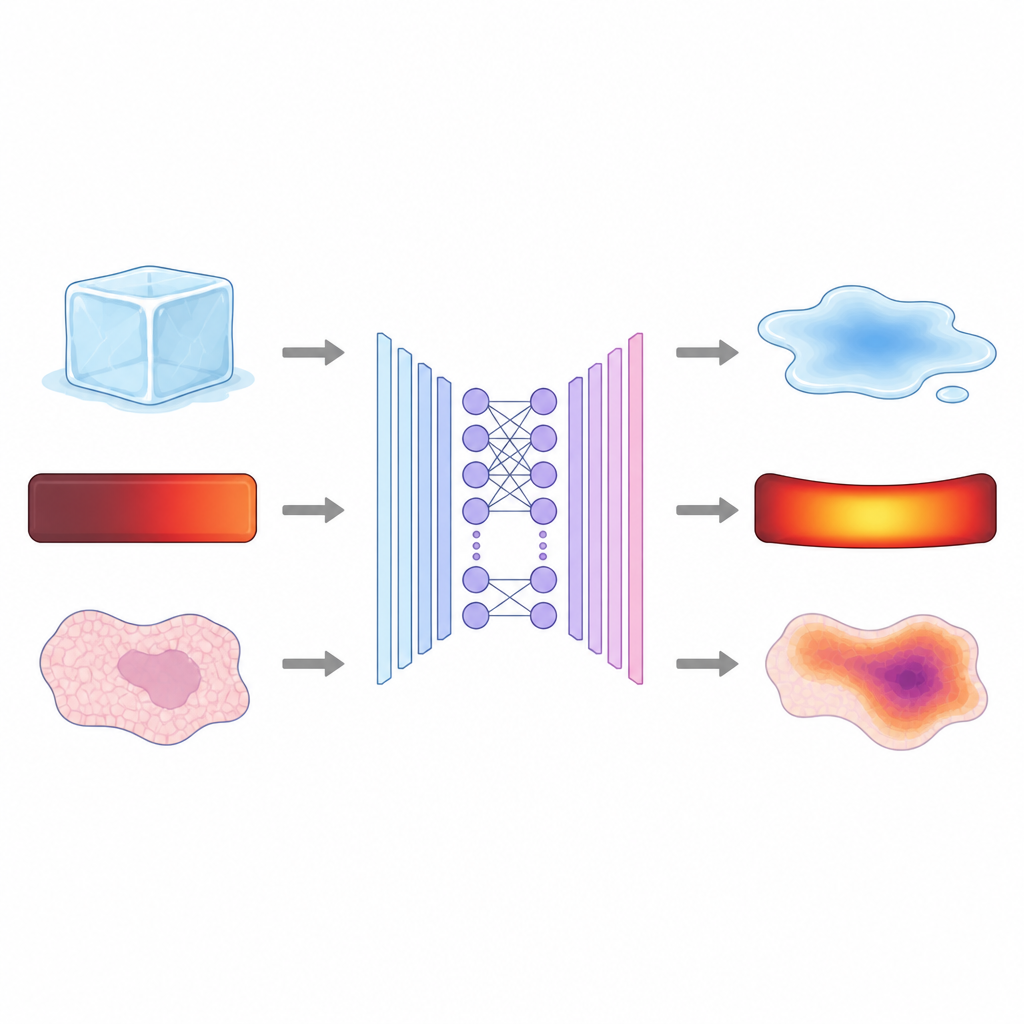
Shifting shapes in science and engineering
Free boundary problems arise whenever the edge of a material or fluid is unknown in advance and must be solved along with the internal state. Classic examples include the moving front between ice and water in a frozen lake, the surface of a liquid metal as it cools, and the changing outline of a growing tumour fed by nutrients from nearby tissue. In each case, the physics inside the region and the motion of the boundary constantly influence one another. Established numerical solvers can handle these systems, but they are often slow and must be rerun from scratch for every new set of conditions, which is impractical when thousands of scenarios must be explored.
Why standard AI tools fall short
Over the last decade, deep learning methods called neural operators have shown that they can learn the rules of complex physical systems directly from data or from equations, and then make predictions almost instantly. However, these tools assume that the region of interest is fixed ahead of time, like a neatly drawn box. For free boundary problems this is not true, because the very shape of the region is part of the answer. As a result, existing neural operators cannot directly handle cases where the domain bends, stretches, splits or forms intricate shapes that are not prescribed in advance.
A new way to follow moving edges
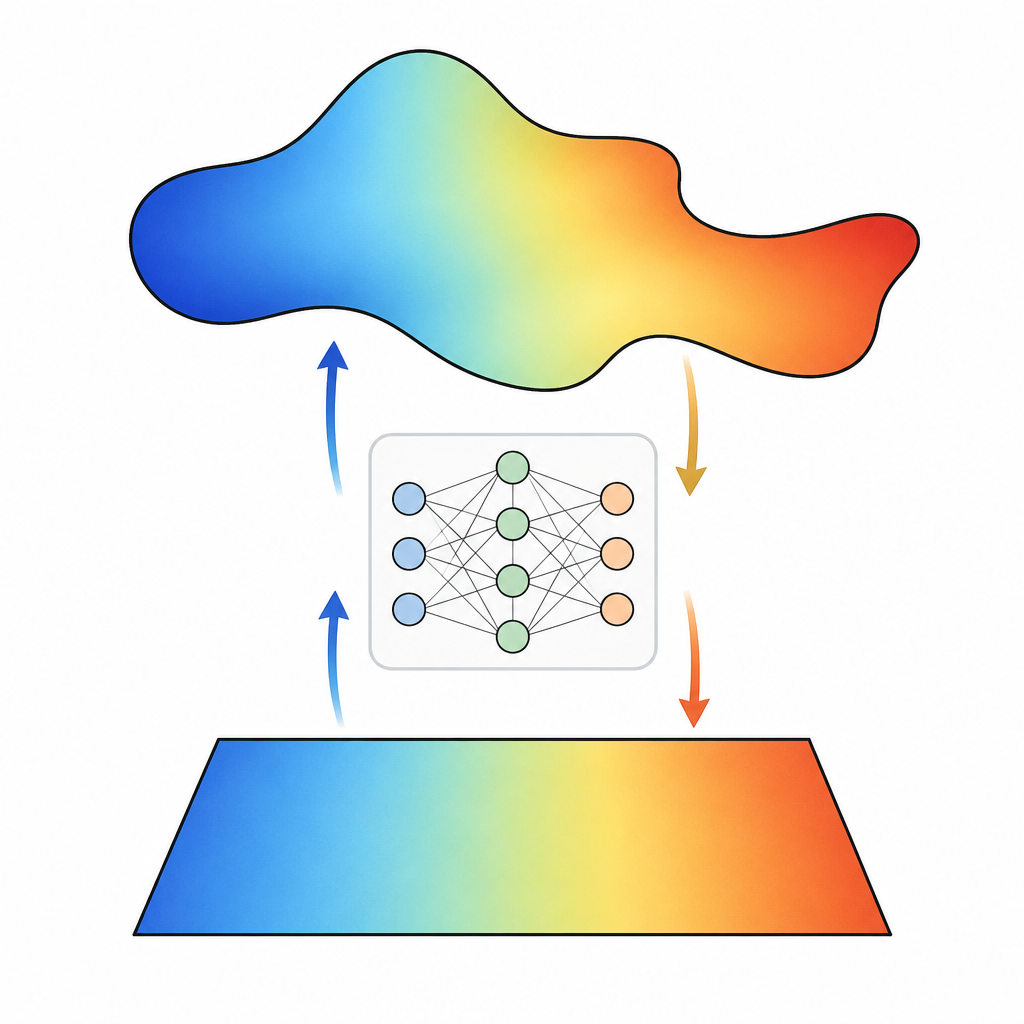
The authors propose the free boundary neural operator (FBNO), a framework that sidesteps this roadblock by cleverly changing the point of view. Instead of working on the unknown, moving region itself, FBNO maps every evolving shape onto a single, simple reference region where the powerful theory behind neural operators still holds. A learned, smooth transformation links the real, moving domain to this reference domain and back again. At the same time, another neural operator learns how the physical quantities, such as temperature or nutrient level, change on the reference region. By combining these two learned pieces, FBNO can predict both the internal fields and the moving boundary without being told the future geometry beforehand.
Putting the method to the test
To check that FBNO works in practice, the team applied it to three very different test beds. The first is the Stefan problem, a classic model of melting and freezing, where the front between phases moves in response to heat flow. FBNO accurately reproduced both temperature fields and the motion of the front while keeping errors well below a few percent, all without relying on precomputed training data. Next, they tackled a problem that couples heat flow to mechanical stretching, where density, temperature and motion interact. With only a handful of training simulations and added physics-based constraints, FBNO learned to track particles as they moved, capturing several physical fields at once with low error and stable performance over time. Finally, they turned to simulated tumour growth in complex, non-convex shapes, a setting closer to clinical questions. Here, trained mostly from data, FBNO predicted how the tumour surface and internal nutrient levels evolved across many different initial shapes.
Speed, accuracy and possible medical impact
Across these examples, FBNO maintained accuracy while delivering predictions many orders of magnitude faster than traditional solvers, using less memory and energy. After training, it can generate full growth histories of a tumour in seconds on a single graphics processor, compared with days of computation on large clusters for standard methods. This speed suggests that, with appropriate clinical inputs such as images and survival statistics, the framework could support personalised forecasts of tumour growth and nutrient distribution, helping doctors compare treatment strategies in real time.
What this work means going forward
For a general reader, the key message is that the authors have found a way to let AI handle problems where not only the state inside a system but also its outer shape are unknown and change with time. By converting messy, evolving geometries into a common, well-behaved frame, FBNO extends the reach of neural operators to a broad class of physical and biological systems. While the method still faces limits, such as difficulty with violent shocks or strongly multi-phase flows, it offers a promising route to fast, flexible simulations of moving boundaries that could influence everything from climate models of sea ice to planning cancer therapy.
Citation: Long, Z., Zhou, Q., Zhu, A. et al. Deep neural operator for free boundary problems. Nat Mach Intell 8, 806–817 (2026). https://doi.org/10.1038/s42256-026-01233-9
Keywords: free boundary problems, neural operators, scientific machine learning, tumour growth modeling, moving boundaries