Clear Sky Science · en
Rise and fall of the pseudogap in the Emery model, insights for cuprates
A Hidden Phase in High-Temperature Superconductors
High-temperature superconductors made from copper oxides are famous for carrying electric current without resistance at relatively warm temperatures. But even before they start to superconduct, these materials pass through a mysterious state called a pseudogap, where some electronic states seem to vanish. Understanding how this hidden phase appears and disappears as the material is tuned is crucial for explaining why these compounds behave so strangely and for guiding future technologies that might use them.
From Electrical Insulator to Good Metal
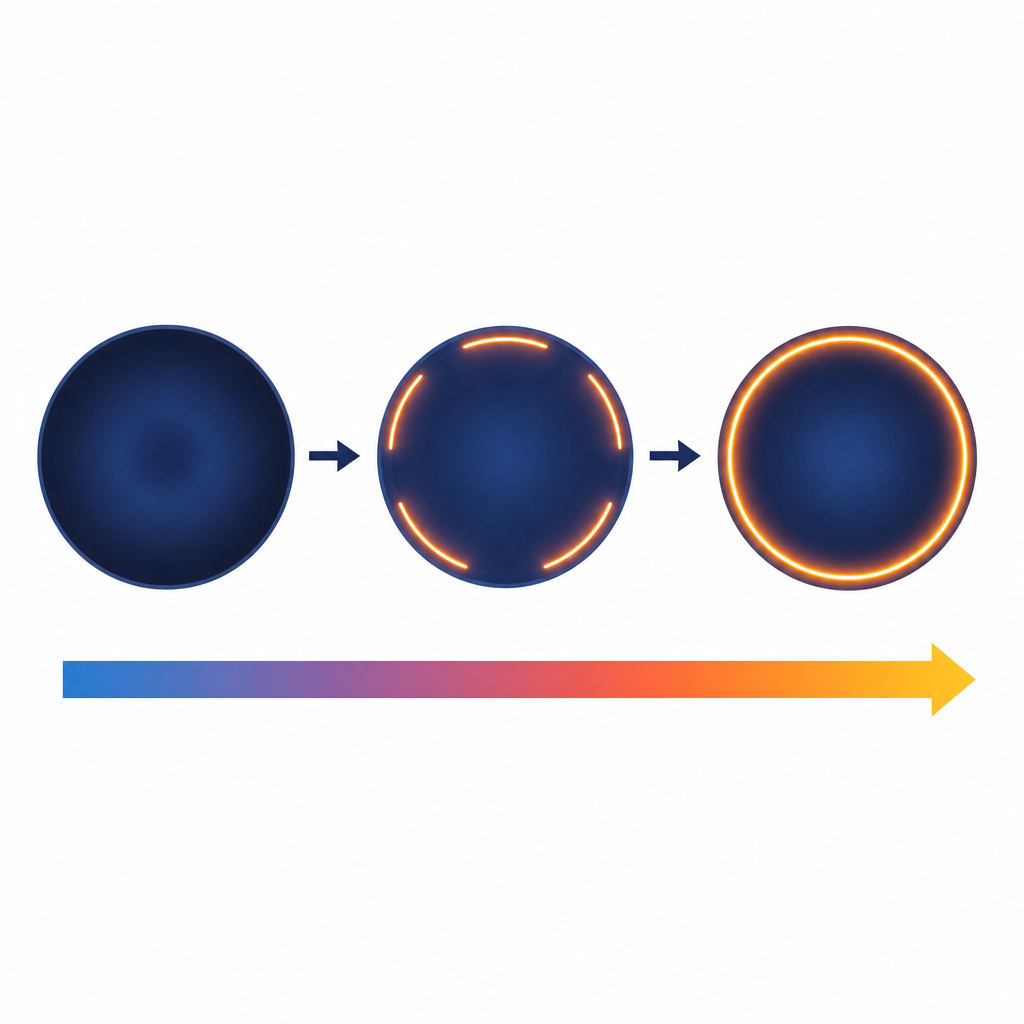
The authors study a theoretical model that captures the essential ingredients of copper-oxide layers, where both copper and oxygen atoms contribute to the motion of electrons. In this model, they vary how many “holes” are added to the system, which is the standard way experimentalists tune real cuprate materials. At low hole content, the system behaves as an insulator with a full gap in its electronic spectrum, so electrons cannot move freely. As more holes are added, the material gradually changes character and eventually becomes a conventional metal where electronic states are available all around the Fermi surface and charge flows easily.
The Rise and Shape of the Pseudogap
Between the insulating and metallic limits, the model enters the pseudogap regime. Here, the electronic states at low energy are not uniformly suppressed. Instead, they disappear mainly near specific points in momentum space called the antinodes, while they remain robust near the nodes. This imbalance creates Fermi arcs, partial segments of what would otherwise be a continuous Fermi surface. By tracking how spectral weight at the nodal and antinodal points changes with temperature and hole content, the authors identify two crossovers: first from insulator to pseudogap and then from pseudogap to full metal. The pseudogap thus “rises” out of the insulating state as holes are added, reaches its most pronounced form at intermediate doping, and then “falls” as the system turns metallic.
Short-Range Magnetism as the Driving Force
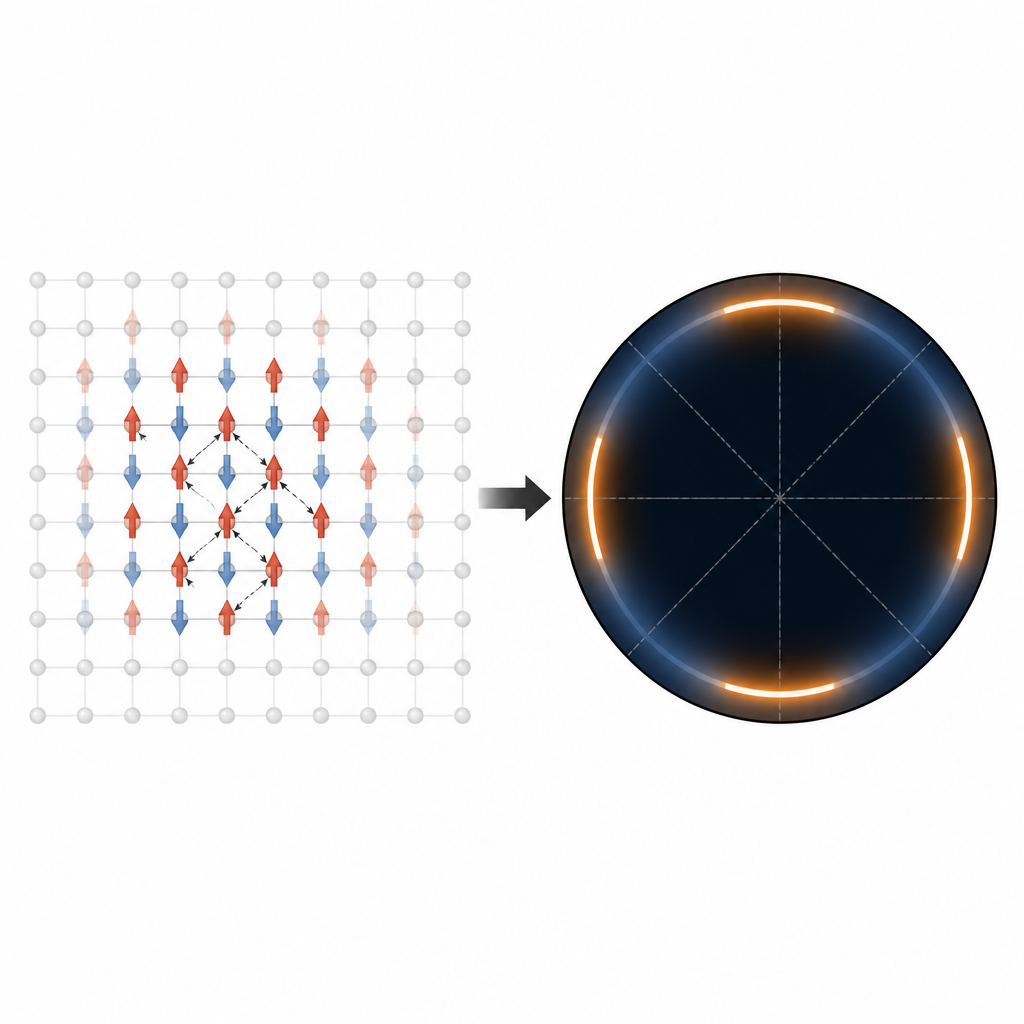
The study also examines how magnetic fluctuations evolve across these regimes. At low hole content, spin correlations extend over many lattice spacings, consistent with a background close to antiferromagnetic order. In the pseudogap regime, however, the magnetic correlations become short ranged, spanning only a few sites, yet remain strong and commensurate, peaking at the wave vector associated with antiferromagnetism. As the system moves into the metallic phase at higher hole content, these fluctuations change character and become incommensurate, with their peaks shifting away from the simple antiferromagnetic pattern. The authors show that it is the short-range, dynamical spin fluctuations in the intermediate regime that are chiefly responsible for opening the pseudogap in momentum-selective fashion.
Connecting Theory with Experiments
When the theoretical predictions are compared with a broad set of experiments on well-studied cuprate compounds, many trends line up. Angle-resolved photoemission finds Fermi arcs that grow and then reconnect into a full Fermi surface in much the same doping range predicted by the model. Neutron scattering and Raman measurements reveal magnetic correlations that are long ranged near the parent insulator, short ranged in the pseudogap regime, and more incommensurate at higher hole content, mirroring the theoretical correlation lengths and susceptibility patterns. Nuclear magnetic resonance and magnetometry experiments also show a characteristic downturn of the uniform spin response in the pseudogap regime, followed by a monotonic increase in the more heavily doped metallic state, again matching the behavior extracted from the model.
What This Means for Understanding Copper Oxides
Overall, the work demonstrates that a realistic three-band model of copper and oxygen orbitals can reproduce the full arc of behavior in the normal (non-superconducting) state of cuprates, from insulating through pseudogap to metallic. The pseudogap appears as a strong-coupling phenomenon tied to short-range antiferromagnetic fluctuations, not as a simple phase transition with a sharp boundary. For a lay reader, this means that the strange partial gap seen in experiments is a natural outcome of electrons that strongly influence one another in both space and time within copper-oxide layers. By capturing these effects in a single, unified framework, the study brings theorists closer to a coherent picture of how these complex materials work.
Citation: Malcolms, M.O., Menke, H., Tseng, YT. et al. Rise and fall of the pseudogap in the Emery model, insights for cuprates. Commun Phys 9, 179 (2026). https://doi.org/10.1038/s42005-026-02685-6
Keywords: pseudogap, cuprate superconductors, spin fluctuations, Fermi arcs, Emery model