Clear Sky Science · en
Ultrafast many-body dynamics of dense Rydberg gases and ultracold plasma
Watching matter change in a trillionth of a second
What happens to matter when an ultra-short burst of laser light rips through a cloud of atoms at a few billionths of a degree above absolute zero? This study uses a single femtosecond laser pulse to push an ultracold gas of rubidium atoms into strange states of matter and then tracks how it rapidly reshapes itself. The work sheds light on how electric forces between charged particles drive the behavior of dense gases and plasmas, which are relevant to astrophysics, fusion research, and future quantum technologies.
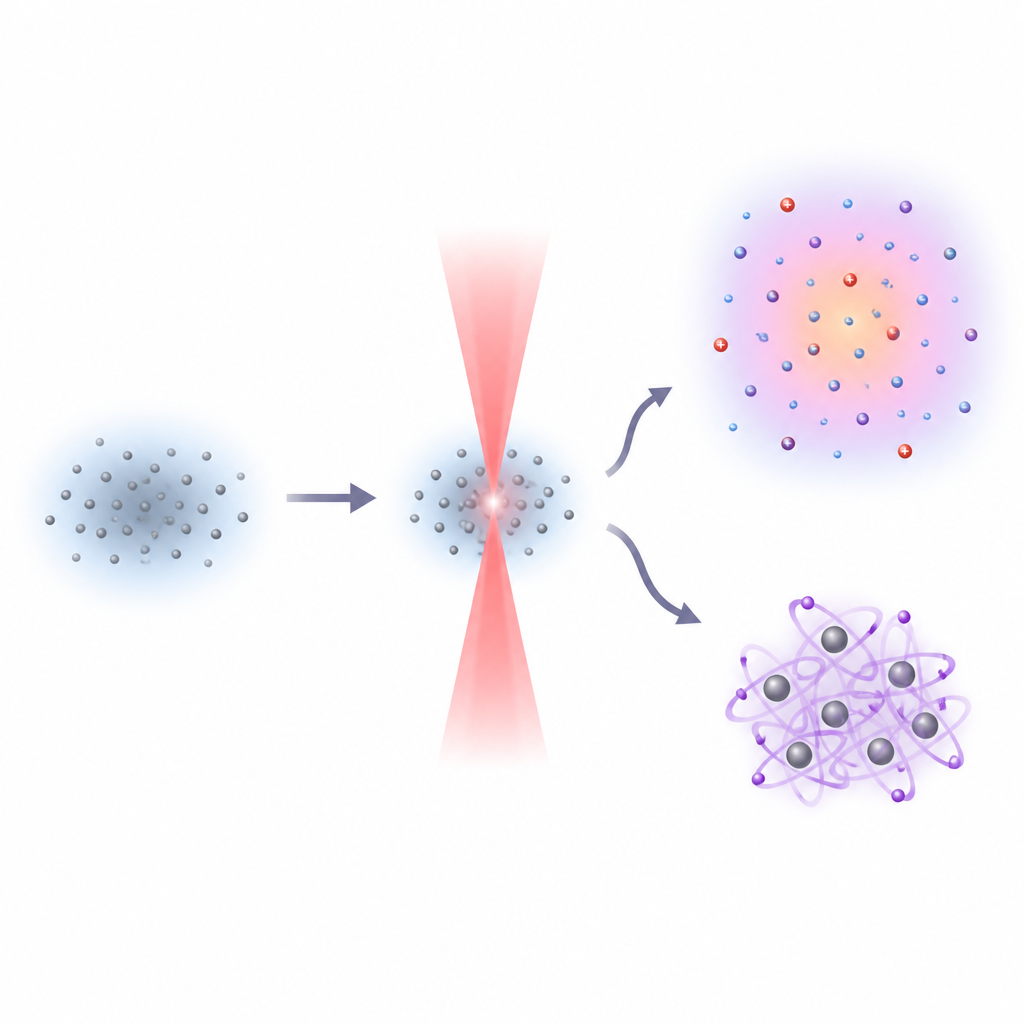
Two surprising paths for an ultracold gas
The researchers start from a Bose Einstein condensate, an ultracold cloud where atoms move in lockstep as a single quantum object. A tightly focused femtosecond laser pulse injects energy so quickly that thousands of atoms are excited or ionized almost at once. By tuning the laser color around a key energy threshold, the team can steer the system toward two different outcomes. On one side, the energy is high enough that electrons are knocked completely free, forming an ultracold plasma. On the other, the energy is slightly lower and electrons are lifted into huge, fragile orbits around their atoms, creating a dense gas of Rydberg atoms with exaggerated atomic sizes.
Controlling tiny particles with fine energy tuning
The key control knob is the “excess energy” given to each electron, which can be set slightly positive or slightly negative relative to the ionization threshold. Positive values favor free electrons and plasma formation, while negative values favor bound electrons and Rydberg states. Because the laser pulse is so short, it has a broad range of colors and can excite many different energy levels at once. This broad range lets the experiment bypass a usual density limit, known as the blockade effect, and pack Rydberg atoms much closer together than slow, narrow-band lasers normally allow. The result is a dense, strongly interacting gas that would otherwise be very hard to make.
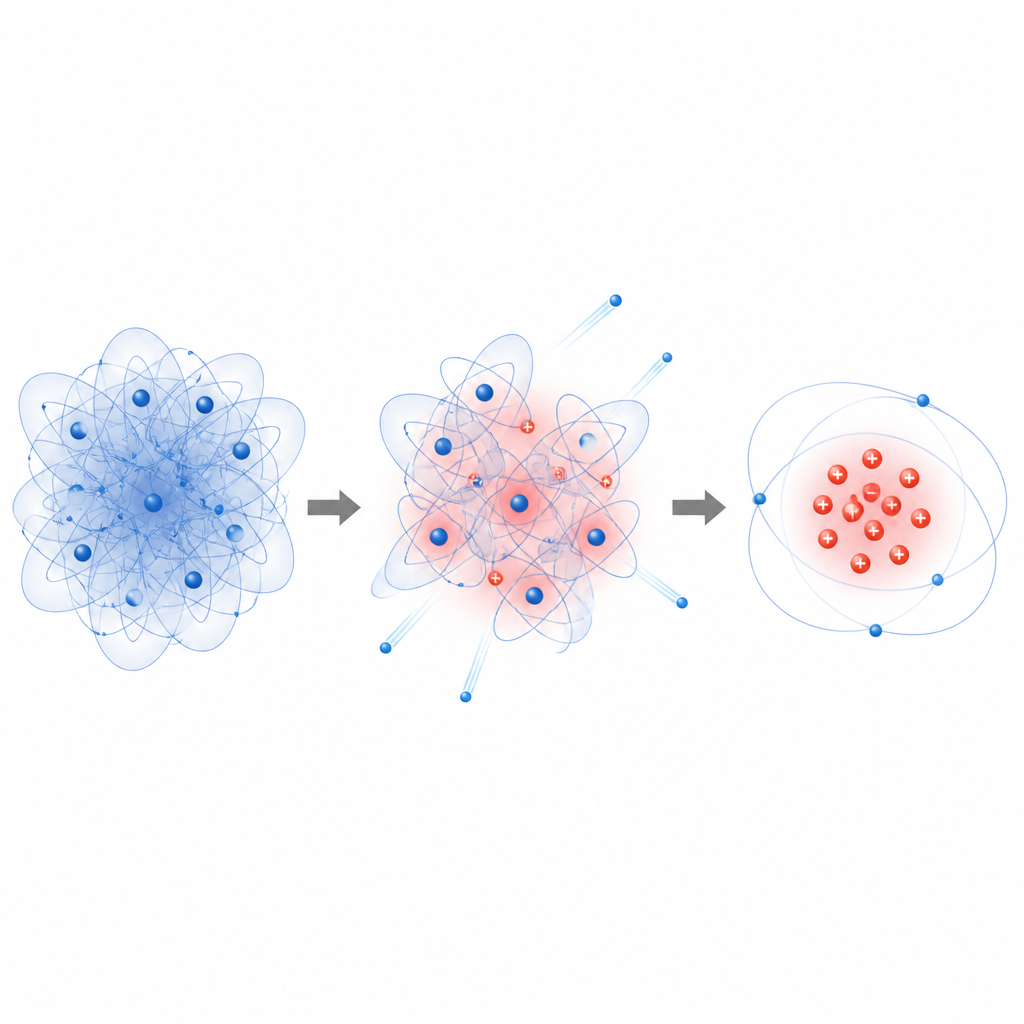
Reading electron energies like fingerprints
To see what the gas has become after the pulse, the team measures the kinetic energy of the electrons that reach a detector. Different groups of electrons act like fingerprints of different processes. Very slow electrons belong to the ultracold plasma, fast ones come from high order ionization, and a separate pulse can knock loose electrons from Rydberg atoms that survived the initial flash. By comparing the detector images with computer simulations of charged particles flying through the apparatus, the researchers can reliably separate free, plasma, and Rydberg electrons and count how many of each type were present at the end of the evolution.
Simulations reveal the hidden dance
Because only a few thousand particles are involved, the team can simulate every electron and ion as an individual object pulling and pushing on all the others. These molecular dynamics simulations include collisions that ionize atoms, collisions that let electrons recombine into Rydberg states, and the full attractive and repulsive forces between charges. The simulated mixtures of plasma, Rydberg, and free electrons match the measurements across a wide range of laser energies. The calculations show that as soon as some electrons leave the region, they leave behind a positively charged cloud that strongly tugs on the remaining particles. This charge imbalance cools the trapped electrons but also makes it much harder for them to settle back into long lived Rydberg states.
How a dense excited gas turns into plasma
By examining conditions on both sides of the ionization threshold, the study answers several open questions about the stability of dense Rydberg gases. When the laser creates overlapping, weakly bound electron orbits, collisions and a small population of very fast electrons quickly drive the system toward plasma. Only when electrons are deeply bound, with much lower energy and smaller orbits, does a significant Rydberg population remain stable over the first hundred picoseconds. The simulations show that if the extra fast electrons from higher order ionization could be avoided, recombination and ionization might balance more closely. In the present setup, however, the extra charge always tips the system toward plasma.
Why this matters beyond one experiment
For a non specialist, the main message is that this work provides a clean, controllable way to watch how a very cold, very dense quantum gas transforms into a plasma in almost no time at all. The strong match between experiment and classical simulations suggests that, in this regime, the complex many body behavior can be understood largely from the electric forces between particles. This insight is important for designing future experiments that aim to create more strongly coupled plasmas, explore exotic electronic phases, or build ultrafast quantum devices based on Rydberg atoms, where knowing exactly how and when a gas turns into a plasma is crucial.
Citation: Großmann, M., Heyer, J., Fiedler, J. et al. Ultrafast many-body dynamics of dense Rydberg gases and ultracold plasma. Commun Phys 9, 170 (2026). https://doi.org/10.1038/s42005-026-02674-9
Keywords: ultracold plasma, Rydberg atoms, femtosecond laser, Bose Einstein condensate, many body dynamics