Clear Sky Science · en
Laser-dressed partial density of states
Shaping Materials with Light
Imagine being able to change how a solid behaves simply by shining a carefully tuned laser on it — making bonds between atoms momentarily weaker or stronger, or nudging electrons into new patterns of motion on a time scale faster than a single light wave oscillation. This article explores a new theoretical tool that helps scientists see, in detail, how electrons and chemical bonds inside a crystal rearrange under intense laser illumination. Understanding this ultrafast reshaping of matter may guide future technologies in ultrafast electronics, light-controlled phase transitions, and even transient superconductivity. 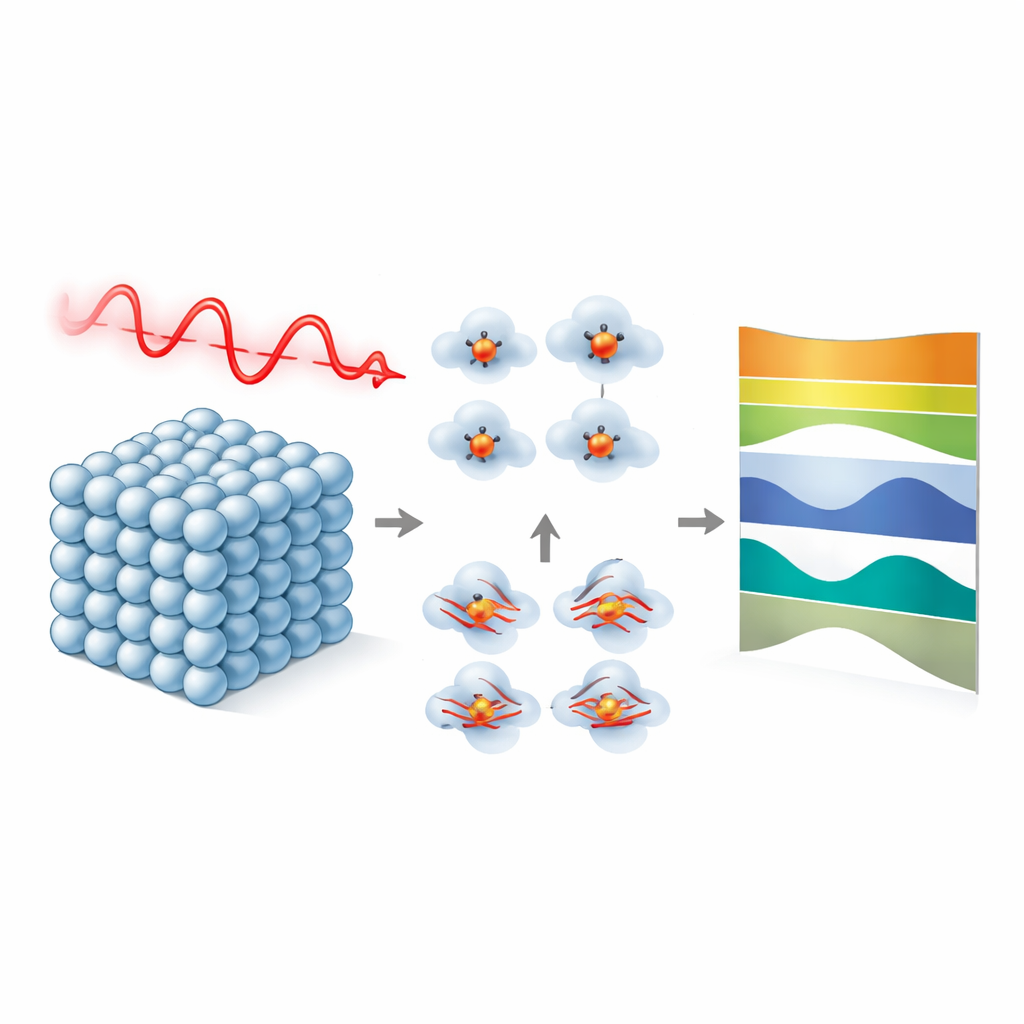
Looking Inside a Solid’s Energy Landscape
Inside any solid, electrons occupy a structured set of energy levels known as the density of states. A widely used way to analyze this structure is the partial density of states, which tells how specific atomic orbitals — such as those centered on zinc or oxygen atoms, or pointing in different directions in space — contribute to bonding. Until now, this tool has mostly been used for materials at rest, without strong external light fields. But modern laser and x-ray techniques can follow electron motion within a fraction of a light cycle, creating an urgent need for equally time-resolved theoretical descriptions.
Watching Bonds in Motion with a New Lens
The authors introduce a “laser-dressed partial density of states,” a quantity that tracks how electrons in selected orbitals and atomic sites respond as a strong, periodic laser field drives the material. They build on a mathematical framework called Floquet-Bloch theory, which treats the crystal under a repeating light field, and combine it with state-of-the-art electronic structure calculations. In simple terms, their method follows how the energy levels associated with particular orbitals shift, broaden, and interfere in time, revealing which bonds are strengthened, which are weakened, and how electrons reshuffle between them during the laser pulse. 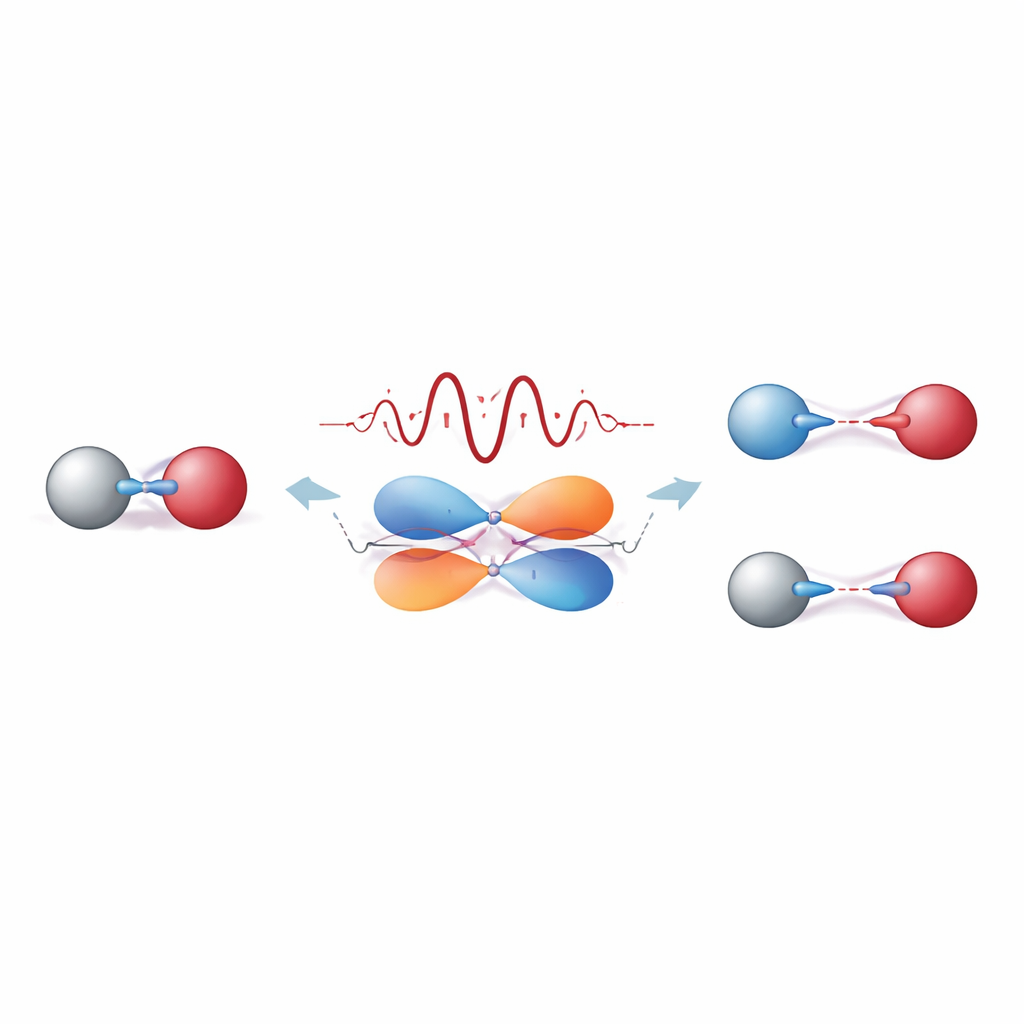
A Test Case: Zinc Oxide Under Intense Light
To show what this new lens can reveal, the study focuses on wurtzite zinc oxide, a technologically important semiconductor. When driven by an intense infrared laser, zinc oxide exhibits strongly nonlinear behavior, including high-order harmonic generation. By resolving the partial density of states for specific orbitals on zinc and oxygen atoms, and for directions parallel and perpendicular to the laser’s electric field, the authors find that key spectral peaks shift to higher binding energies, become less intense, and broaden. These changes reflect electrons being partially promoted from valence to conduction states and the emergence of additional “sidebands,” as if each original level splits into several light-dressed partners.
Directional Bonds and Hidden Charge Motion
A striking outcome is that not all bonds are affected equally. Peaks associated with antibonding orbitals shift in a nearly uniform way, but bonding orbitals respond differently depending on whether they are aligned with the laser polarization. In particular, hybridized bonds between zinc and oxygen along the laser direction become energetically misaligned, signaling a weakening of those bonds. By comparing the laser-dressed partial density of states with the time-dependent electron density, the authors link these spectral signatures to real-space charge rearrangements: dipole-like charge patterns that oscillate within each unit cell and higher-order distortions that do not cancel out when averaged. These patterns help explain why many subcycle-resolved x-ray and optical measurements in driven crystals show signals that oscillate mainly at twice the laser frequency.
Why This Matters for Future Control of Materials
In summary, the laser-dressed partial density of states provides a detailed, orbital-by-orbital picture of how electrons and bonds in a crystal respond to strong light fields in real time. For a non-specialist, this means scientists now have a way to connect what an experiment measures — such as rapidly changing absorption or reflection of x-rays — directly to which bonds are momentarily forming or breaking inside the material. This deeper insight could help design pump–probe schemes that trigger specific structural changes or electronic responses only when a favorable bonding pattern appears, moving us closer to the goal of tailoring material properties on demand using light.
Citation: Bezriadina, T., Popova-Gorelova, D. Laser-dressed partial density of states. Commun Phys 9, 161 (2026). https://doi.org/10.1038/s42005-026-02669-6
Keywords: ultrafast electron dynamics, laser-driven materials, Floquet engineering, bond control with light, zinc oxide