Clear Sky Science · en
Thermodynamics of active matter with internal degrees of freedom
Why tiny engines inside matter matter to us
Many living things, from bacteria to our own cells, move and organize themselves by constantly burning energy. Engineers now build synthetic particles that do something similar, promising smart materials that can carry drugs, heal themselves, or reconfigure on demand. Yet most theories treat these "active" units as if they simply push forward with a fixed force, glossing over the intricate internal steps that actually convert fuel into motion. This paper lays out a general blueprint for describing how such hidden inner workings power motion and waste heat, connecting the tiny events inside each unit to the large-scale behavior we can observe.
Hidden inner states that drive motion
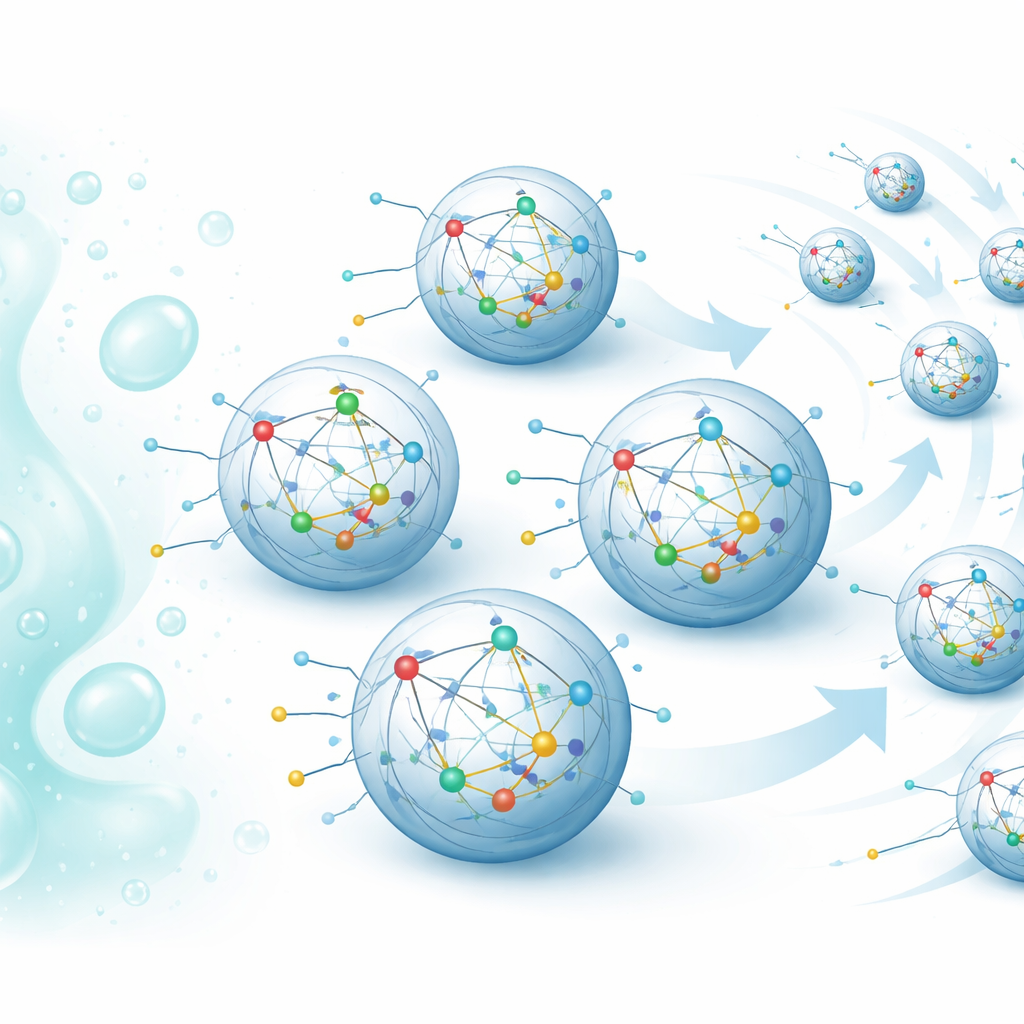
The authors start from the observation that real biological machines—motor proteins, enzymes, and swimming microbes—do not move because of a single push. Instead, they cycle through many internal configurations, binding and releasing molecules and changing shape along the way. To capture this, each active unit is modeled as a network of internal states, linked by transitions that can depend on the environment. Some of these transitions are special "power strokes" that nudge the whole unit forward or backward, while others only reshuffle its internal configuration. By insisting that each step respects basic thermodynamic rules about heat and entropy, the framework keeps track of how much energy is spent and how much is turned into directed motion.
From microscopic jumps to smooth motion
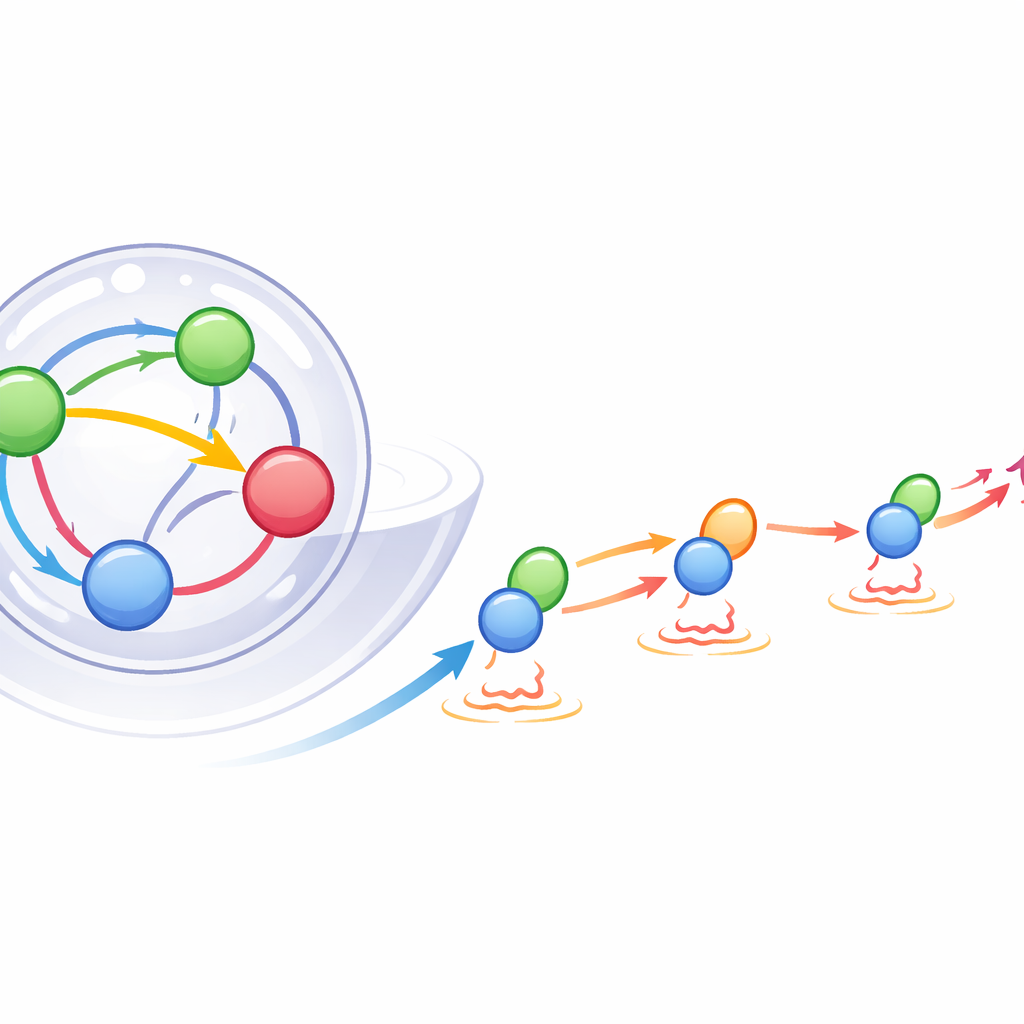
Although the inner network may be very complex, experiments typically only see the position and orientation of each unit. The authors therefore develop a way to "zoom out" from discrete power strokes to a smoother, coarse-grained description. When the typical step size is small, many internal jumps blend into an effective drift speed and an added source of random motion along the particle’s heading. Remarkably, all the purely internal transitions that do not directly move the particle disappear from the visible motion. To an observer tracking only trajectories, an actively powered system can even look like an ordinary, passive suspension in equilibrium—while still burning energy in unseen internal cycles. This highlights why a faithful thermodynamic accounting must include the hidden state network, not just the paths traced in space.
Measuring the cost of activity
To quantify how much heat an active material dumps into its surroundings, the authors use modern stochastic thermodynamics. They separate the total dissipation into three contributions: passive drift and diffusion under external forces, active displacements produced by power strokes, and purely internal transitions such as chemical reactions. Using tools from network theory, they show that one need not track every single link in the internal state graph. Instead, the dissipation can be expressed in terms of a minimal set of independent cycles that run through the network. Each cycle carries a current (how often it is traversed) and an "affinity" (how strongly it is driven by fuel or external forcing). The heat production is then just a sum over these cycles, plus any work done by non-conservative external forces, giving a compact and physically transparent picture.
A test case: a smart particle in a soft trap
To illustrate their theory, the authors study a single active particle in two dimensions confined by a soft harmonic trap, similar to a bead held by optical tweezers. Inside the particle sit four states arranged in several cycles, some of which include a forward step, some a backward step, and one an "idle" loop that burns fuel without net motion. Simulations reveal that the particle’s propulsion speed and direction change with position in the trap: far from the center, forward steps are suppressed by the restoring force, and backward or idle cycles become more common. As the trap is stiffened, the total dissipation rate shows a surprising non-monotonic trend—first dropping, then reaching a minimum, and finally rising again—because the relative importance of different cycles shifts as mechanical relaxation and internal cycling compete. In contrast, a simpler "tightly coupled" model, where each chemical event always produces the same step, predicts a smooth decay of dissipation that misses this richness.
From single particles to flowing active fluids
Going beyond a single unit, the authors derive coarse-grained hydrodynamic equations for many interacting active particles. By averaging over all but one "tagged" particle and then over orientations, they obtain continuum fields such as density and polarization that describe the material on large scales. Within the same framework they identify a local dissipation field: a position-dependent heat rate that can be written in terms of macroscopic currents and cycle affinities. This links the internal state network to experimentally accessible fields, suggesting ways to infer or control energy flows in active materials without resolving every microscopic detail.
What this means for future smart materials
In essence, the paper provides a general thermodynamic language for active matter with rich internal structure. It shows that what happens inside each unit—how many cycles exist, which ones couple to motion, and how they respond to forces—can qualitatively change how much energy is consumed and how a system behaves under confinement or driving. For designers of bio-inspired machines and adaptive materials, this means that tuning the internal network may be just as important as adjusting external forces or shapes. The framework opens the door to systematically exploring which minimal internal designs can reproduce key biological capabilities such as sensing, adaptation, and efficient energy use.
Citation: Bebon, R., Speck, T. Thermodynamics of active matter with internal degrees of freedom. Commun Phys 9, 162 (2026). https://doi.org/10.1038/s42005-026-02662-z
Keywords: active matter, stochastic thermodynamics, self-propelled particles, non-equilibrium physics, smart materials