Clear Sky Science · en
Machine learning assisted prediction of dynamics in current-driven nested skyrmion bags
Magnetic Whirls as Tiny Data Carriers
Modern electronics increasingly rely on manipulating the spin of electrons rather than just their charge. This study explores exotic whirlpool-like patterns in magnets, called skyrmion bags, as potential information carriers for future low-energy, high-density devices. By combining advanced computer simulations with machine learning, the authors show how these tiny structures can be steered precisely by electric currents and used to route signals in nanoscale circuits.
What Skyrmion Bags Are and Why They Matter
Skyrmion bags are clusters of swirling magnetization: a larger swirl encloses several smaller ones, a bit like marbles inside a soap bubble. Each swirl contributes to a quantity called topological charge, which captures how the spins wrap around in space. Crucially, this charge controls how a skyrmion bag moves when pushed by an electric current. Unlike ordinary magnetic domains, these textures are robust and can be packed densely, making them attractive for memory and logic applications where many bits of data must coexist on tiny tracks.
Keeping Magnetic Whirls on a Straight Path
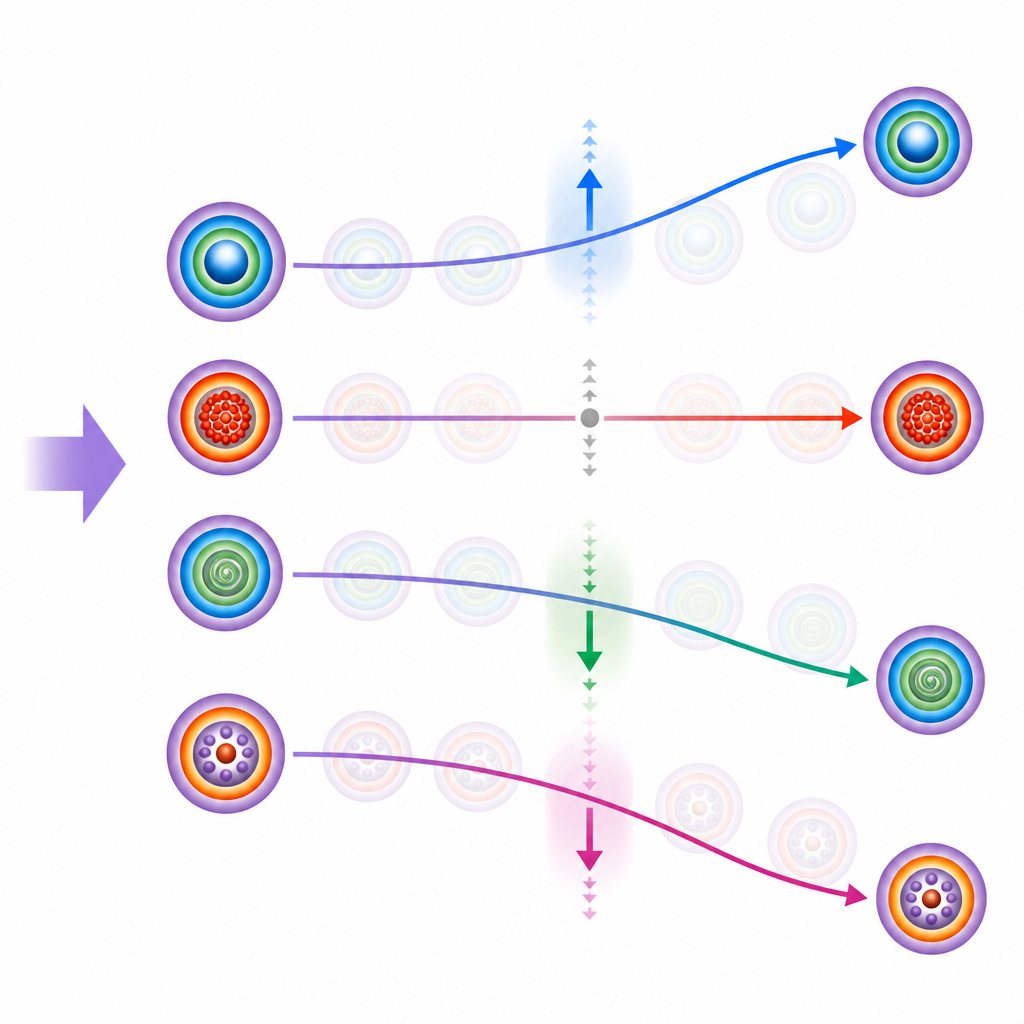
One major obstacle to using skyrmions in devices is the skyrmion Hall effect: when driven by a current, they tend to drift sideways instead of moving straight ahead, which risks hitting device edges and being lost. The authors design a special class of "balanced" nested skyrmion bags whose total topological charge is zero. In these structures, positive and negative contributions cancel so that the side forces balance out. Detailed micromagnetic simulations, supported by analytical calculations, show that these zero-charge bags travel in a straight line along the current direction, greatly simplifying their use in racetrack-style memory where straight motion is essential.
Shaping and Confining the Swirls
As more and more small skyrmions are nested inside a bag, internal forces can stretch the structure sideways even if its overall sideways drift remains negligible. The team maps out when such complex bags are stable by tuning a single dimensionless parameter that summarizes the competition between different magnetic energies. They also explore adding extra concentric domain walls around a large nested bag to act as a confining cage. A few additional walls can successfully suppress sideways stretching, but too many layers squeeze the inner skyrmions so hard that some of them annihilate, transforming the structure into other multi-turn patterns with very different motion.
Letting Machines Learn How the Whirls Move
Predicting exactly how a nested skyrmion bag will travel for every possible combination of structure and material settings is computationally expensive if done with full simulations alone. To overcome this, the authors generate a large dataset of simulated trajectories and train twelve different machine learning models to forecast the motion angle from just five inputs: the outer and inner skyrmion counts, the magnetic damping, the interaction strength, and the current. Modern gradient-boosted decision trees and a neural network learn this complicated relationship very well, reaching high accuracy across a wide range of motion angles, while simple linear regression fails, revealing that the behavior is strongly nonlinear.
Steering Signals in Nanoscale Circuits
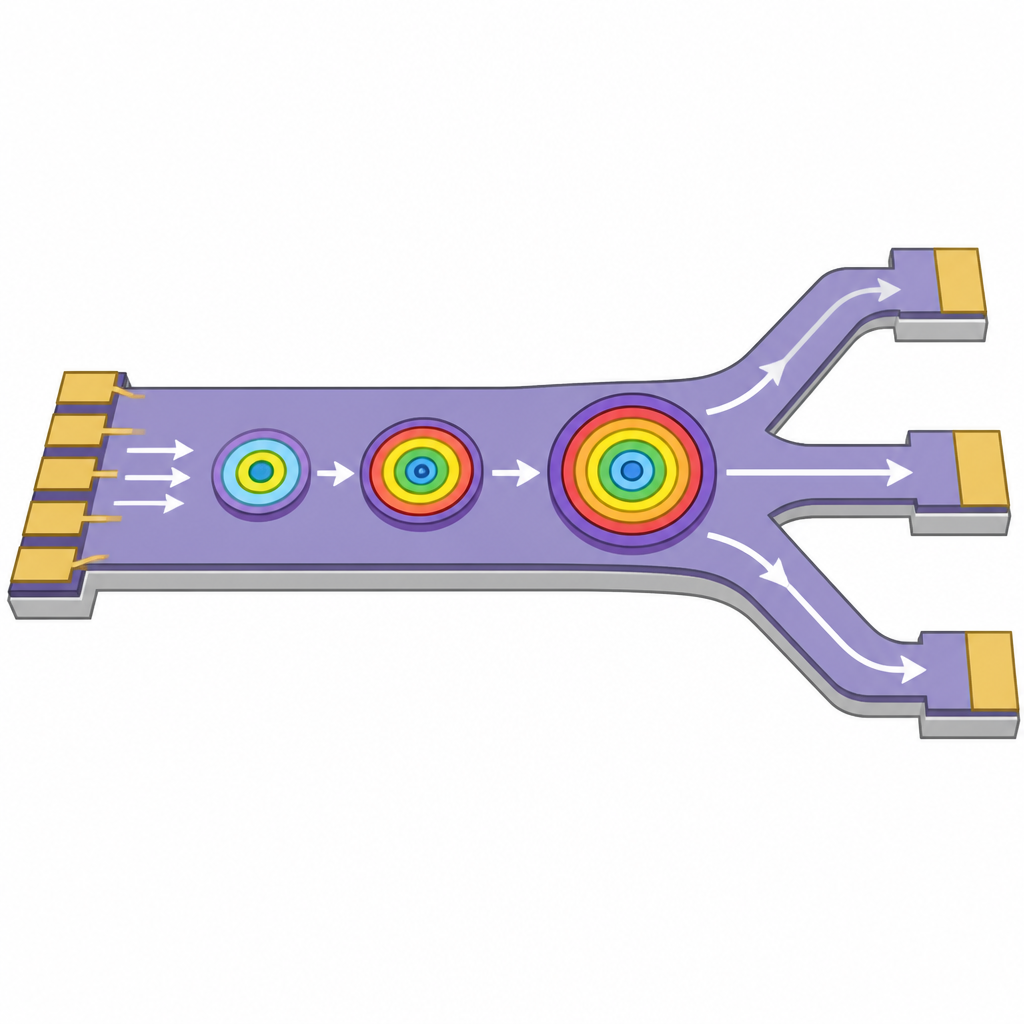
Armed with fast machine learning predictions, the researchers design a demultiplexer device, which takes one incoming skyrmion bag and sends it to one of several output channels depending on its structure. By choosing different combinations of inner and outer swirls, the motion angle can be tuned over more than sixty degrees, so bags with different internal layouts naturally peel off toward different exits under the same current. In this picture, the presence or absence of a bag at a given output represents digital ones and zeros. This work shows that by engineering the topology and confinement of skyrmion bags and combining physics-based models with machine learning, it is possible to build spintronic components such as racetrack memories and signal routers that exploit, rather than fight, the sideways motion of magnetic whirls.
Citation: Li, R., Zhu, Y., Zhang, X. et al. Machine learning assisted prediction of dynamics in current-driven nested skyrmion bags. Commun Phys 9, 184 (2026). https://doi.org/10.1038/s42005-026-02660-1
Keywords: skyrmion bags, spintronics, magnetic memory, machine learning, Hall angle