Clear Sky Science · en
Roughening and dynamics of an electric flux string in a (2+1)D lattice gauge theory
Why tiny strings of force matter
In many theories of particle physics, the force that binds particles together is pictured as a thin string of energy stretched between them. This study looks at how such an electric string behaves in a simple two dimensional world and asks a subtle question: does the string stay tight and well defined, or does it begin to wobble and spread out as the particles are pulled apart? The answer sheds light on how the familiar idea of continuous space can emerge from a world made of discrete building blocks.
From rigid ropes to restless strings
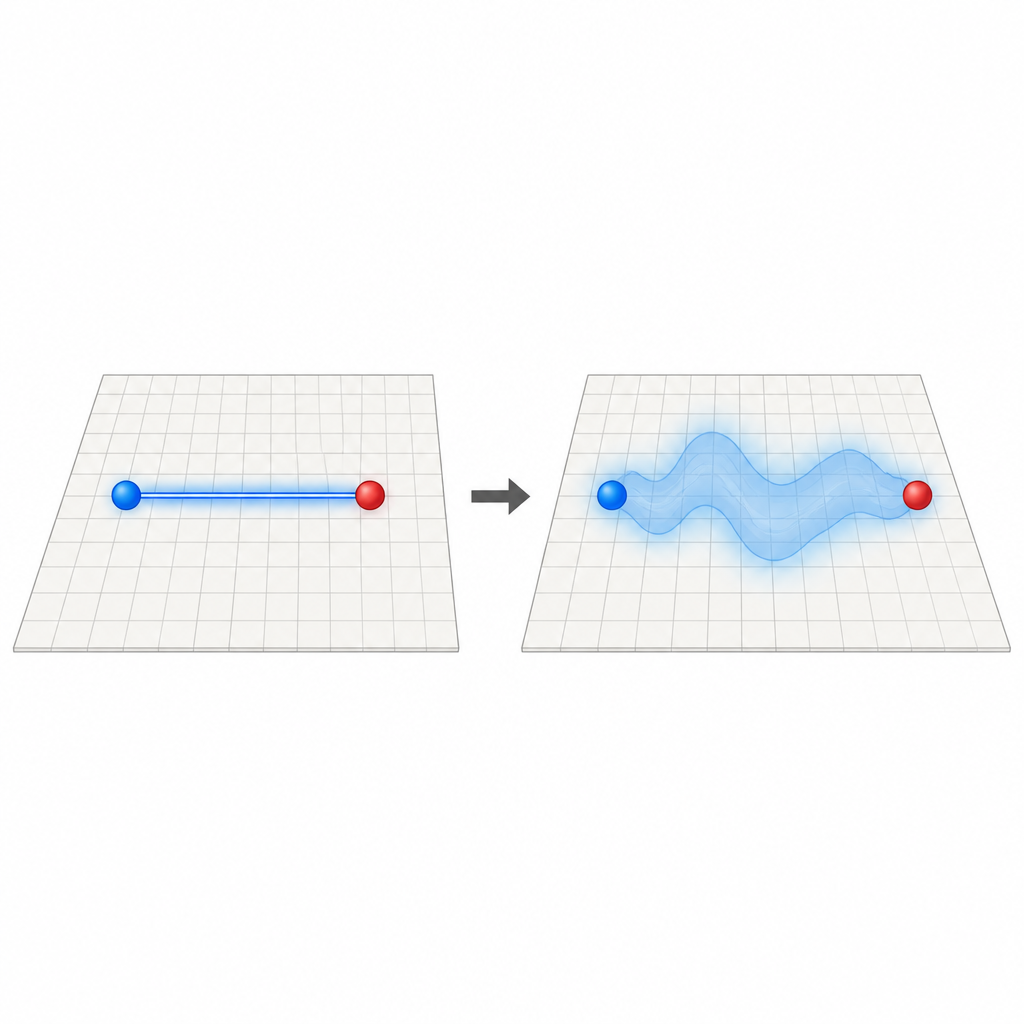
The authors focus on a model where space is a square grid and the basic force can take only two values, a stripped down version of more realistic gauge theories used in high energy physics. When two static charges are placed on this grid, they are connected by a tube of electric flux. At very strong coupling this tube behaves like a taut rope: its position is sharply defined and its thickness stays roughly constant even when the charges are moved farther apart. As the coupling is reduced, however, the string enters a “roughening” region where it becomes floppy, wanders sideways across the grid, and its average width slowly grows with the distance between the charges.
Measuring a wandering string
To follow this change in behavior, the team uses advanced numerical tools known as tensor networks, and in particular matrix product states, to simulate large grids with high precision. They work with a dual description of the model that maps the original gauge theory to a more familiar spin system, which makes the calculations more efficient. In this setting they measure three key quantities: how the electric field spreads out across the grid between the charges, how quantum entanglement grows along the string, and how much energy is needed to hold the charges apart. Together these observables allow them to pinpoint the onset of roughening without relying on a simple local marker of the transition.
Signatures of a rough phase
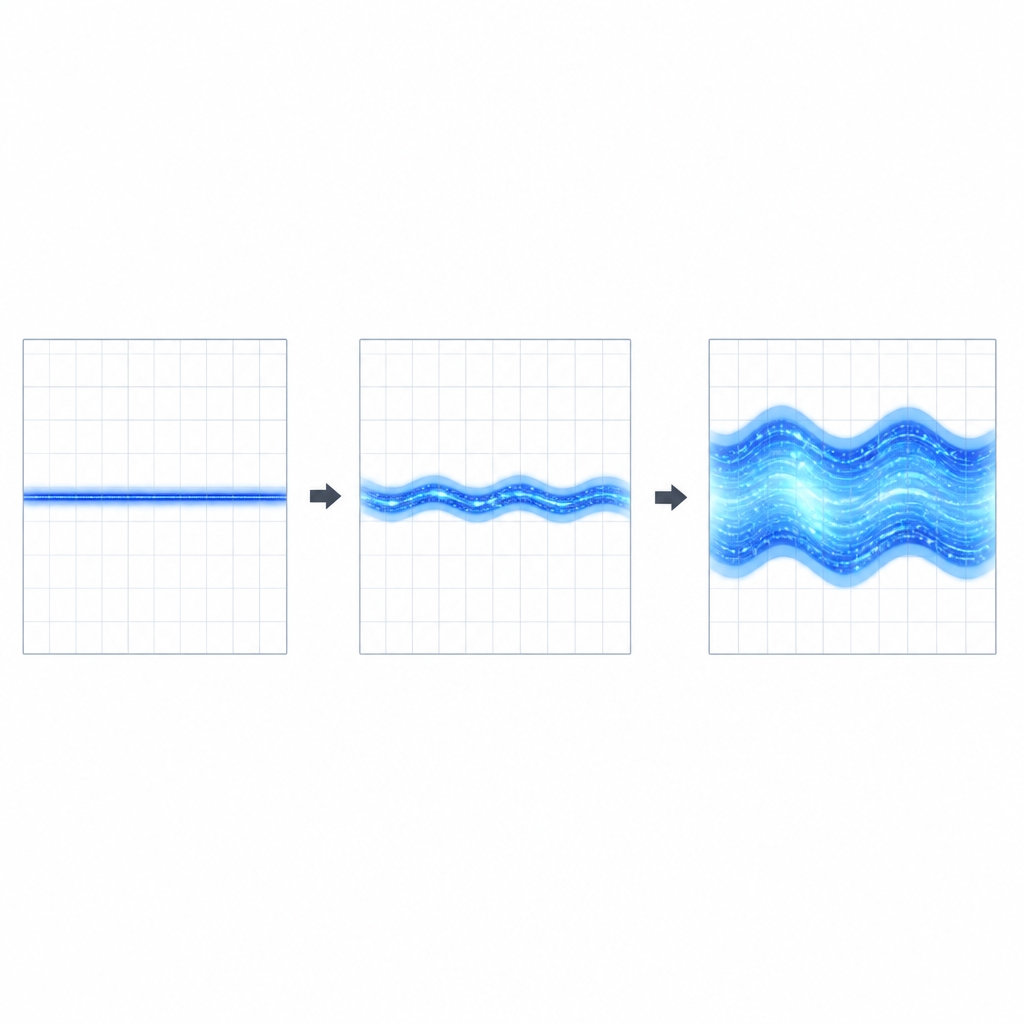
Within the roughening region the simulations show that the string width increases roughly like the logarithm of the distance between the charges, a hallmark of a delocalized object that keeps spreading as it grows longer. The quantum entanglement between the two sides of the system also acquires a logarithmic dependence on the string length, matching what is expected for a one dimensional critical system described by a massless boson. In addition, the energy that binds the charges is not purely linear in their separation: it contains a universal correction that falls off as one over the distance, known from effective string theory as the Lüscher term. The value of this correction lets the authors extract an effective “speed of sound” for vibrations along the string.
Recovering smooth space from a grid
A further hallmark of the roughening region is the recovery of rotational symmetry. On a square grid, strings stretched along the axes and strings tilted off the axes usually have different energies, because one must follow the steps of the grid. The simulations show that near the roughening point this difference fades away: both straight and tilted strings effectively depend only on the true geometric distance between charges. This signals that, even though the underlying world is a lattice, the physics along the string begins to resemble that of a smooth, continuous space.
Watching strings evolve in time
Beyond static properties, the authors explore what happens when a string is suddenly created in the vacuum of the theory and then allowed to evolve. In the roughening region the entanglement entropy along the string grows linearly in time at a rate that is almost independent of the coupling and the string length, consistent with waves of excitations spreading along a critical one dimensional medium. The physical width of the string, however, behaves quite differently: its rate of growth remains sensitive to the coupling and saturates in a way that does not simply mirror the entanglement dynamics. In the strongly confined region, by contrast, the string remains narrow and stiff and both its width and entanglement grow much more slowly.
What this means for our picture of confinement
Overall, the study paints a detailed picture of how a confining electric string in a simple lattice model can pass from a rigid, rope like object to a fluctuating, rough string while still keeping the charges bound. In this roughening region the string behaves as if it were a continuous vibrating filament, with widening thickness, long range quantum entanglement, universal energy corrections, and restored rotational symmetry. These insights help bridge the gap between discrete lattice descriptions and smooth field theories, and they offer concrete targets for future quantum simulations that aim to recreate such strings in the laboratory.
Citation: Di Marcantonio, F., Pradhan, S., Vallecorsa, S. et al. Roughening and dynamics of an electric flux string in a (2+1)D lattice gauge theory. Commun Phys 9, 171 (2026). https://doi.org/10.1038/s42005-026-02659-8
Keywords: lattice gauge theory, electric flux string, roughening transition, tensor networks, quantum entanglement