Clear Sky Science · en
A flexible Bayesian framework for atomic masses by locally inferring configuration mixing
Why the Weight of Atoms Matters
Every star, planet, and person is built from atomic nuclei, dense bundles of protons and neutrons whose masses subtly shape how the universe evolves. Knowing these nuclear masses precisely is crucial for understanding how heavy elements like gold or uranium are forged in stellar explosions, yet many of the relevant nuclei are too short-lived to measure directly. This paper introduces a new way to predict these unknown masses while honestly tracking how uncertain those predictions are, using a blend of physics insight and modern Bayesian statistics.
Blending Simple Pictures of the Atomic Nucleus
Physicists often describe nuclei using the shell model, in which protons and neutrons occupy energy “shells” a bit like electrons in atoms. Different ways of filling or slightly re‑arranging particles in these shells correspond to different shapes of the nucleus, from nearly spherical to strongly deformed “football” or “pancake” shapes. Traditional global mass formulas typically pick a single preferred configuration for each nucleus, which can miss important structure and underestimate uncertainties, especially for exotic nuclei far from stability. The authors instead treat the true nucleus as a mixture of several plausible configurations and let the data decide how much each one contributes.
From Configurations to a Probabilistic Mass Map
In their framework, called SPICE (Shell‑model Probabilistic Inference of Configuration Ensembles), the authors start from a compact shell‑model‑inspired mass formula with only about a dozen adjustable parameters. For each nucleus, they compute the mass that would result from several distinct configurations, such as promoting a few protons or neutrons into a higher‑lying shell associated with either harmonic‑oscillator or spin‑orbit structures. Rather than allowing these configurations to interact directly through a complicated quantum calculation, they assign each one a weight and interpret the observed nuclear mass as a probabilistic blend of these options. Those weights are allowed to vary smoothly across the chart of nuclides, depending on the numbers of protons and neutrons. 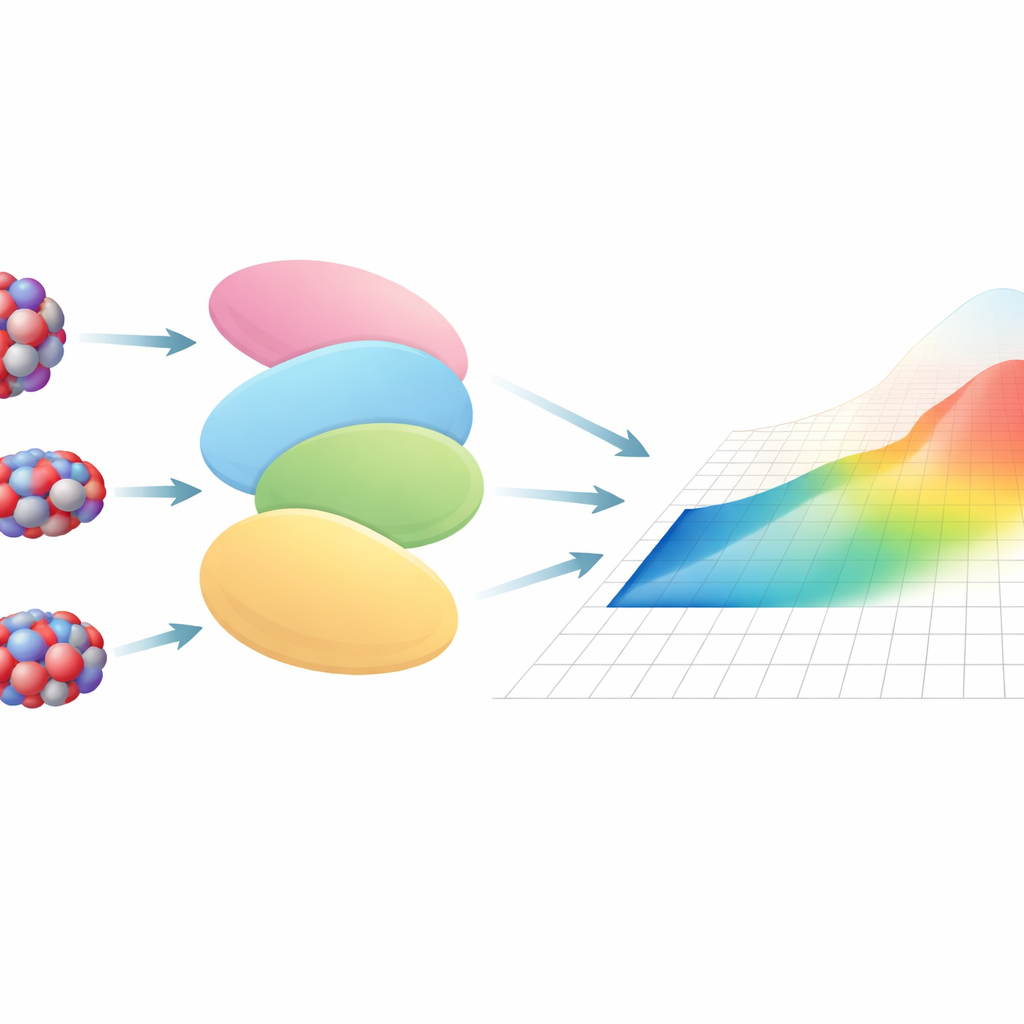
Using Bayesian Learning to Capture Uncertainty
To learn which configurations matter where, the authors use a Bayesian mixture model driven by experimental mass data from the latest Atomic Mass Evaluation. A statistical tool called a Gaussian process lets the configuration weights change gradually as one moves from one nucleus to neighboring ones, while also allowing the model to become more uncertain in regions with little or no data. This approach both improves the accuracy of predicted masses and naturally produces credibility intervals that describe how confident the model is. Across thousands of nuclei, SPICE reaches typical deviations of about half a million electron‑volts—competitive with leading global mass formulas—while explicitly quantifying the uncertainty in each prediction and avoiding a proliferation of arbitrary parameters. 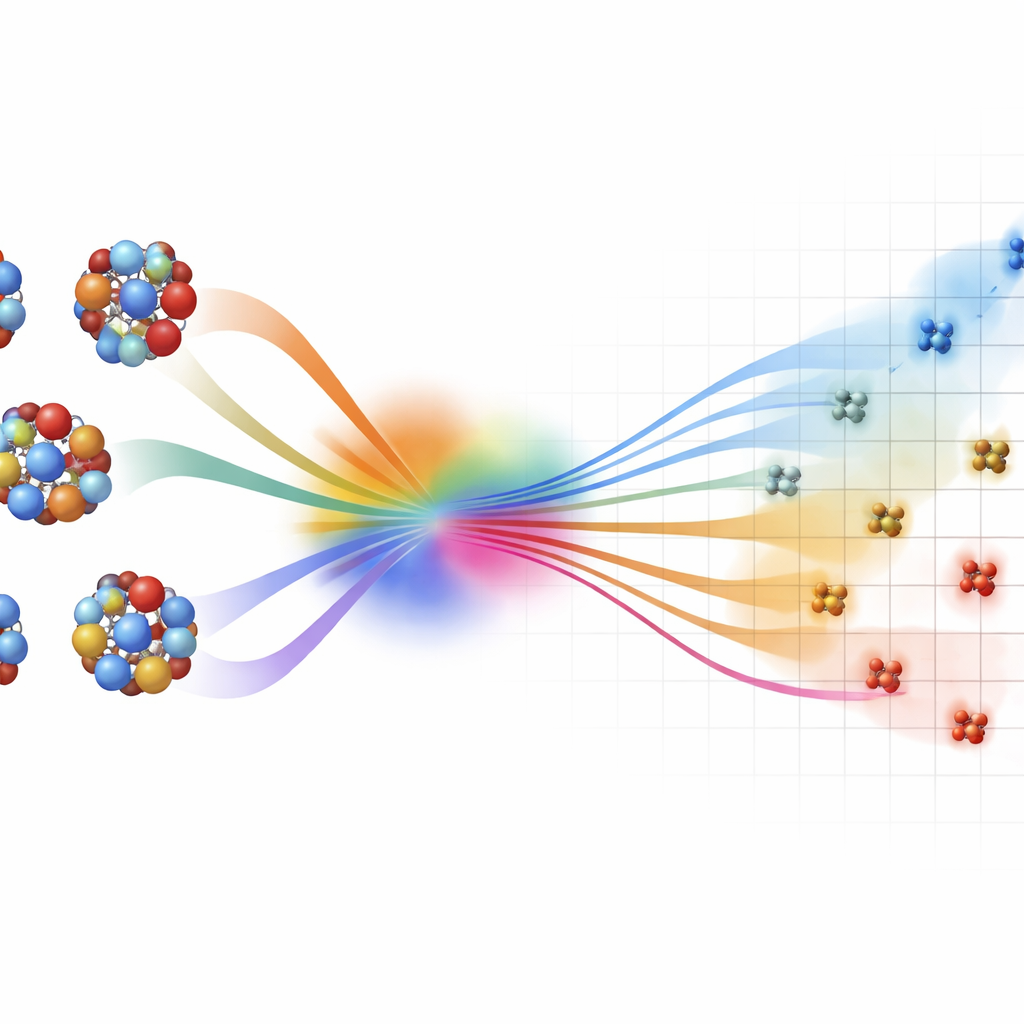
Peering into Extreme Nuclei and Their Shapes
Because SPICE outputs configuration weights, it does more than provide numbers: it offers clues about how nuclear structure evolves. The authors find that certain promoted configurations become more important in regions where nuclei are strongly deformed, while spherical configurations dominate near traditional magic numbers. As the model is pushed toward the “drip lines,” where adding one more neutron or proton makes a nucleus unbound, its predicted uncertainties grow in a controlled way rather than giving false confidence. By examining separation energies—the energy needed to remove a neutron—they show how this behaviour affects element chains that are key to rapid neutron‑capture (r‑process) nucleosynthesis in astrophysical sites. They also demonstrate that the inferred mixture of configurations can be carried over to other observables, like the gradual swelling of nuclear charge radii in deformed regions.
What This Means for the Cosmic Origin of Elements
To a non‑specialist, the main message is that this work delivers a compact, physically motivated, and statistically honest map of nuclear masses, including those that cannot yet be measured. By treating the nucleus as a local blend of a few simple structural patterns and learning those blends from data, the SPICE model achieves accuracy comparable to far more elaborate approaches while clearly stating how trustworthy each prediction is. This combination of interpretability and uncertainty quantification is essential for simulations of element formation in stars and stellar explosions, where small shifts in nuclear masses can lead to large changes in the predicted cosmic abundance of heavy elements.
Citation: Storbacka, M., Qi, C. A flexible Bayesian framework for atomic masses by locally inferring configuration mixing. Commun Phys 9, 143 (2026). https://doi.org/10.1038/s42005-026-02636-1
Keywords: nuclear masses, Bayesian modeling, shell model, r-process nucleosynthesis, uncertainty quantification