Clear Sky Science · en
Theory for magneto-optical detection of the interfacial orbital Rashba-Edelstein effect
Turning Electric Pulses into Hidden Magnetism
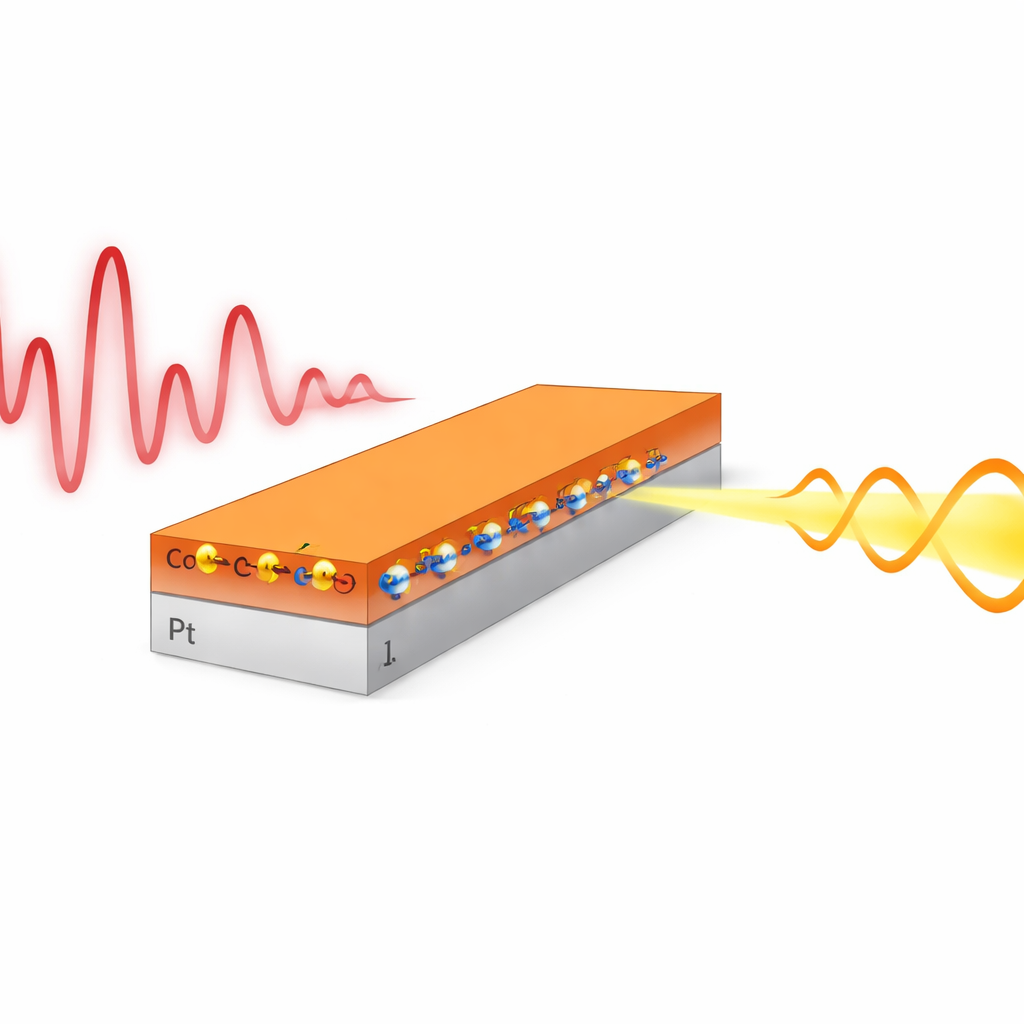
Modern electronics mostly shuffles electric charge, but inside solids there is a richer world of spinning and orbiting electrons that can, in principle, store and process information faster and more efficiently. This paper explores how brief terahertz-frequency electric pulses can stir up a subtle kind of magnetism at the boundary between two metals and, crucially, how that hidden motion can be “seen” using light. The work shows that a previously overlooked orbital effect, rather than the usual electron spin, may dominate in a promising class of ultrafast detectors.
From Spin Electronics to Orbital Electronics
For decades, spintronics has used the tiny magnetic moments associated with electron spin to build better memories and emit ultrafast terahertz radiation. Well-known effects, such as the spin Hall effect and the Rashba–Edelstein effect, convert ordinary charge currents into spin accumulations that can push and twist magnetic layers. Recently, theorists realized that electrons’ orbital motion around atoms can carry angular momentum just as spin does. This led to the prediction of “orbital Hall” and “orbital Edelstein” effects, in which electric currents create flows or accumulations of orbital angular momentum. These orbit-based signals could generate powerful torques in devices, but they have been hard to detect directly, especially in realistic stacks of different materials.
A Subtle Rotation of Light as a Probe
The authors focus on a particular optical effect that can act as a fingerprint of current-induced magnetism. When linearly polarized light passes through a magnetized material, its polarization plane can rotate. In the widely used Kerr and Faraday effects, this rotation is proportional to the magnetization itself, which makes it difficult to pick out a small, electrically induced change on top of a large, static magnetic background. Instead, this study uses the Voigt effect, a “quadratic” response where the rotation depends on the square of the magnetization. By carefully analyzing how the rotation changes when the underlying magnetization or the electric field is reversed, the team derives a formula that separates the ever-present equilibrium signal from the extra piece caused by the electric pulse. This extra piece behaves in a characteristic way, switching sign when either the magnet or the driving field is flipped.
A Closer Look at a Cobalt–Platinum Interface
To put this idea on solid footing, the researchers perform detailed quantum-mechanical calculations for a thin film made of a ferromagnetic cobalt layer in contact with a heavy-metal platinum layer. Even though platinum is not magnetic on its own, the nearby cobalt induces small magnetic moments in the first platinum layers. The team first computes how each atomic layer contributes to the ordinary Voigt effect at rest, finding that platinum contributes almost as much as cobalt despite its tiny static moment. This is traced back to platinum’s strong coupling between electrons’ motion and their magnetism, which enhances how light “feels” its magnetic state.
Orbital Motion Takes the Lead
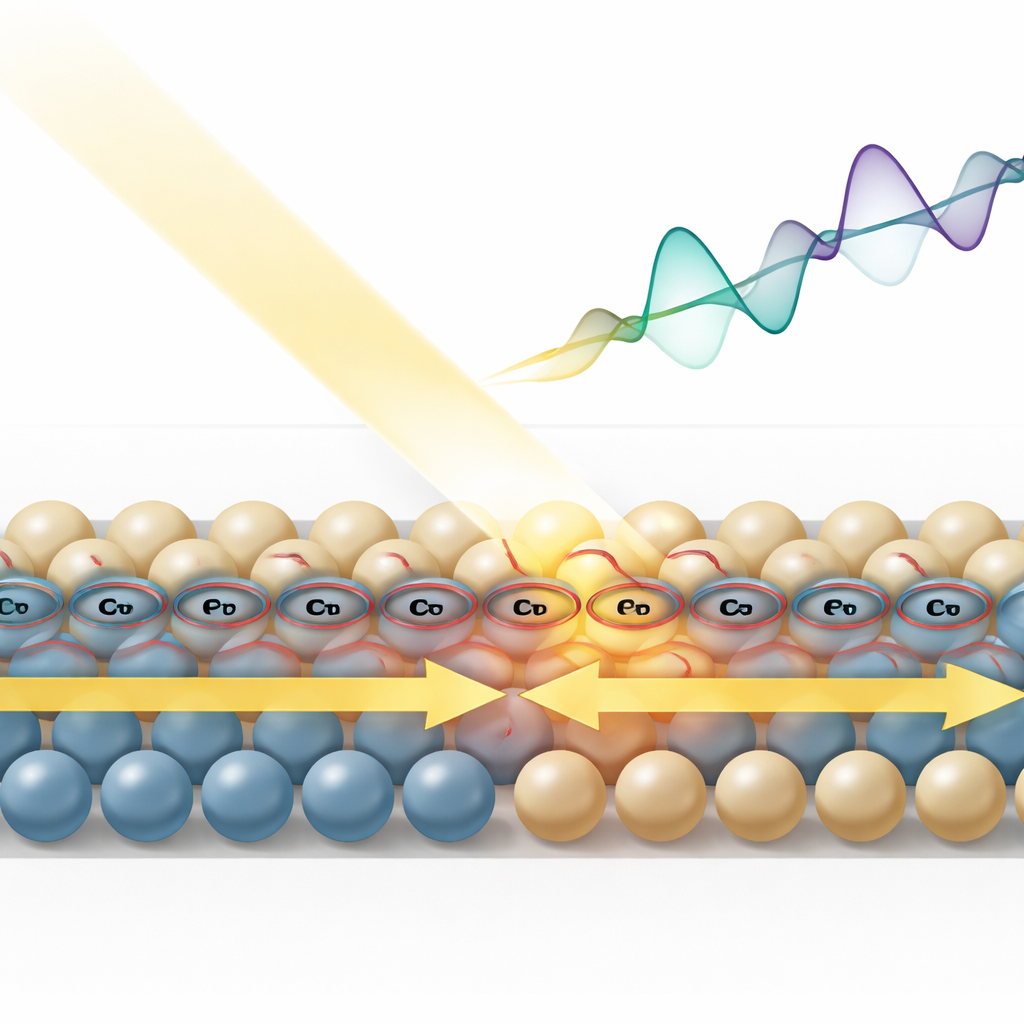
The key step is to apply a terahertz-frequency electric field along the plane of the layers, mimicking recent experiments. Using linear-response theory, the authors calculate how this field induces additional spin and orbital angular momentum at each layer through Rashba–Edelstein–type mechanisms. They show that, right at the cobalt–platinum boundary where inversion symmetry is broken, the electrically induced orbital polarization is roughly two to three times larger than the induced spin polarization. They then feed these induced moments into their optical model to predict how much extra Voigt rotation the terahertz pulse should generate and how that rotation behaves when the magnetization is reversed.
A New Window into Orbital Electronics
The calculations reveal that the measured rotation odd in magnetization – the part that flips sign when the magnet points the other way – is overwhelmingly dominated by the orbital contribution, and that the platinum side of the interface is the main player. In other words, the observed ultrafast optical signal in such terahertz detectors is best understood as arising from an orbital Rashba–Edelstein effect rather than a purely spin-based one. For non-specialists, the takeaway is that light can be used to read out fleeting orbital currents that appear at buried interfaces when strong electric pulses are applied. This establishes a practical route to probe and eventually harness orbital degrees of freedom in future “orbitronic” devices that could complement or even surpass today’s spintronic technologies.
Citation: Alikhah, S., Jo, D., Berritta, M. et al. Theory for magneto-optical detection of the interfacial orbital Rashba-Edelstein effect. Commun Phys 9, 131 (2026). https://doi.org/10.1038/s42005-026-02617-4
Keywords: spintronics, orbitronics, magneto-optical effects, terahertz detection, cobalt platinum bilayers